

What it does
A line array’s splays decide where its energy lands. Too little curvature and the back rows are loud while the front rows fall into a hole; too much and the far seats go quiet and the high frequencies part company with the lows. ArrayCalc shows you the result on its Sources page, one trace per band, and leaves the search to you — its Auto splay gives a starting point, not an answer.
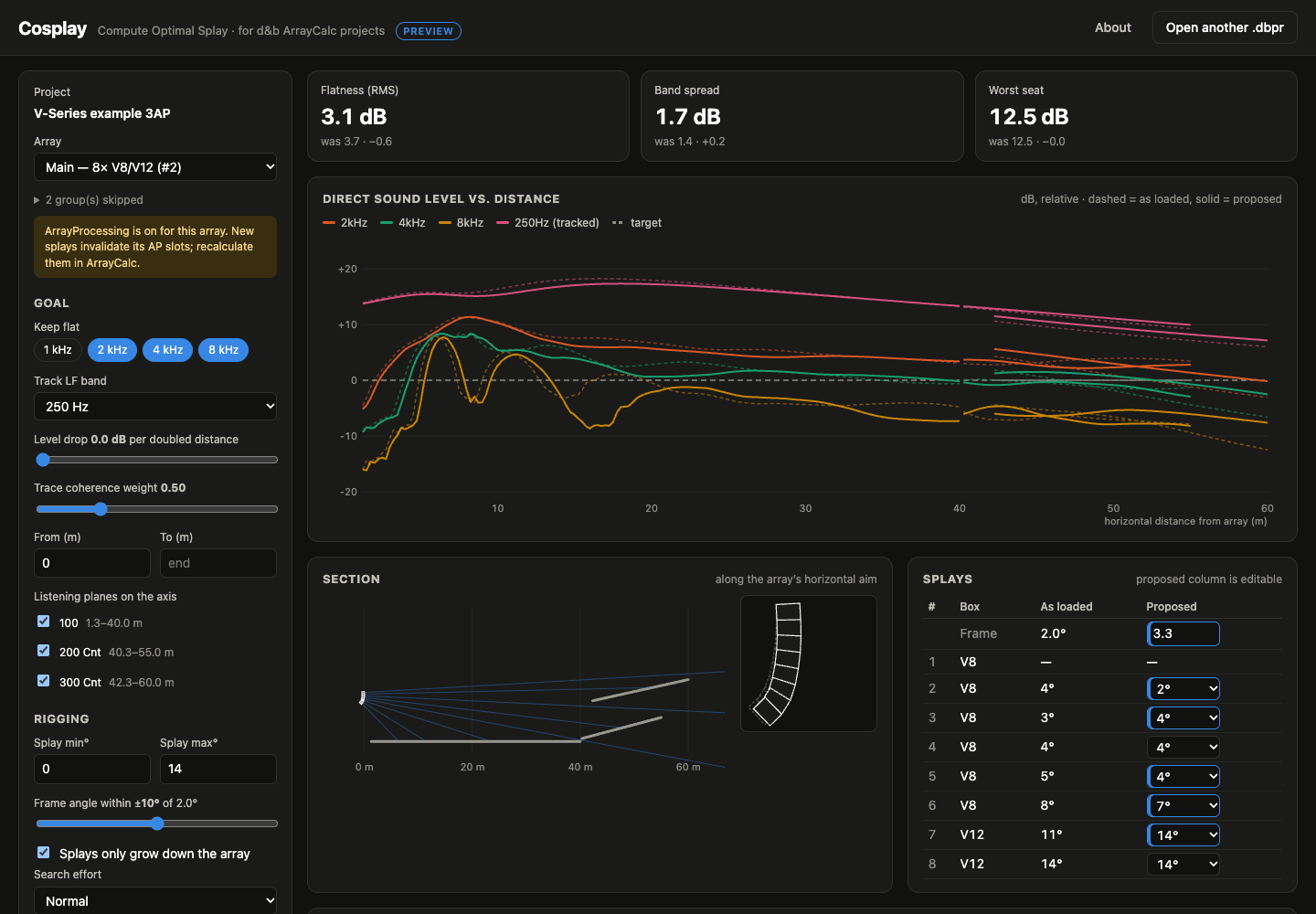
Cosplay does the search. It reads the project, finds where the listening planes cross each flown array’s aim, and tries thousands of splay sets and frame angles against a goal: the chosen high-frequency bands as flat as possible front to back (or falling at the rate you set), the bands running parallel to each other, and one low band tracking with them. Splays stay inside the family’s mechanical range and, if you like, only grow down the array.
The answer is written back into a copy of the project — frame angle, splays, each cabinet’s angle and hinge position and the height of the lowest edge, together, and to the mirrored hang too if you ask. Nothing else in the file changes. Open it in ArrayCalc and check the Sources page and the rigging loads there.
- Reads a d&b ArrayCalc .dbpr in the browser; nothing is uploaded
- Flown line arrays from any family ArrayCalc lays out on a flying frame
- Direct level vs. distance per octave band, as loaded and proposed, on the array’s own axis
- Goal: flat (or a set level drop per doubled distance) HF bands, bands running together, a tracked LF band
- Searches discrete splays and the frame angle, within the family’s range, optionally only growing down the array
- Every proposed splay is editable, with the prediction updating as you change it
- Writes a copy of the project with the new angles, and to the mirrored hang if you ask
Where it stands
An early preview, checked against ArrayCalc 12.8.3 itself. Every flown array in ArrayCalc’s example projects re-lays from its own splays onto the stored hinge points to within 0.2 mm, and writing them back changes nothing. A file Cosplay wrote opened in ArrayCalc with the new frame angle and splays and rigging reporting Load OK, and ArrayCalc’s own unprocessed traces for those splays agreed with Cosplay’s prediction to about a decibel from 5 to 40 m. Right under the array it reads 2–4 dB low. Compression-rigged families (GSL, KSL, XSL, CCL) get the nominal splay; ArrayCalc deflects each by up to 0.3° under load. Stacked arrays are not supported yet, and new splays invalidate any ArrayProcessing slots.