Measure the room, shape what goes into it, fire the cues, and talk to whatever is doing the amplifying.
Audio at an event is several unrelated jobs sharing one word. Something has to tell you what the room is actually doing, in numbers that survive being questioned. Something has to shape what goes into it. Something has to fire the cues on time and put them out of the right output. And something has to talk to the amplifiers, the network they sit on and the radio mics above them — usually over a protocol somebody else designed and never published.
These are the tools written for those jobs, in most cases because the existing answer was a demo licence, a spreadsheet, or a laptop that had to stay in the rack for one feature. Every one of them has a public repo you can read and build.
20 projects · 14 with builds to download
Measurement
The numbers you quote to a licensing officer or a production manager, and the ones you use to decide whether the system is working.
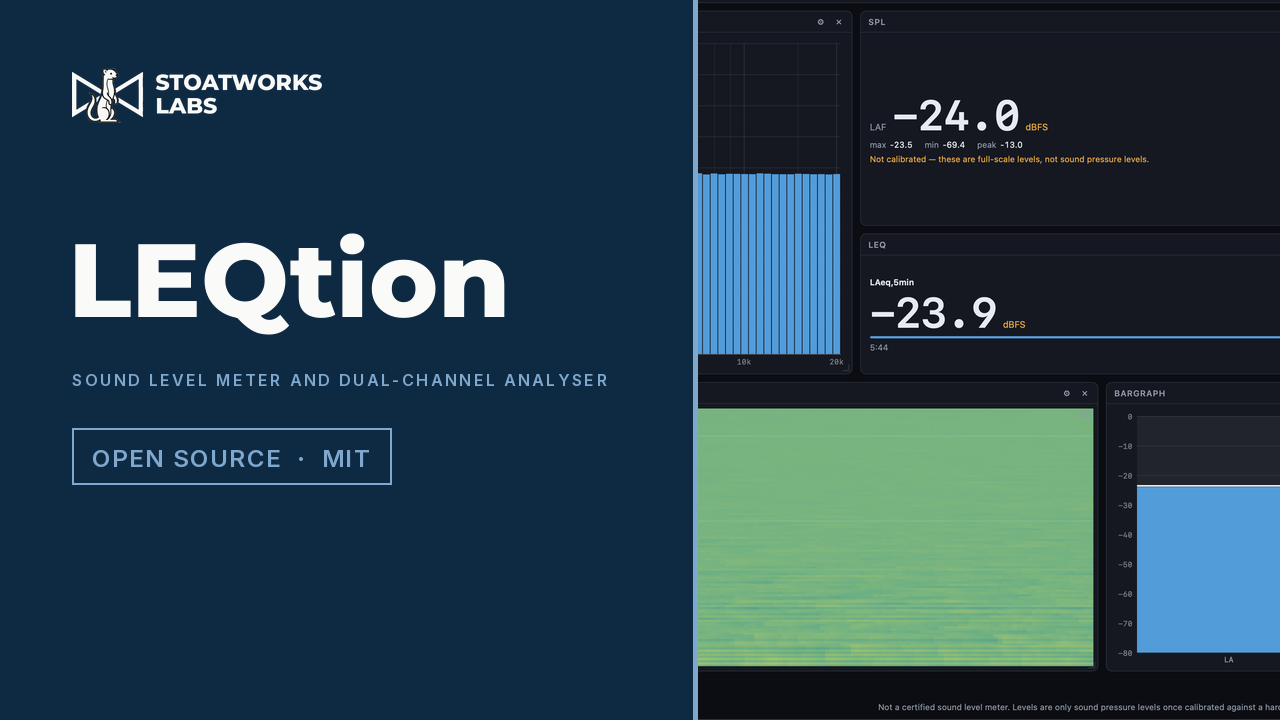
A desktop sound level meter and dual-channel analyser: fractional-octave RTA, spectrograph, time-weighted SPL and as many LEQs as you care to define, plus level history charts, CSV logging, a signal generator and transfer function measurement with phase, coherence and delay finding — on a grid of tiles you lay out yourself.
SPL
LEQ
RTA
Transfer function
Signal generator
IEC 61672
Processing
Plugins that sit in the signal path rather than beside it, so they have to be correct in somebody else's process.
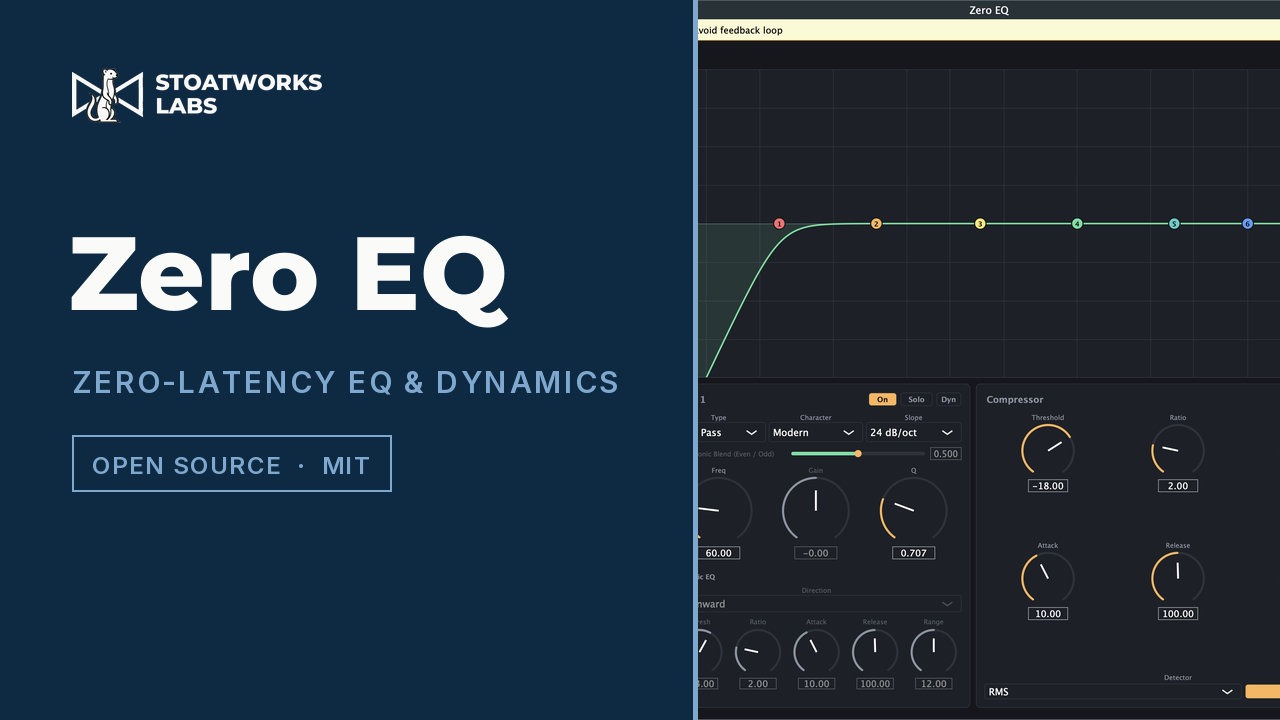
Zero-added-latency parametric EQ, dynamic EQ with external sidechain, band-isolated harmonic generation and a compressor, with ballistics-accurate metering and a full preset system.
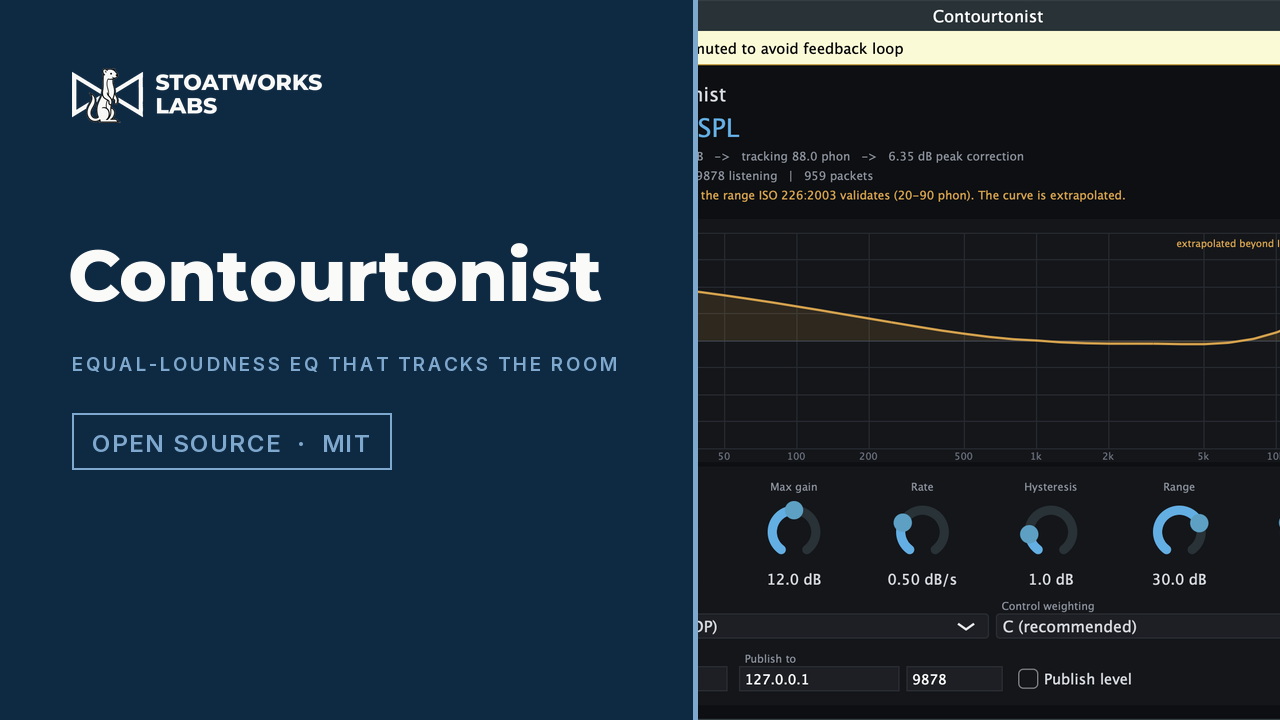
Measures how loud the room actually is — from a calibrated measurement microphone or an SPL meter's live output — and applies the ISO 226:2003 equal-loudness correction needed to hold the tonal balance the system was tuned for as the show level moves.
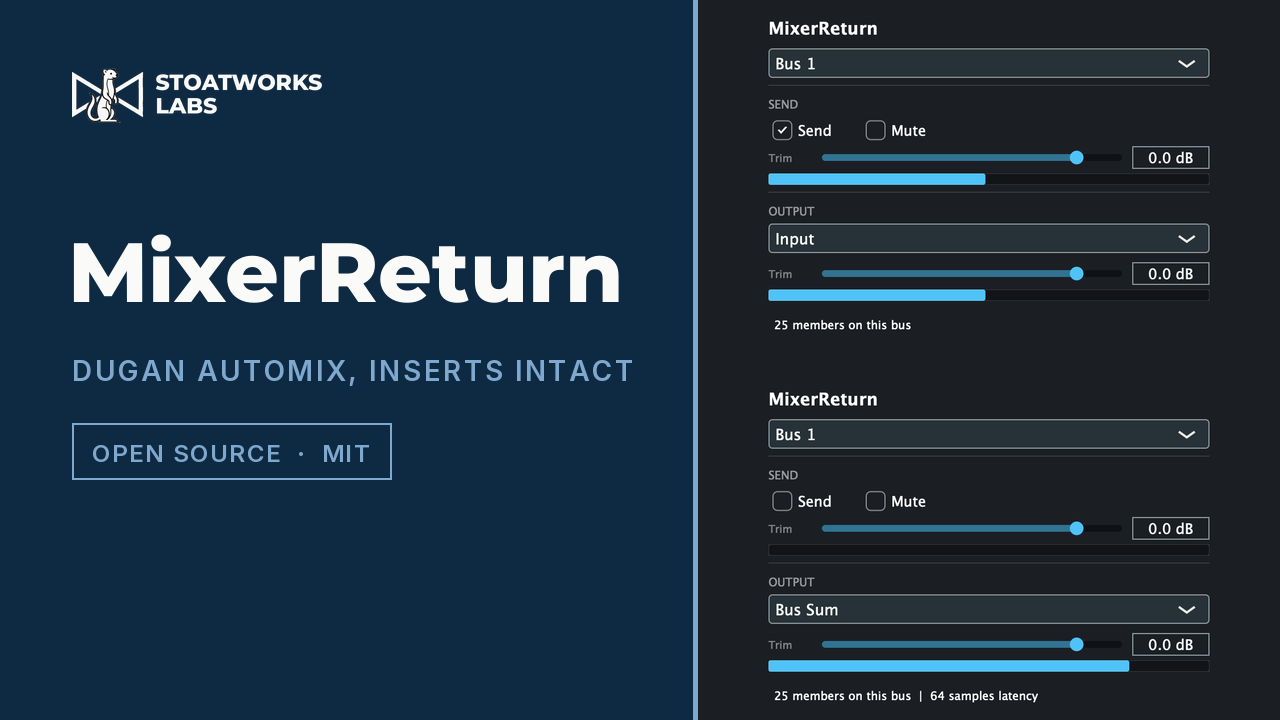
An interface for Waves SuperRack Performer: run the Dugan Automixer across a console's channel direct outs and return the automixed result summed to a single stereo pair, into a group's external input — leaving every insert slot free.
VST3
AU
SuperRack
Automix
Allen & Heath
Playback and show control
Getting the right thing out of the right output at the right moment, from a surface that isn't a laptop keyboard.
Audio · Show Control / Application/ C++ / JUCE/ v0.4.1
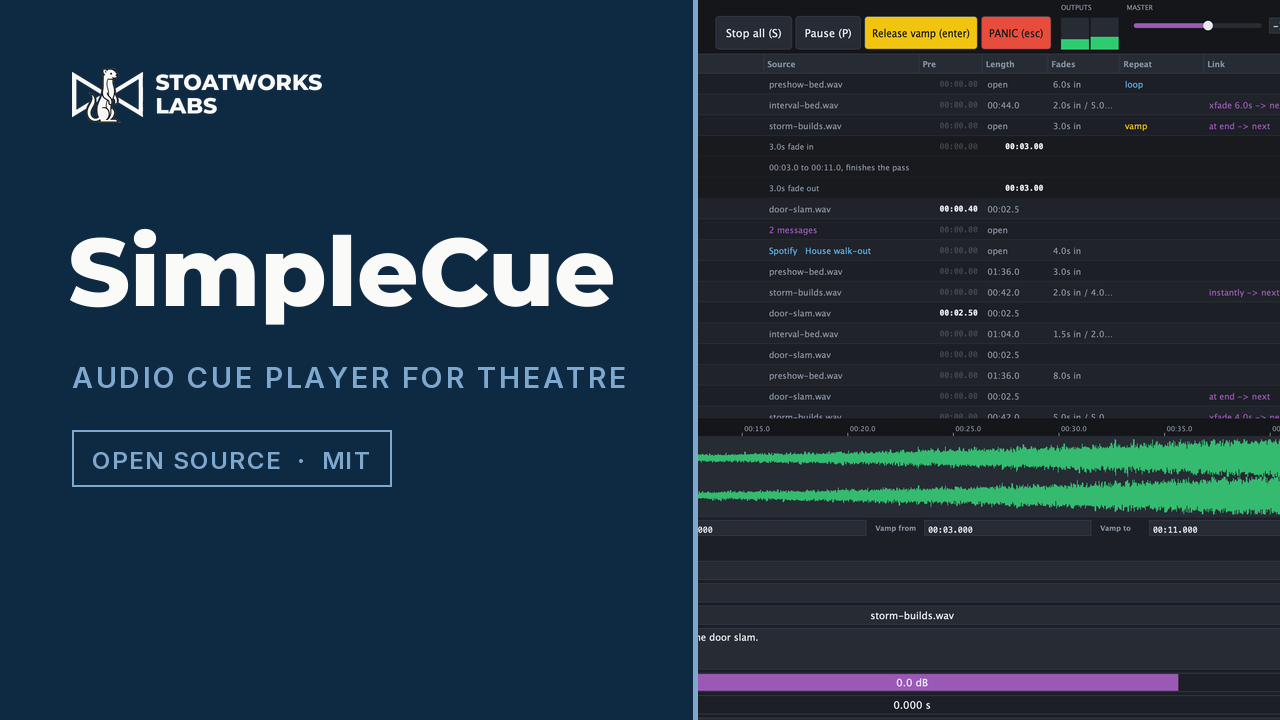
A platform-independent audio cue player for theatre and live events — cues, fades, links, loops and vamps, with a per-cue output routing matrix. Driven by OSC, MIDI, MSC, MMC, Art-Net or sACN.
Theatre
Cue playback
OSC
MIDI
MSC
sACN
Networks and amplifiers
Talking to the boxes, over whatever they happen to speak.
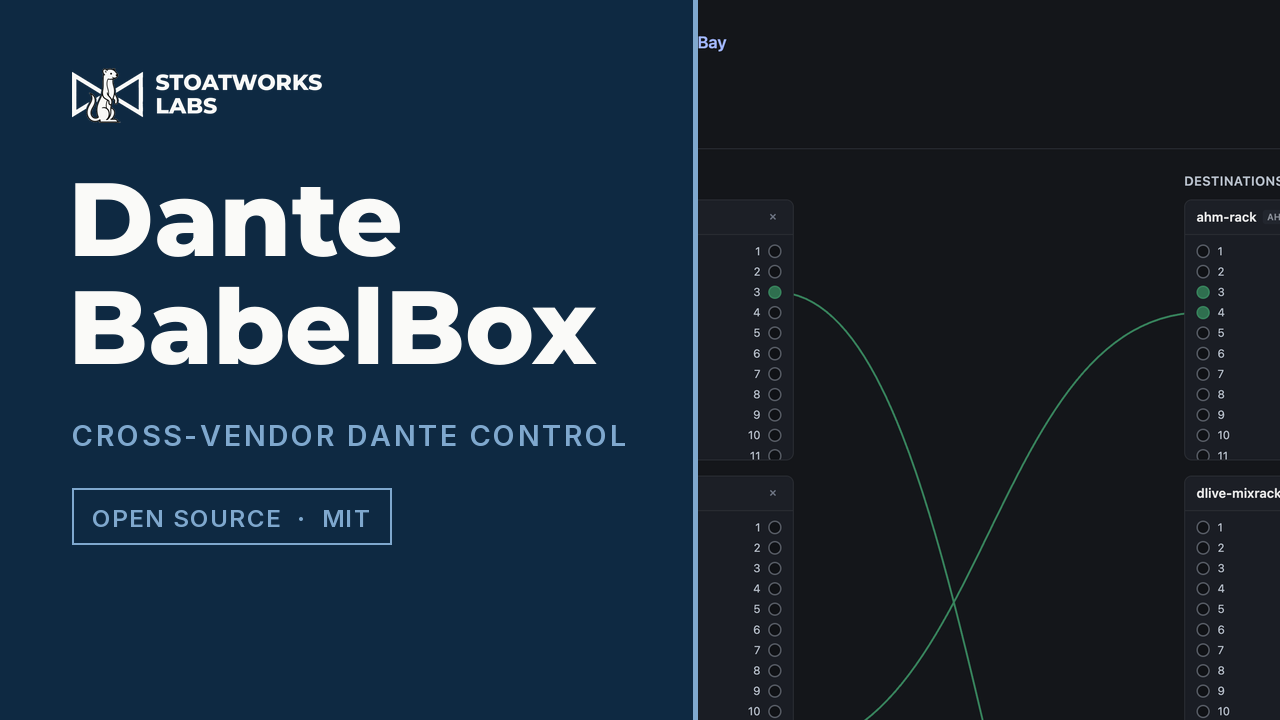
A cross-vendor Dante control bridge: preamp gain and phantom control across Behringer/Midas, Allen & Heath and Yamaha, plus radio-mic telemetry from Shure and Sennheiser.
Dante
Preamp control
Yamaha
Allen & Heath
Radio mics
Coordination and monitoring. Filed here as well as under RF, because on a show day it is the audio department's problem.
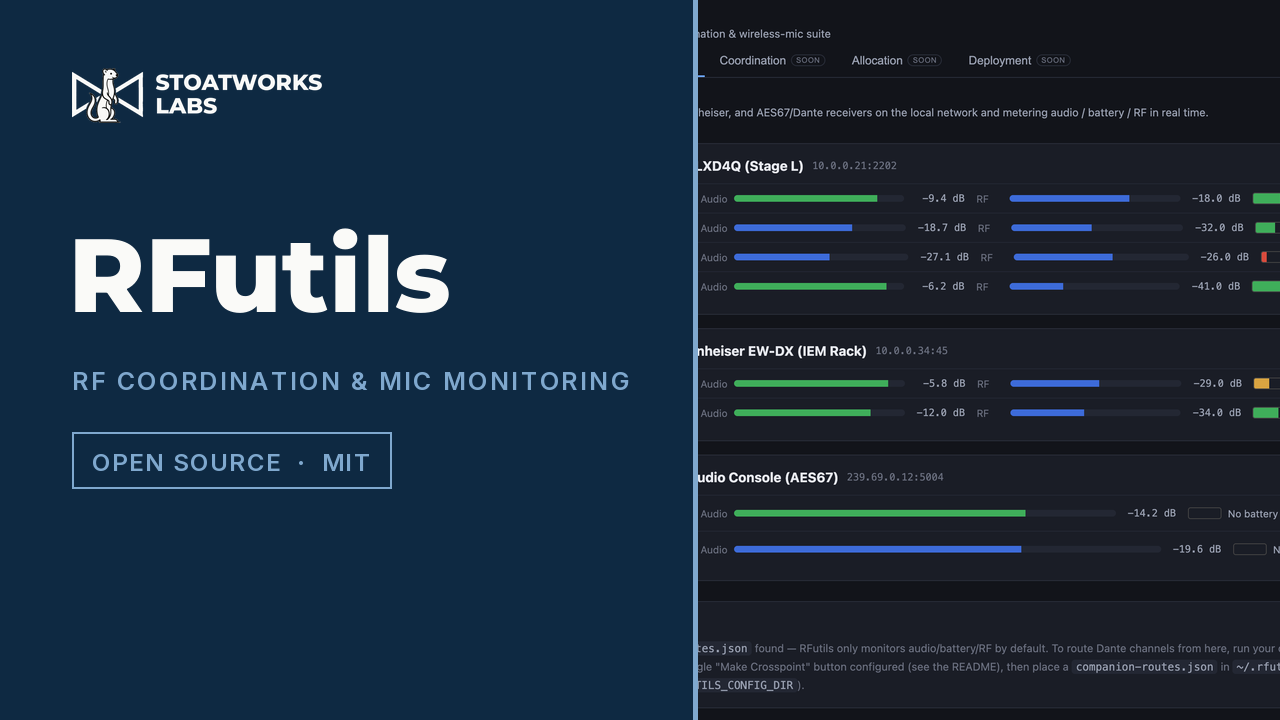
A browser-based RF suite for radio mics: WWB/WSM/PMSE file exchange, live Shure and Sennheiser monitoring with headphone cueing, IM-aware coordination, and device programming.
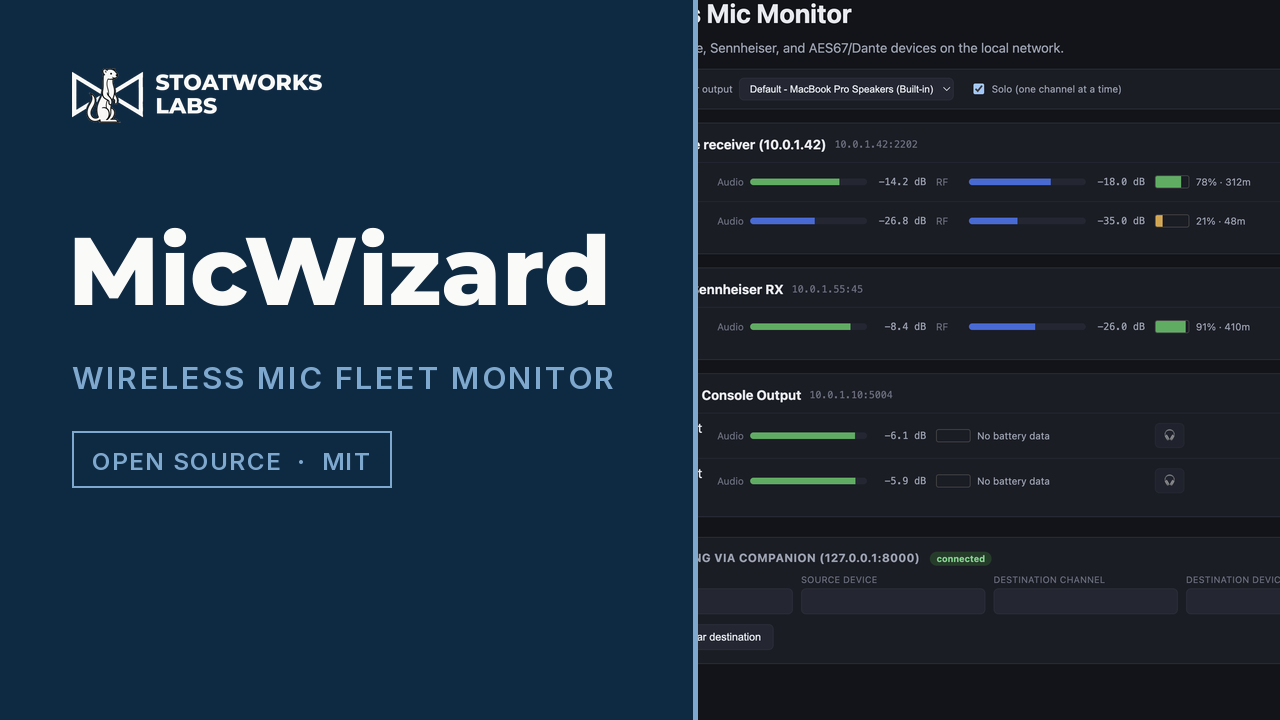
Discovers and monitors Shure and Sennheiser wireless receivers on the network: AES67 metering, battery and RF status, local headphone cue, and optional Companion-driven Dante routing.
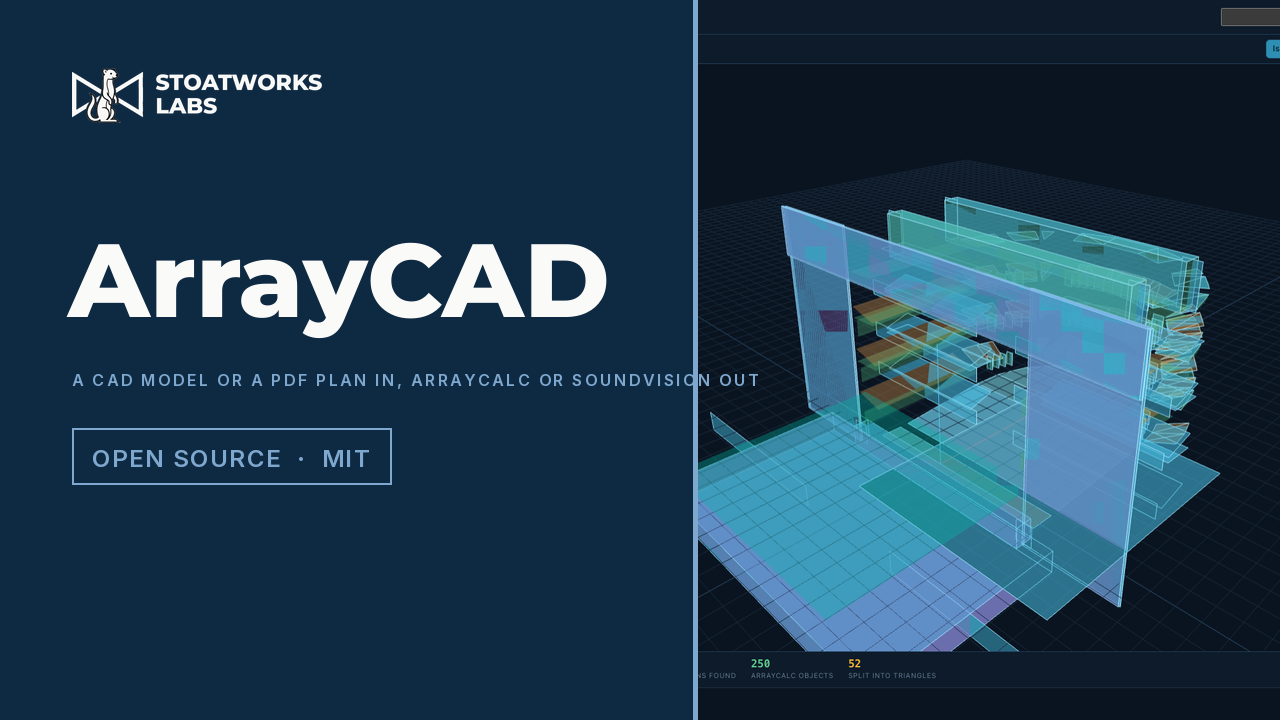
Turns a venue drawing into the file a loudspeaker prediction tool can open — d&b ArrayCalc, L-Acoustics Soundvision or AFMG EASE Focus 3 — and converts between the three. An ArrayCalc venue is a few dozen parametric planes; a CAD export of the same theatre is tens of thousands of triangles, so the work is the reduction — weld, merge coplanar regions, recover each outline, and write it back as the quads and triangles ArrayCalc actually accepts. It also reads the drawing on the way in: layers named as dimensions, rigging or services are left out, plane types come off the names, banks of separately modelled seats become the audience plane they stand for, and meshed surfaces are re-cut from their own outlines — a seat-by-seat theatre plan lands as 17 objects instead of 3,710, all of it visible and one click from being put back. Reads DWG directly, DXF, glTF, IFC and the usual mesh formats, and MVR from any lighting visualiser — and writes MVR back, so the finished venue returns to the visualiser it came from. No 3D model? Drop a PDF or an image of the plan instead: set the scale, click inside a room to detect its outline, and type a height at each corner — level, raked, raised or sunk. The .dbacv format is undocumented; this reproduces a real export byte for byte and has been round-tripped through ArrayCalc itself until every object came back untouched.
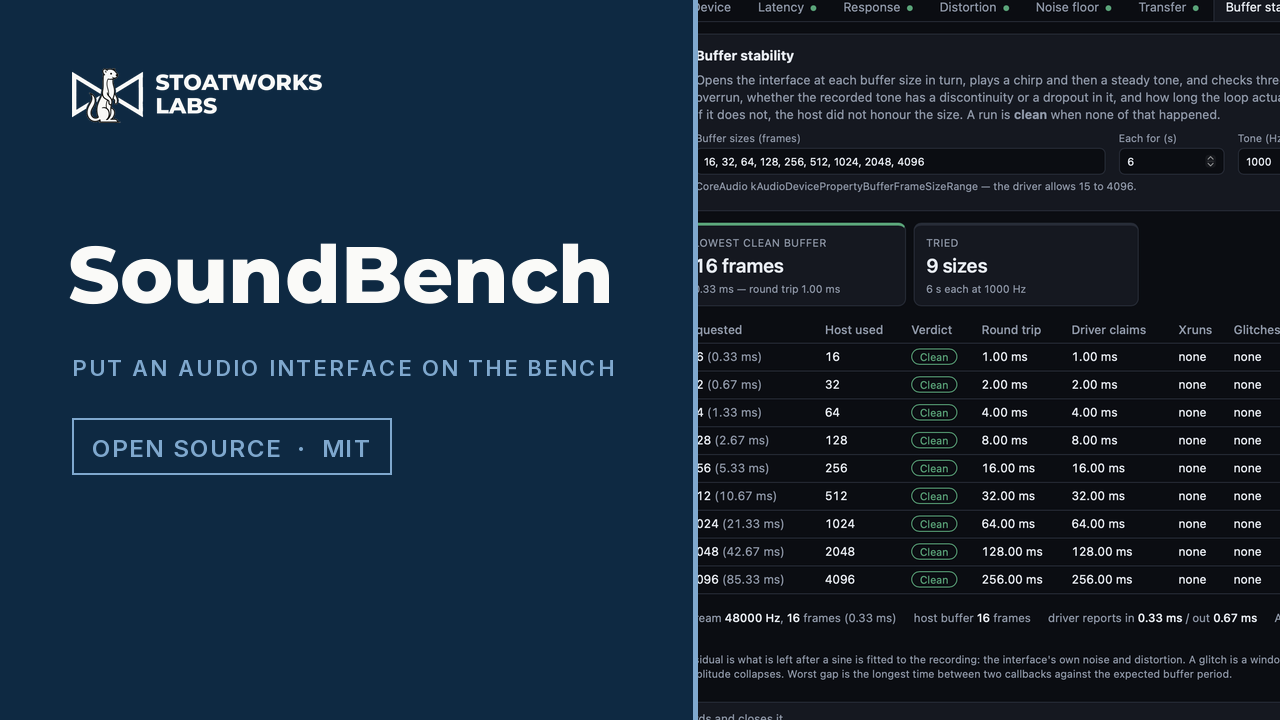
A desktop test bench for audio interfaces. Loop an output back to an input and it reports what the driver claims against what the hardware does: the full driver property list, round-trip latency by chirp cross-correlation beside the driver's own figure, frequency and phase response with THD against frequency from one log sweep, THD+N and SNR from an AES17-style tone, the noise floor with its spurious peaks listed, a noise transfer function with coherence, and a buffer stability sweep that opens the device at every size and checks for xruns, glitches in the recorded tone, and whether the latency actually grew. Built on a vendored PortAudio so it reaches CoreAudio, WASAPI, WDM-KS and ASIO directly, and sets the device's own buffer size and sample rate for each test.
Turns a mixing console show file into documentation an engineer can actually use — a patch list, a specification sheet and a wiring topology diagram, as PDFs. Runs in the browser or on the command line.
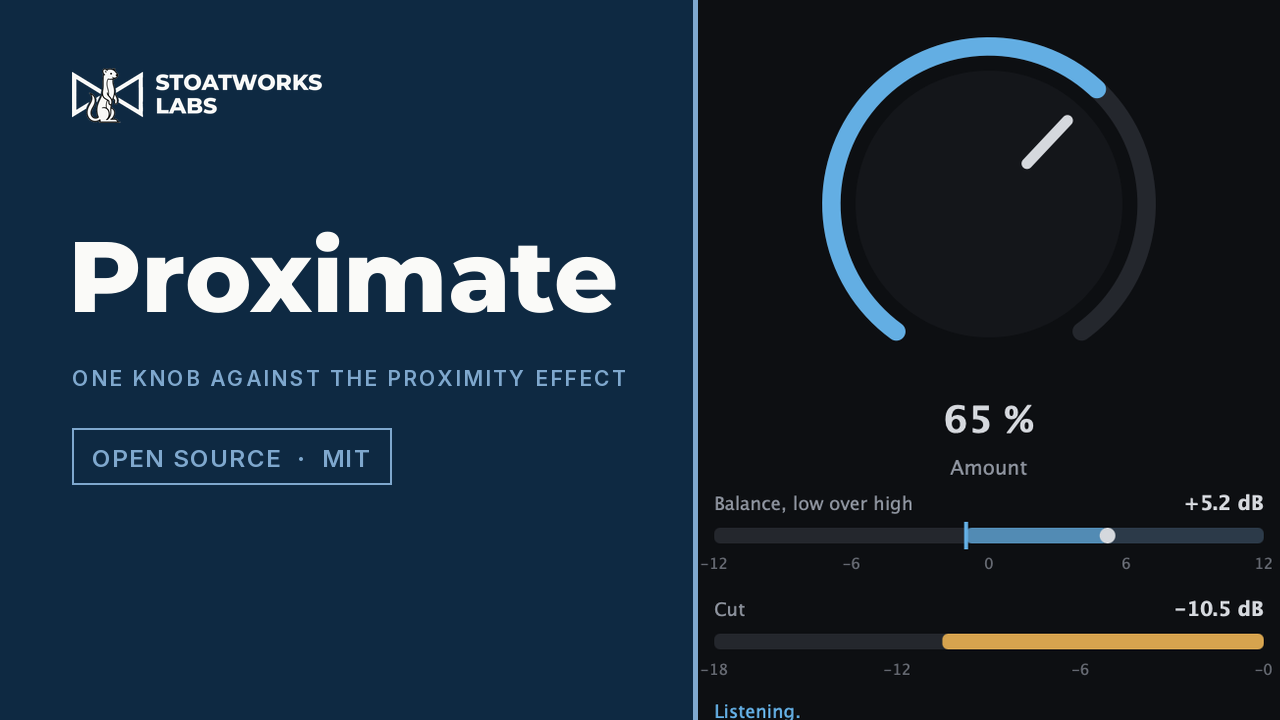
A one-knob proximity effect compensator for speech and vocal microphones, as VST3, AU and a standalone app. It measures the balance between the energy under 250 Hz and the energy over it, holds that balance at or under a ceiling the knob sets, and takes the excess off with a first-order low shelf shaped like the effect it is undoing — deepening and reaching further up as the talker leans in, coming back off as they step away. Cut only, zero latency, blind to level, and it holds still through pauses.
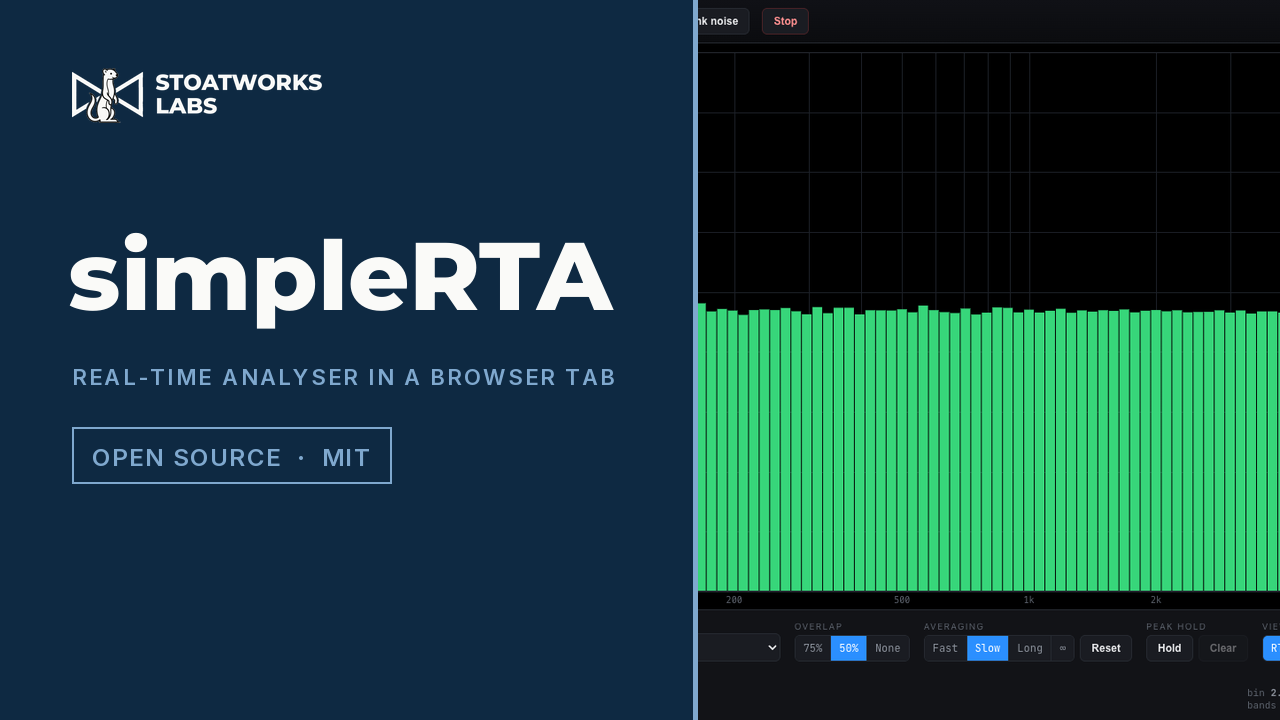
A real-time audio analyser that runs entirely in a browser tab: an RTA from 1/3 to 1/48 octave, a spectrograph sharing its frequency axis, and a full-height meter with peak, RMS, peak hold and broadband Z/A/C. The transform chain is pinned by tests at every size and window, and the built-in pink noise source is the check that it reads level before you trust it about a room.
The software half of a partyline intercom rig: a server that mixes, and endpoints with up to ten keys each. Every key is its own AES67 stream carrying either a partyline bus — minus that endpoint's own voice — or a direct point-to-point path.
Video FX · AV Systems · Audio · Networking & Infrastructure / Application/ Rust / TypeScript/ v0.3.0
An optional desktop client for the Stoatworks software — plugins, tools, applications and Companion modules. Shows what you have installed and what has an update, and installs each one in whichever formats you use: FFGL for Resolume, OpenFX for Resolve, After Effects, VST3 and Audio Units for a DAW. It keeps itself up to date too. No account, and nothing sent anywhere.
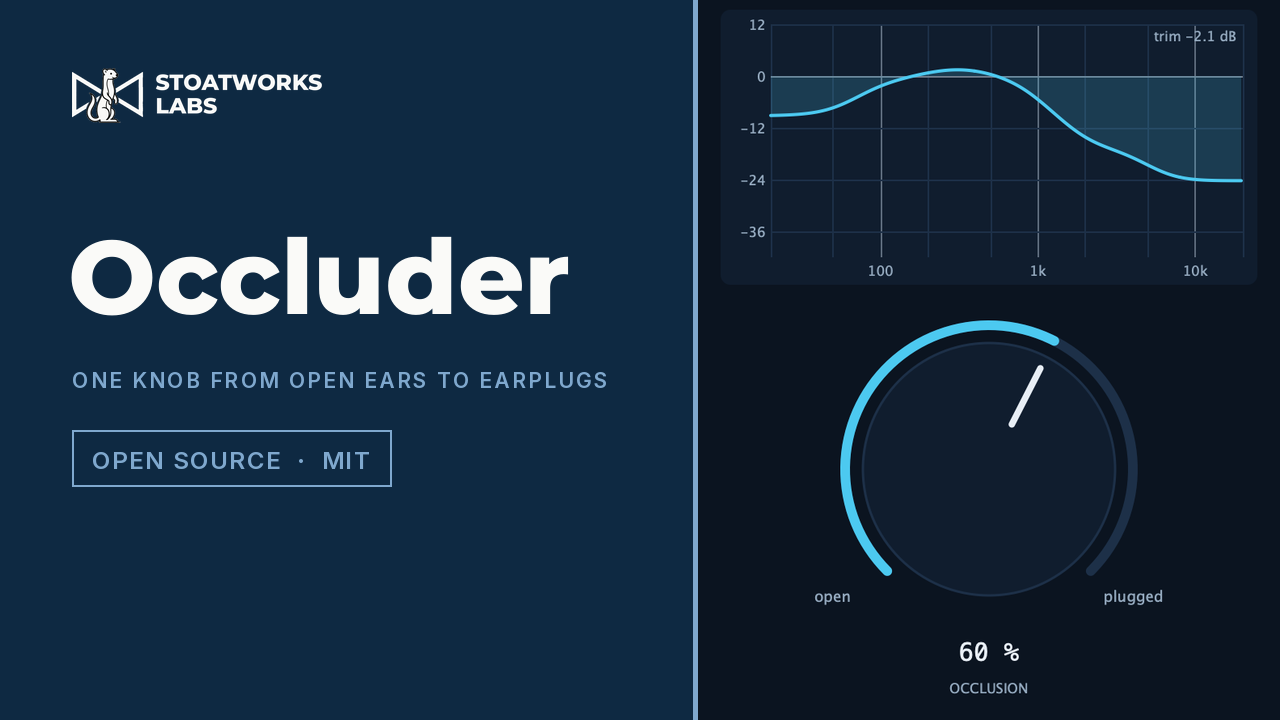
A one-knob EQ that makes a recorded voice sound the way you hear your own — from your ears as they are up to foam earplugs in. The curve is a fit to the acoustics of a plugged ear rather than a low-pass with a name: bone-conducted own voice trapped in the ear canal plus the plug's attenuation of the air path, relative to the open ear. Each setting is trimmed so the level of speech stays put and only the shape changes; 0 is a bit-exact pass-through. VST3, AU and a standalone app, zero latency.
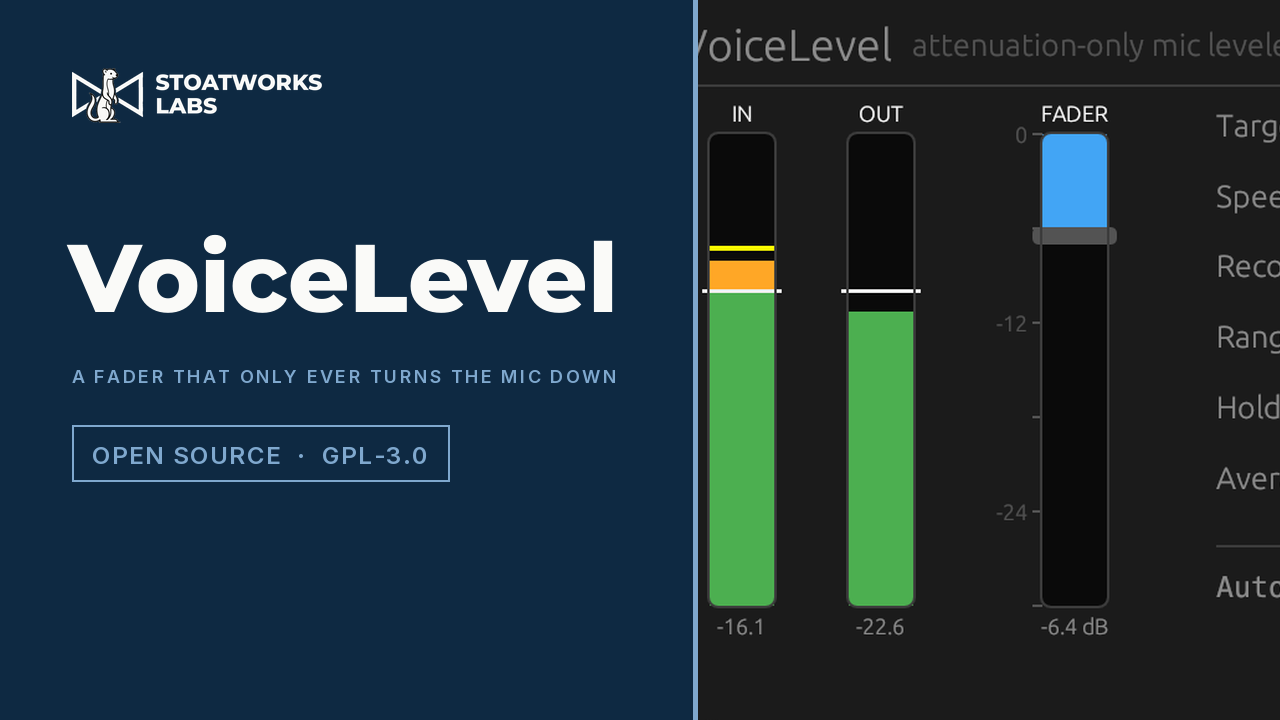
An attenuation-only automatic microphone leveler for live sound, as VST3, CLAP and a standalone app. It is a virtual fader with an operator's hand on it: when the talker is over the target level it is pulled down at a dB-per-second speed, it holds still while they pause, it eases back up more slowly and stops at unity — it never adds gain, so it cannot push a channel into feedback — and it has no look-ahead, so it adds no latency. Learn listens to the talker at the soundcheck and parks the fader where it puts them on target.
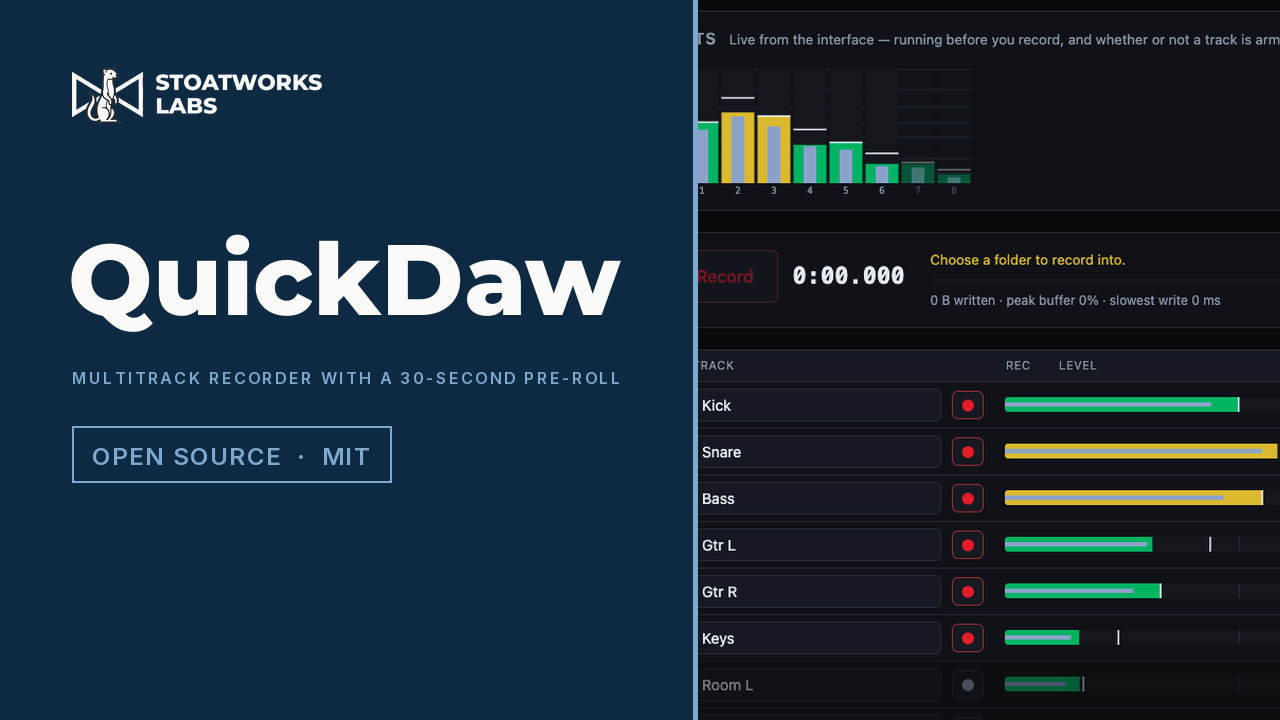
A multitrack recorder that runs entirely in a browser tab. Choose an audio interface and it gives you one track per input, mapped 1:1, streamed straight to a folder on disk as mono WAVs. A continuous pre-roll buffer holds every input as it arrives, so pressing record puts the previous 30 seconds at the head of the take. When a disk stalls, the frames it lost are padded with silence and written into the take's manifest, so a gap costs content and never time — and a generated test signal proves the whole chain without an interface, with a 1 kHz reference at exactly -18 dBFS.
Multitrack
Recording
Pre-roll
WAV
Web Audio
Where the work actually went
Nearly all of it went into measurement maths and DSP, because those are the parts that go wrong quietly. An LEQ derived by tilting a spectrum with a weighting curve changes when you change the transform size, the window or the overlap — none of which have anything to do with the sound. A weighting filter designed by a naive bilinear transform is exact at 1 kHz and more than ten decibels out at the top of the band, so it passes the one check most people run and fails everywhere nobody looks. Zero EQ shipped four releases with a broadband saturator where a frequency-selective one belonged, because a single-tone test cannot tell the two apart; that is on its page, in those words.
This is why the project pages here explain the method rather than only listing features. A screenshot of a meter tells you nothing about whether the number on it is right, and the difference between the two is the whole reason these exist.
What has been proven, and what hasn't
Each project says on its own page exactly what has been tested and what has only been reasoned about. The pattern across the audio work is consistent: the maths and the DSP are covered by tests, and the last cable usually isn't. No acoustic calibrator has ever been connected to LEQtion or Contourtonist, no MIDI or lighting hardware to SimpleCue, and Dante BabelBox has been validated against mock devices rather than real preamps — its page says which captures would fix that, if you have the hardware.
None of that makes a tool unusable. It means the caveats on each page are worth reading before a show depends on one, and that a bug report from real hardware is the most useful thing anyone can send.
The full index carries every project at once, searchable and filterable by discipline, type and how finished it is — including the disciplines that don't yet have a page of their own.