

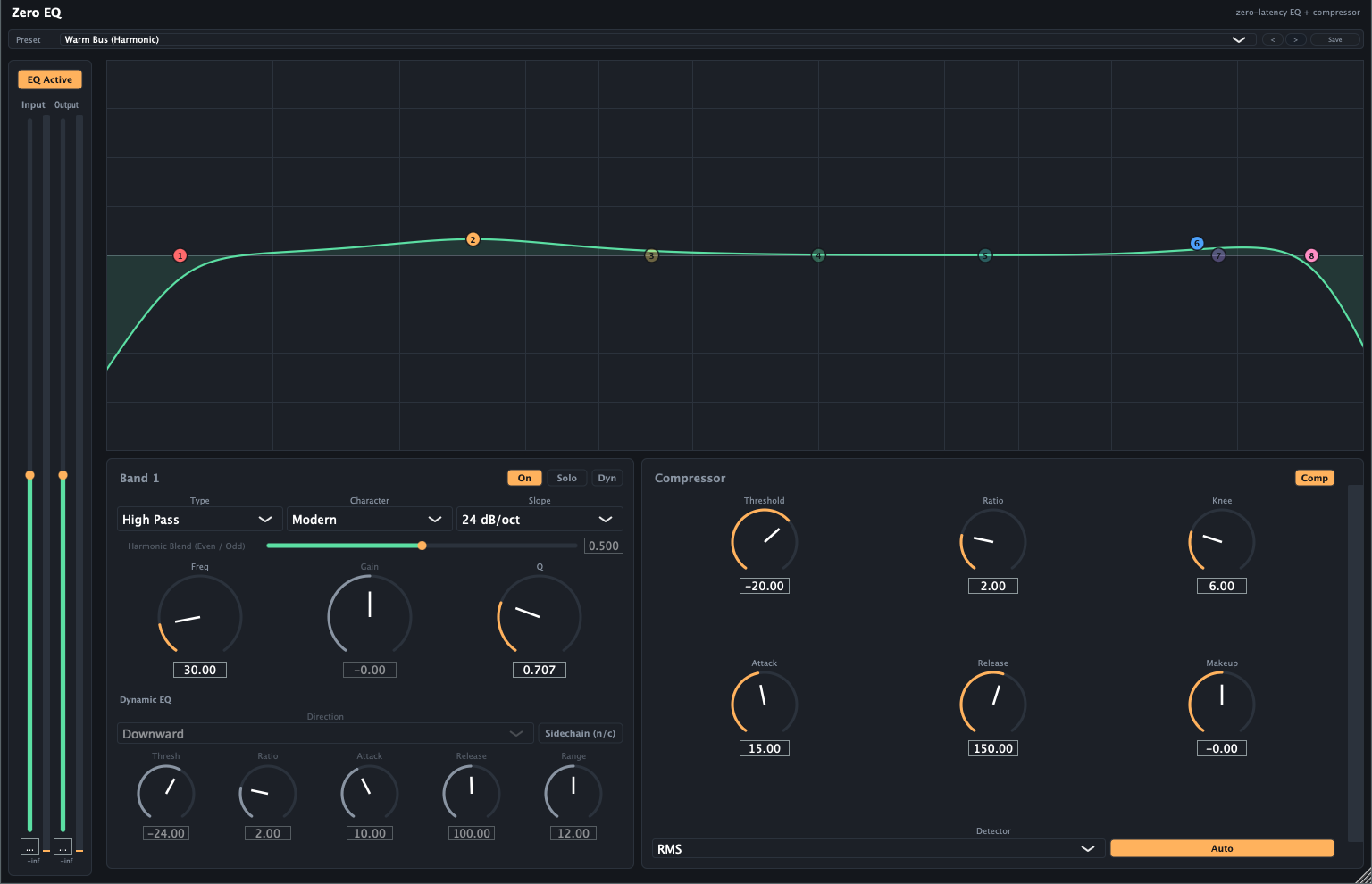
What it does
A zero-added-latency parametric EQ and compressor as VST3, AU and a standalone application. Every filter is minimum-phase IIR — no lookahead, no linear-phase convolution, no oversampling, no buffering beyond the host's block size — so it is safe to track through in a live or monitoring chain.
Any gain-having band can be switched out of static mode into a dynamic one, with its own threshold, ratio, attack, release and range, detecting either on the signal already in the chain or on an external sidechain input.
- Node-based curve over a live pre and post spectrum analyser: drag for frequency and gain, scroll for Q, double-click to add a band
- Dynamic EQ per band, downward (duck) or upward (boost), with optional external sidechain
- Three per-band characters — Modern, Vintage (proportional Q that widens with gain) and Harmonic (harmonics generated from only that band's frequency region)
- Post-EQ feed-forward compressor: soft knee, peak or RMS detection, no lookahead
- Metering combining fast peak, VU-style integration, a 4× oversampled true-peak estimate and a held clip indicator
- Seven factory presets plus user save and load, doubling as the host program list
- The plugin's own DSP compiled to WebAssembly, so the whole thing runs in a browser tab against built-in sources or your own file — no install, and the audio never leaves the page
Where it stands
Released at v0.8.2, which stops designing filter coefficients on the audio thread every block; v0.8.1 changed nothing but the Windows installer, which no longer touches the system PATH — the earlier one could overwrite it. The DSP is verified analytically against the RBJ and Butterworth cookbook formulas and against real audio through the shipped processor class, including FFT-verified per-band harmonic content; pluginval passes clean on VST3 and with two known benign warnings on AU, and it has been loaded and used inside REAPER on real audio. It has not been used in a live environment or on real gear in a show signal chain. Four earlier releases shipped a broadband saturator as the Harmonic character before that was caught — a single-tone test cannot tell a frequency-selective process from a broadband one.
Watch it running
Nothing loads from YouTube until you press play.Watch it there instead