
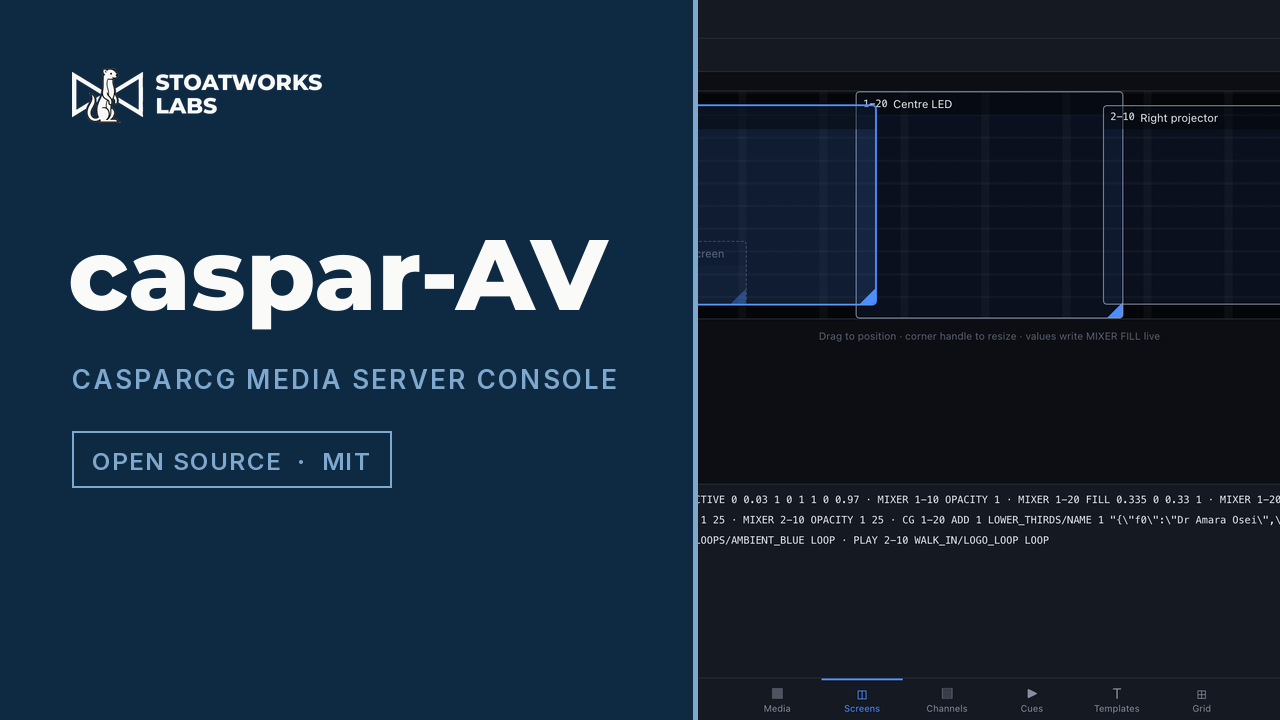
caspar-AV
ReleasedA live-events media server built on CasparCG, with screens on a canvas, frame-accurate cues, a media library, GDD template forms and a trigger grid, all in a browser. Tested against a real CasparCG 2.5.0.

Software
These work, and the source is on GitHub, but they aren't ready to go on the shelf with the rest yet. A couple have releases you can download. Treat those as an early look rather than something to take on a job, and expect the rough edges to move about.
Each card says how far along it is, and each page says what's been tested and what hasn't. If one of these is the thing you've been waiting for, tell me: knowing somebody wants it is the best reason to finish it sooner.
A live-events media server built on CasparCG, with screens on a canvas, frame-accurate cues, a media library, GDD template forms and a trigger grid, all in a browser. Tested against a real CasparCG 2.5.0.
Takes one video input, usually a locked-off wide of the stage, lets you draw as many regions of interest on it as you like, and sends each one back out of a Blackmagic DeckLink, cropped and scaled to the output raster.
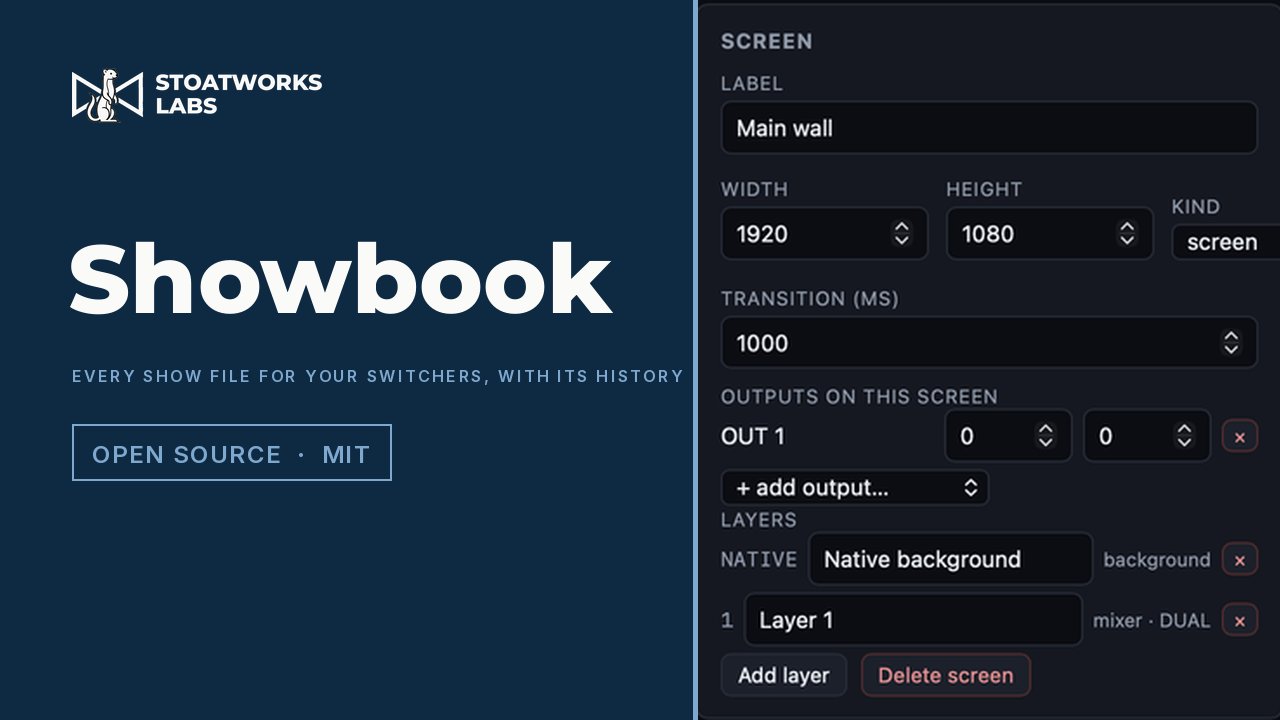
A desktop show file library for video switchers: Barco Event Master (E2, S3-4K, EX, Encore3) and Analog Way LivePremier (Aquilon), with Midra 4K and Alta 4K read as well. Every show is kept with a version history and the vendor file it came from, and the patch, the screens, the layers and the presets are drawn to scale. It writes PDF documentation, test patterns, multiviewer layouts and Bitfocus Companion pages, converts a show between platforms with a report of what carried over, what was adapted and what was dropped, and pulls from and pushes to the live hardware.
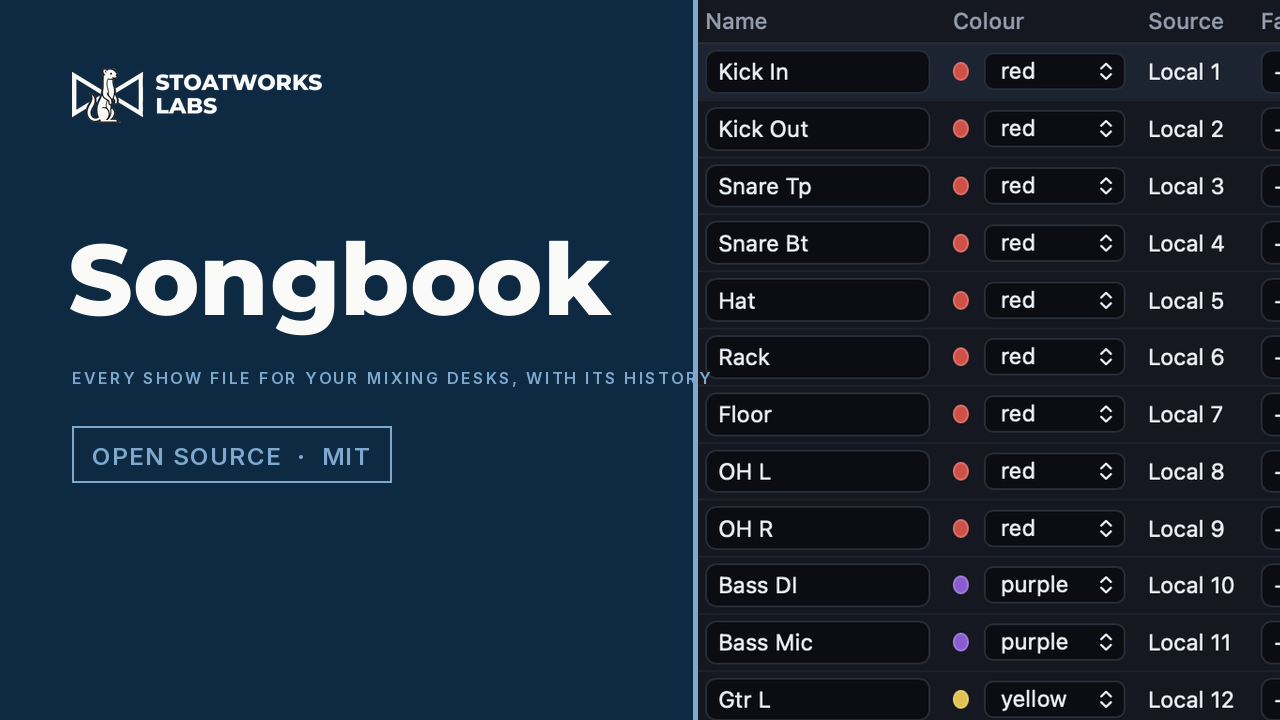
A desktop show-file library for digital mixing desks: Allen & Heath SQ, dLive and Avantis, and Yamaha CL/QL, TF, DM3 and DM7. Every show is kept with a version history and the vendor file it came from. You can look at and edit the I/O and patch, the channels, the sends, the buses, the DCAs and mute groups and the scenes. It writes PDF documentation, an input-list CSV, printable label strips and Bitfocus Companion pages; it converts a show between desks with a report of what carried over, what was adapted and what was dropped; it writes SQ shows and CL/QL files back with their checksums intact; and it pulls from and pushes to the live desk over MIDI/TCP or SCP. Songbook Lite runs the same in a browser tab.
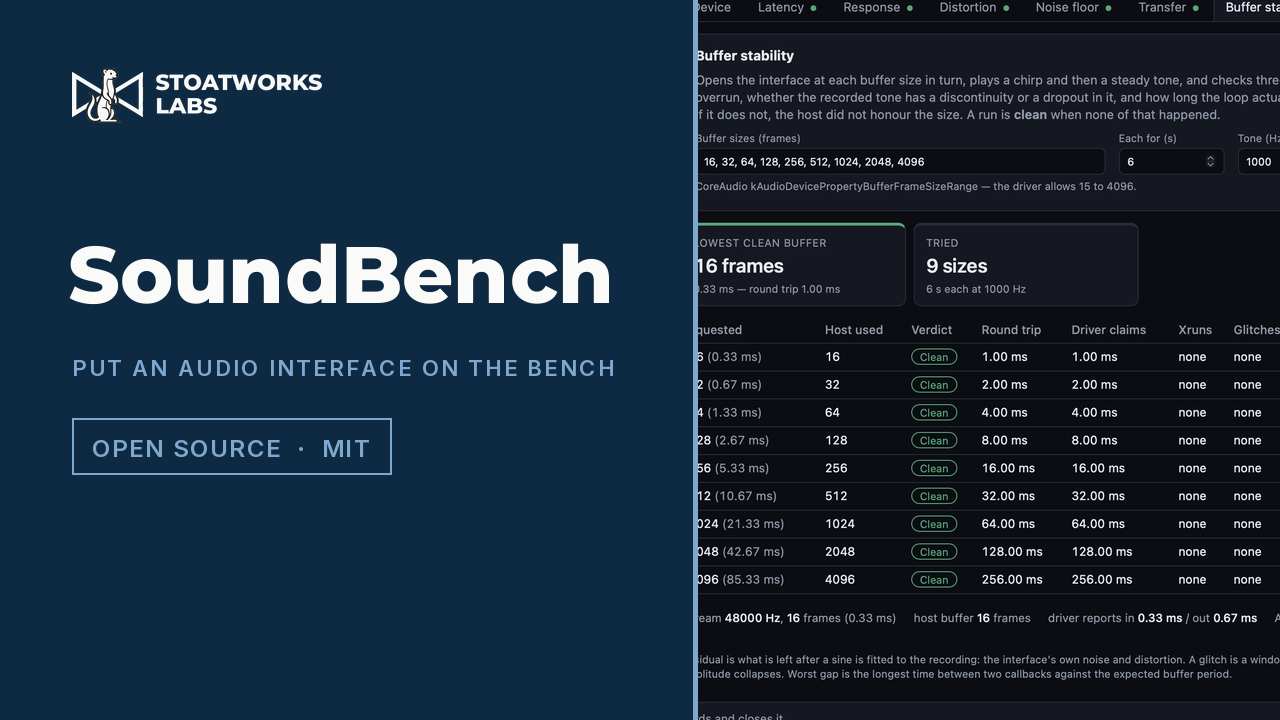
A desktop test bench for audio interfaces. Loop an output back into an input and it puts what the driver claims next to what the hardware actually does: the full driver property list, round-trip latency by chirp cross-correlation beside the driver's own figure, frequency and phase response with THD against frequency from one log sweep, THD+N and SNR from an AES17-style tone, the noise floor with its spurious peaks listed, a noise transfer function with coherence, and a buffer stability sweep that opens the device at every size and checks for xruns, glitches in the recorded tone, and whether the latency actually grew. It's built on a vendored PortAudio, so it gets at CoreAudio, WASAPI, WDM-KS and ASIO directly and sets the device's own buffer size and sample rate for each test.
The software half of a partyline intercom rig: a server that mixes, and endpoints with up to ten keys each. Every key is its own AES67 stream carrying either a partyline bus (minus that endpoint's own voice) or a direct point-to-point path.
Finished, or near enough