
What it does
A kestrel hovers over a wide field and picks out one thing at a time; so does this. One wide camera becomes several tighter shots, each on its own SDI output, with no operator riding a pan bar.
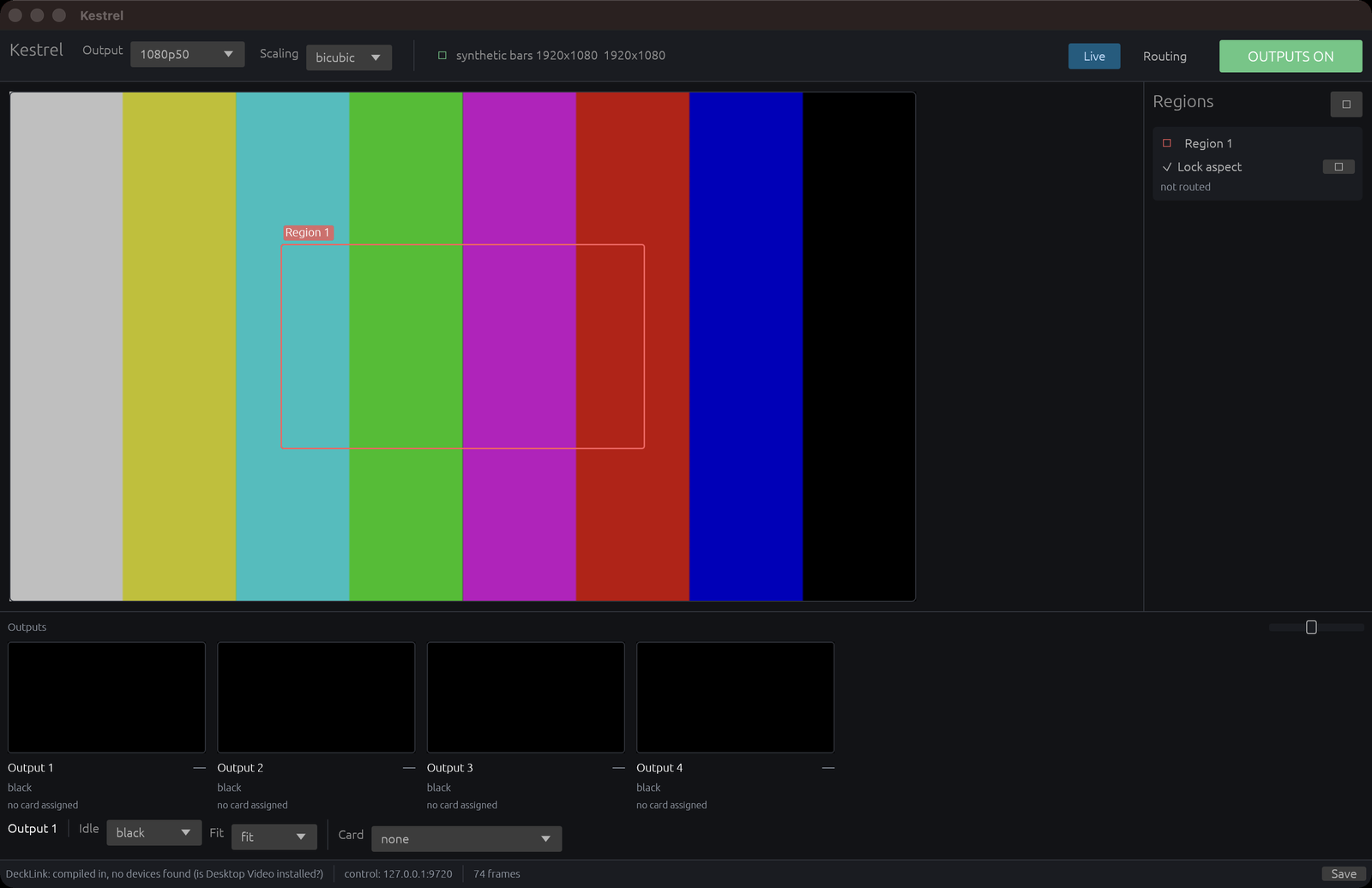
A large preview of the input carries the regions as draggable rectangles. A row of output previews along the bottom shows exactly what is on each wire, with a scale percentage saying how far the source is being blown up — so an over-cropped region is visible as a number rather than a judgement. A crosspoint matrix and a Companion module drive the whole thing from a Stream Deck.
- Any number of draggable regions of interest on one input
- Per-output preview showing exactly what is on that wire
- A scale percentage per output, so over-cropping is a number not a guess
- Crosspoint matrix — regions down the side, outputs across the top
- Companion module, verified against a really-running Kestrel
Where it stands
In development. The GPU path is verified by pixel readback, the control API end to end, and the Companion module against a really-running Kestrel. SDI is now verified on a real DeckLink Duo 2: colour bars read back off the wire by an independent BT.709 probe, enumeration and capture agreeing with Blackmagic's own scan, input loss producing legal black rather than a frozen frame, and the global kill muting every output while the crosspoint survived. Not yet exercised: format autodetect and mode changes, which need a second SDI cable. One source, macOS, Windows and Linux, but only macOS has ever been run.