

Four tools for the LivePremier (two of them for the Midra 4K and Alta 4K as well), and a second page for the generation before it
Analog Way
The frame will tell you almost anything. Its own interface asks you to go and look.
An Analog Way LivePremier is a very capable processor with a very literal control surface. Everything it knows is reachable (the object model is enormous and the device answers whatever you ask it), but the stock Web RCS shows it one panel at a time, has no cue stack, can't be driven from a fader or a command line, and wants a finished number in every numeric field rather than the sum you did in your head to get there.
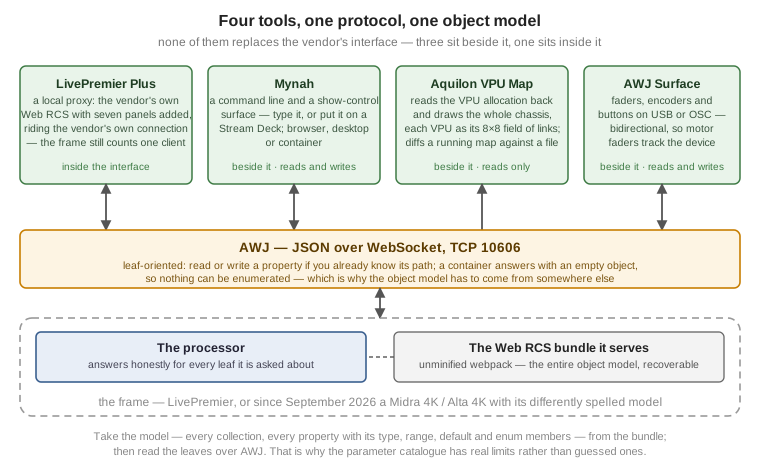
None of these replace that interface. Three of them sit beside it and one sits inside it, and all four are built on the same protocol work: AWJ, the JSON-over-WebSocket interface the device's own web application uses. They're separable on purpose, so take the cue stack without the VPU map, or the control surface without either. Since September 2026 two of them, LivePremier Plus and Mynah, also speak Analog Way's other current platform, the Midra 4K and Alta 4K, whose object model is spelled differently under the same protocol, and both have made their first writes to a live Pulse 4K.
The older Midra and LiveCore processors are a different problem with a different answer. Those boxes still work. The software written to drive them doesn't, because it was built on runtimes that no longer exist. openRCS is a new control surface written against the protocol rather than against the dead application, and it has a page of its own.
The switcher's own interface, with the missing panels
LivePremier Plus
A local proxy, which you browse to instead of the frame
Point it at a switcher and the vendor's own Web RCS comes up with seven additions already in it, drawn with the vendor's own stylesheet and riding the vendor's own connection, so the device still counts one client. It's the whole of this page in one place for anyone who'd rather not run three things.
- VPU Map: the mixer allocation as a budget (fitted, held, spare, and what a staged configuration would change)
- Console: a lighting-desk command line, "Recall Screen 1 Memory 5" or "R Sc 1 Me 5"
- Timeline: a theatre cue stack that advances on one GO, with per-cue fade, delay and follow times
- Memories: every bank in one searchable list, with the buffer holding each memory shown beside it
- Layer: every one of a layer's properties, generated from the device's own catalogue rather than transcribed
- MIDI Mapping: a control surface on the layer under your hands, with soft pickup so a fader can't jump a live value
- Arithmetic in numeric fields: type 1080-80 into a layer width and get 1000
Control without the interface
Mynah
A browser, a desktop app or a container, plus a Stream Deck
The command line and the show-control surface on their own, for when you don't want the vendor UI in front of you at all. Type what you want to happen, or put it on a button. The hosted site is a demonstration only and always will be: a page served over HTTPS can't open a connection to a switcher on your network, so driving hardware means running it locally.
- A terse command syntax that abbreviates: "Recall Screen 1 Memory 5" or "R Sc 1 Me 5"
- Desktop builds, a container image, and a hosted demo that admits it's a demo
- A Bitfocus Companion module with well over a hundred presets and a command builder, driven end to end in Companion 5.0.1
Where every mixer in the chassis went
Aquilon VPU Map
A desktop app, a server or a container, read-only
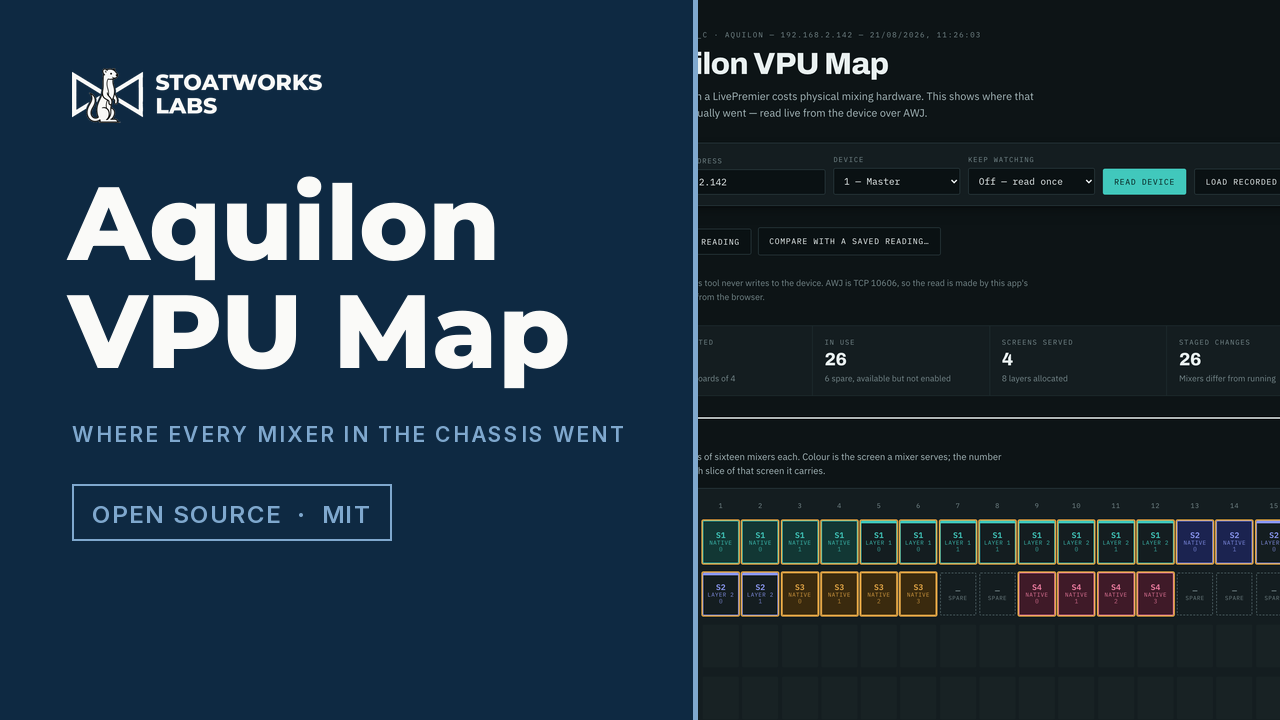
Every layer costs physical mixing hardware, and a frame won't tell you a configuration doesn't fit until it fails to fit. This reads the allocation back and draws the whole chassis on one screen, each VPU as the 8x8 field of links the manual draws it as. It also diffs the running map against the staged one, which catches the case where every difference is a link moving and no property changes at all.
- The grid follows the manual's own figures: a row is one layer link, and columns belong to screens
- "Will it fit?" answered from the device's own figures rather than inferred
- Save a reading before the show, compare against it during
- Three recorded configurations ship with it, so it's usable with no frame attached
Faders, encoders and buttons on the frame
AWJ Surface
A local server, with a control surface on USB or OSC
Opacity, size and position are continuous values, and a continuous value wants a fader under a hand rather than a number in a field. Bidirectional, so motor faders track the device and scribble strips name the layer each strip is pointed at. Its read-only mode is enforced by the client having no reachable write path rather than by a flag, which matters more than it sounds, because on this device subscribing is itself a write.
- X-Touch, APC40, MIDICON PRO and MIDICON-2 profiles, plus OSC and learn-anything
- Bindings say PREVIEW or PROGRAM and resolve per event, because which preset letter is on air moves at every take
- Bring-up tab: sweep every control and it reports what the profile got wrong
- The same engine LivePremier Plus runs in the browser, and this repo is one host of it
One protocol under all four
Everything here speaks AWJ, the JSON-over-WebSocket interface the device's own web application uses, on TCP 10606. It's a leaf-oriented protocol: you can read and write a property if you already know its path, and you can't enumerate anything, because a container answers with an empty object. That normally means a control application is limited to whatever paths somebody managed to observe.
The way past it is the vendor's own bundle. The Web RCS ships as an unminified webpack build that keeps its original TypeScript module paths and its generator's headers, so the entire object model (every collection, every property with its type, range, default, read-only flag and enum members) is recoverable from the file the switcher already serves you. Take the model from there, then read the leaves over AWJ. That's why the parameter catalogue in the control surface has real limits rather than guessed ones: 67 layer parameters and 19 screen controls, generated from the switcher rather than typed from a PDF.
It also explains a trap that runs through all four. Subscribing is a write: the Subscriptions list is a `replace` on a path like anything else, so a tool that means to watch a live frame and not touch it can't get there by declining to call `set()`. The read-only paths here are built with no reachable write path at all, and poll instead.
What has been on a real frame
More of this than is usual, and it corrected things rather than confirming them. The VPU map has read a real Aquilon C end to end in two configurations, and the second corrected two things the first had made look settled; on 9 September 2026 a second Aquilon C confirmed the model. The control surface's whole chain (a fader movement through to an opacity write, a TAKE, and the preset flip that follows it) has been exercised on a real Aquilon C, with the frame captured first and all 87 values verified restored afterwards, and that same day every one of the 421 paths its catalogue generates was issued at the box and answered. The preset-letter rule was settled by firing a take and re-reading rather than by reasoning about it. Mynah's grammar has been executed verb by verb against an Aquilon C, and its Midra 4K spellings were proven on a live Pulse 4K on 12 and 13 September through LivePremier Plus. Those were the first writes any of these tools have made to that platform, typed by the operator at the Console.
What has not happened is just as specific. No physical control surface has ever been plugged into the surface host. The four controller maps come from published documentation, and a MIDI implementation chart is exactly the kind of document that's quietly wrong, which is why there's a bring-up mode. The VPU map has never seen a Link setup, a capacity other than 4K or 5K, a combined VPU, Optimized mode or Cut & Fill; its repository says which recorded capture would settle each one, and the guide for recording it assumes nothing.
There's no frame here between visits, so in the meantime the recorded captures are the ground truth. A capture from your frame is the single most useful thing anyone can send.
Why there's no hosted demo of the proxy
LivePremier Plus has no hosted demo and can't have one. The interface you'd be looking at belongs to Analog Way and is served by your switcher: the proxy carries it and contains no part of it, so without a device there's nothing to show at all. Run it from the container, a desktop build or a checkout on the same network as the frame.
The demo that does exist, Mynah's hosted site, is a demonstration of the command syntax and nothing more. A page served over HTTPS can't open a connection to a switcher on your network, so no hosted copy of any of this will ever drive hardware, however much it looks like it might.
Not affiliated with Analog Way
Analog Way, LivePremier, Aquilon, Midra, LiveCore, NeXtage, Ascender and Pulse2 are their vendor's names, and none of this is endorsed by, supported by or connected to them. Product names are used only to describe what the software talks to.
The protocol work was done against device behaviour and against files the device itself serves, not against a specification anybody published. Treat it as accurate for the frames and firmware it's been tried on and no further. Each project's own page says exactly which those are.
Companion module
The command syntax on a Stream Deck instead of in a text field, with well over a hundred presets and a command builder, driven end to end in Companion 5.0.1 against the simulator.
The other generation, and the rest of the video work
Everything else
There's more where this came from
This is one corner of it. The full index covers audio, video, RF, content management, show control and the networking underneath.