

Cross-vendor control bridge
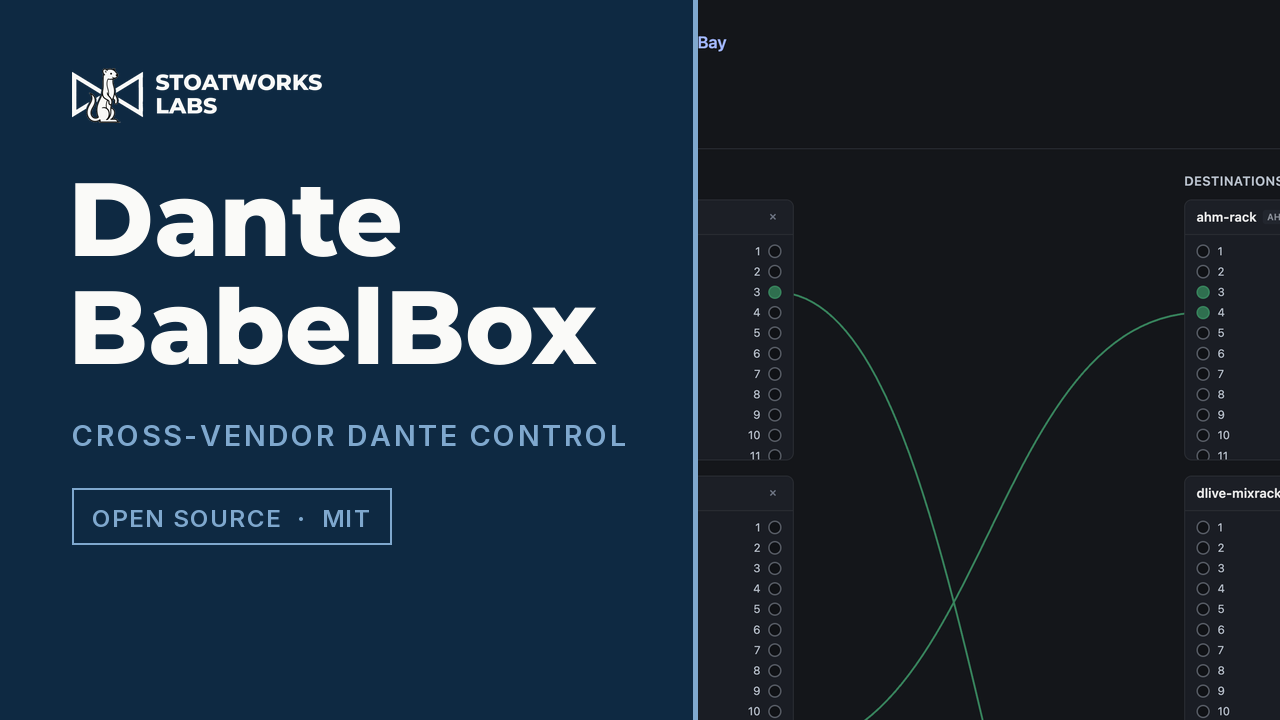
Dante BabelBox
Dante carries the audio. It doesn't carry the control.
Dante gives you audio and basic device discovery, and nothing whatsoever about preamp gain, phantom power or wireless-mic status. Every vendor layers its own proprietary control protocol on top of the same network, and none of them talk to each other.
BabelBox translates between them, so state on one vendor's device is usable from outside its ecosystem.
The bridge
Dante BabelBox
Rust, runs anywhere on the network
A translating router covering two domains that share a network and nothing else.
- Preamp control — gain and phantom across Behringer and Midas (OSC), Allen & Heath (NRPN over TCP) and Yamaha DM3 (OSC)
- Radio-mic telemetry — battery, RF and audio level from Shure ULX-D and Axient (ASCII over TCP) and Sennheiser EW-DX (SSC/JSON over UDP)
- One unified gain, phantom and telemetry state out the other side
Telemetry doesn't need the Dante card
The radio-mic side talks to receivers over their own control protocol, on the network they're already on. Whether the receiver has a Dante audio option fitted makes no difference — the telemetry was never travelling over Dante in the first place.
Where this sits
It is a bridge, not a mixer and not a control surface. It makes another vendor's preamp reachable and another vendor's receiver readable; what you build on top of that is up to you.
This one needs hardware, not code
BabelBox can translate between vendors, but it cannot yet impersonate one — appear as a native device of a foreign brand, so a console drives it from its own preamp UI. That is blocked on packet captures, and a capture needs hardware rather than code.
Windows
Select both adapters in Network Connections, right-click, Bridge Connections. The quickest of the three.
macOS
Network settings → Manage Virtual Interfaces → New Bridge. Say yes when Wireshark's installer offers ChmodBPF, or every capture needs sudo.
Linux
A handful of copy-pasted `ip link` lines rather than a menu. No config files to edit.
Everything else
There's more where this came from
This is one corner of it. The full index covers audio, video, RF, content management, show control and the networking underneath.