Dante BabelBox
Cross-vendor Dante control
What it does
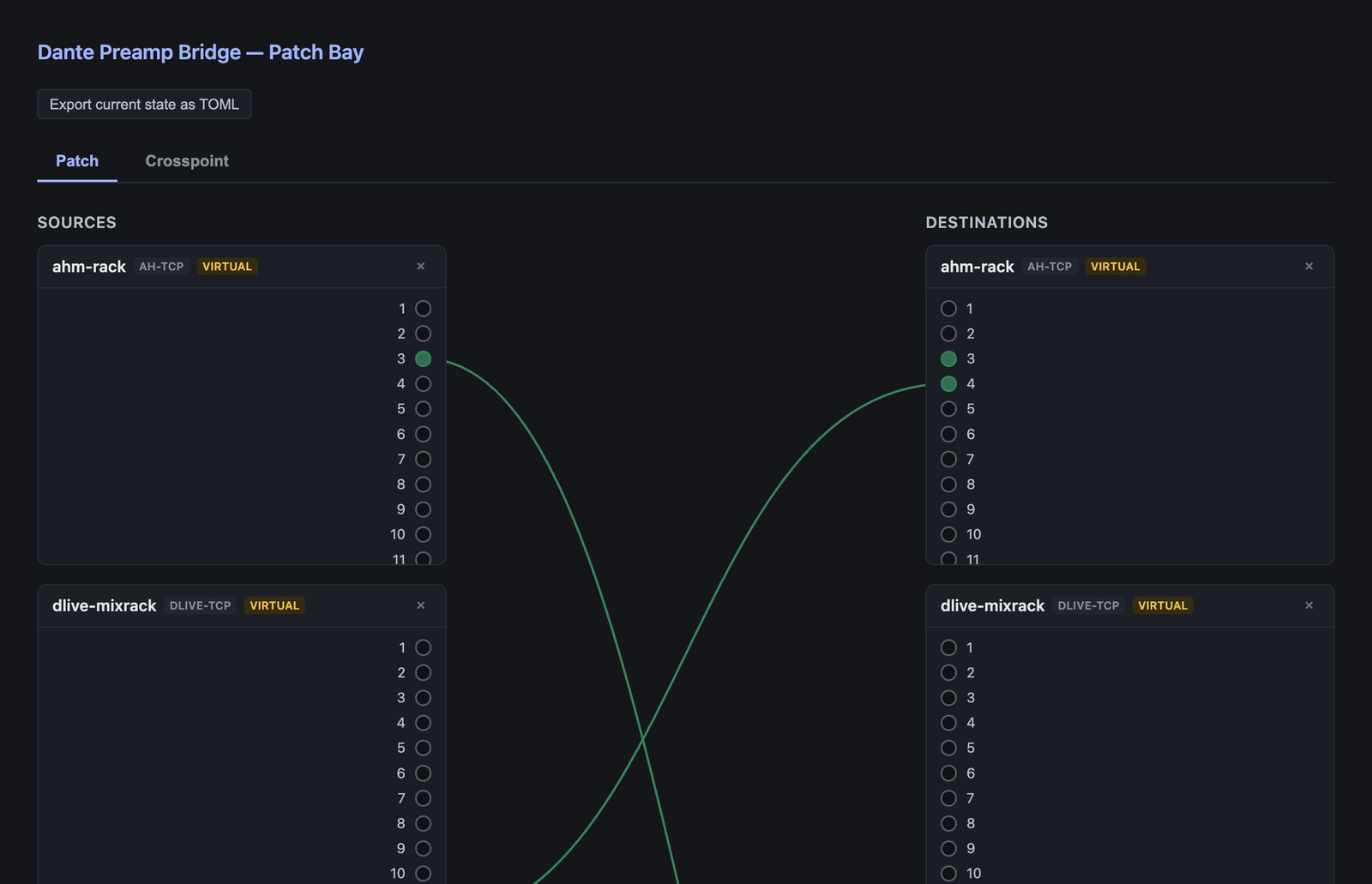
Dante carries audio and mDNS device discovery, but nothing about preamp gain, phantom power or wireless-mic status — every vendor layers its own proprietary control protocol on top of the same network. BabelBox translates those protocols so state on one vendor's device is usable from outside its own ecosystem.
Two domains: preamp control across Dante-networked consoles and stageboxes, and radio-mic telemetry, which works whether or not the receiver even has a Dante option fitted.
- Behringer and Midas X32, M32, Wing and HD96 over OSC
- Allen & Heath AHM processors and dLive over NRPN-over-TCP
- Yamaha DM3 over OSC
- Shure ULX-D and Axient telemetry over ASCII/TCP
- Sennheiser EW-DX over SSC/JSON
- One unified gain, phantom and telemetry state out the other side
- Yamaha Rio and Tio stageboxes over Audinate ConMon — gain, +48 V and metering
- Any AES70/OCA device, discovered at runtime — Focusrite RedNet and anything else with AES70 enabled
Where it stands
Released at v0.2.0, which added the Allen & Heath DT preamp codec and Yamaha SCP discovery. The adapters are built against official or community-authoritative vendor protocol specs, with one clearly-flagged exception — the Lectrosonics mic adapter's wire format is an unverified placeholder. No adapter has been run against real hardware — only against mock devices in the test suite. Two wire formats have been, though: the Yamaha R-series HA protocol was captured from a real QL1 and Rio3224-D2, rebuilt from that documentation and transmitted back, and the stagebox changed its gain; and the Shure QLX-D console-mount path was reverse-engineered from a real QLXD4. The protocols are proven; the code around them is not.
Help wanted
This one needs hardware, not code
BabelBox can translate between vendors, but it cannot yet impersonate one — appear as a native device of a foreign brand, so a console drives it from its own preamp UI. That is blocked on packet captures, and a capture needs hardware rather than code.
Every desk and stagebox from the same manufacturer has a private handshake — how they find each other, pair up, and agree on gain and phantom power. None of it is in any public spec. To join that conversation from outside, it first has to be recorded happening between two devices that already trust each other.
So the capture that matters is a console paired with its own native stagebox: a real Yamaha QL1 talking to a real Rio or Tio, not to a foreign-vendor box. Your laptop sits inline between the two, passing everything through unchanged, while Wireshark watches. About twenty minutes, and no specialist network gear — no tap, no mirroring switch.
What you'd need
- A spare desk and its matching stagebox — same brand and family, so you get the pairing they already trust
- A laptop with two Ethernet ports: a built-in port or Thunderbolt adapter, plus a cheap USB-to-Ethernet one
- Two ordinary Ethernet cables, and Wireshark
- A bench, before or after a show. Never a live network mid-event — inserting anything into a production Dante network isn't worth the risk
Windows
Select both adapters in Network Connections, right-click, Bridge Connections. The quickest of the three.
macOS
Network settings → Manage Virtual Interfaces → New Bridge. Say yes when Wireshark's installer offers ChmodBPF, or every capture needs sudo.
Linux
A handful of copy-pasted `ip link` lines rather than a menu. No config files to edit.
Writing a device plugin If you have a published control spec instead of hardware: a plugin implements one trait, compiles as a cdylib and loads into any build, so it never has to land in this repo at all.
Watch it running
Nothing loads from YouTube until you press play.Watch it there instead