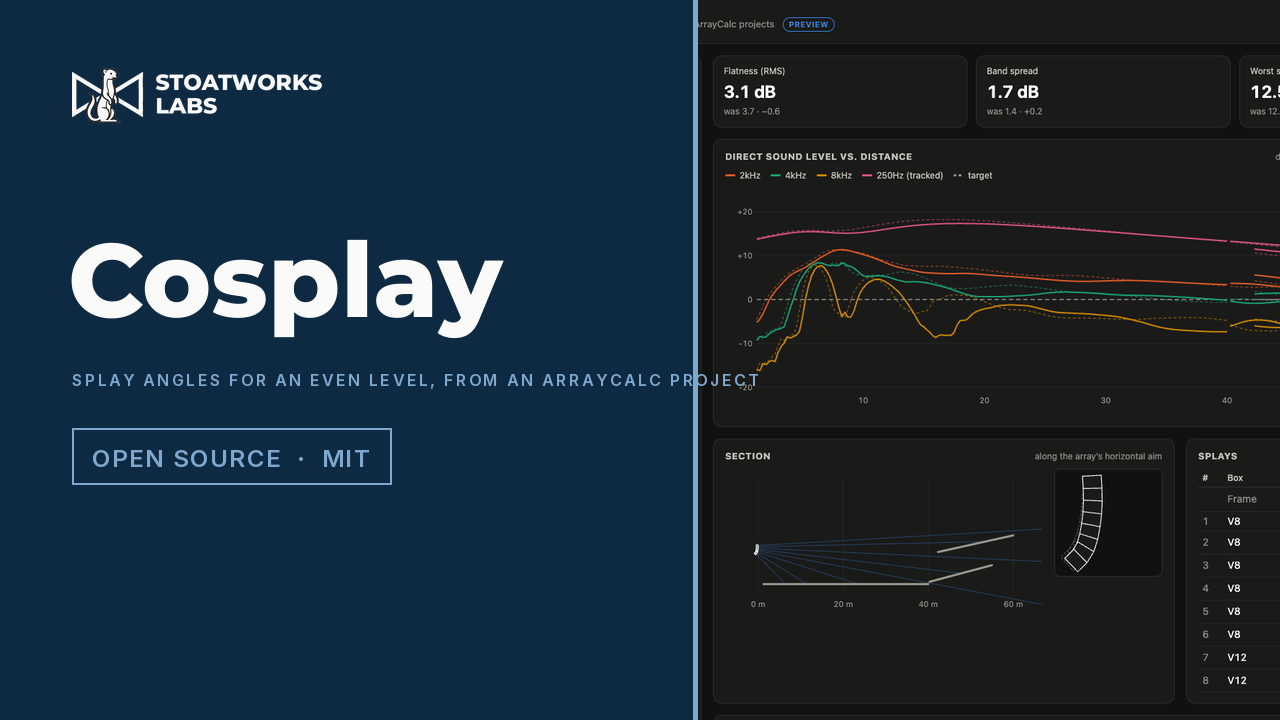
The splays decide where the level lands. Let something else try ten thousand of them.
Open a d&b ArrayCalc project, pick a flown line array, and Cosplay (Compute Optimal Splay) searches its splays and frame angle for the most even direct level along the array's axis, with the octave bands running together instead of apart. The answer goes back into a copy of the project for ArrayCalc to open.
It runs in the browser and the project is never uploaded. ArrayCalc has no plug-in interface, but a .dbpr is a database, so Cosplay reads the arrays and listening planes straight out of it. The levels are its own prediction rather than d&b's measured data, so ArrayCalc has the final word: open the file there and check the Sources page and the rigging.
d&b’s own V-Series example 3, main hang: dashed traces as loaded, solid as proposed, one colour per octave band, against a flat target.
What it does
01
Reads the project, not a copy of it
Flown arrays, their boxes and splays, the listening planes and the room's temperature and humidity come straight out of the .dbpr. Where the planes cross each array's aim is the line the level is judged along, which is the same line ArrayCalc's “Direct sound level vs. distance” plot follows, balcony and stalls both.
02
Rigging measured from the file
ArrayCalc stores each cabinet's front hinge point, and the step from one hinge to the next is fixed for each box type. So any new set of splays is laid out exactly from what the file already records, and every flown array in ArrayCalc's example projects rebuilds from its own splays to within 0.2 mm.
03
A goal you can say out loud
The high bands you pick as flat as possible front to back (or falling at the rate you set per doubled distance), the bands running parallel to each other, and one low band tracking with them. Splays stay inside the family's range, in whole degrees, and can be kept growing down the array.
04
Back into ArrayCalc
Frame angle, splays, every cabinet’s angle and position and the lowest-edge height are written together, to any hang ArrayCalc links as its mirror as well (and to an unlinked look-alike if you ask), and nothing else in the file changes. Every proposed splay stays editable first, with the prediction following as you change it.
What to check before a show
01
Its own prediction, checked against ArrayCalc’s
d&b’s measured cabinet data isn't available outside ArrayCalc, so each box is modelled as a coherent line source as tall as the box, with distance and air losses. On d&b’s V-Series example, ArrayCalc’s own unprocessed 2 kHz and 500 Hz traces for Cosplay’s splays matched its prediction to about a decibel from 5 to 40 m. Directly under the array it reads 2–4 dB low.
02
Compression rigging is nominal
On GSL, KSL, XSL and CCL, ArrayCalc bends each splay by up to 0.3° under load. Cosplay writes the nominal splay and doesn't model the bend. The splay range it offers per family is a default to check, and can be changed.
03
What it doesn't do yet
Flown arrays only, so no stacked, horizontal or SUB arrays. New splays invalidate any ArrayProcessing slots, which ArrayCalc then has to recalculate, and pick-point loads are left for ArrayCalc to work out.
Run your own copy
There's no container for Cosplay (preview), so the hosted copy is the one to use.