

Occluder
One knob from open ears to earplugs
What it does
When you speak you hear yourself two ways at once: through the air, which is what a microphone hears too, and through your skull, which radiates the low end of your voice into the ear canal from the inside. With the canal open that low end mostly escapes. Block it and it is trapped — 20 to 25 dB more around 200 to 500 Hz — while the plug shuts the air path out, and the consonants with it. That is the occlusion effect: the boomy, muffled, talking-into-a-bucket sound of your own voice with earplugs in, in-ear monitors, or a finger in each ear.
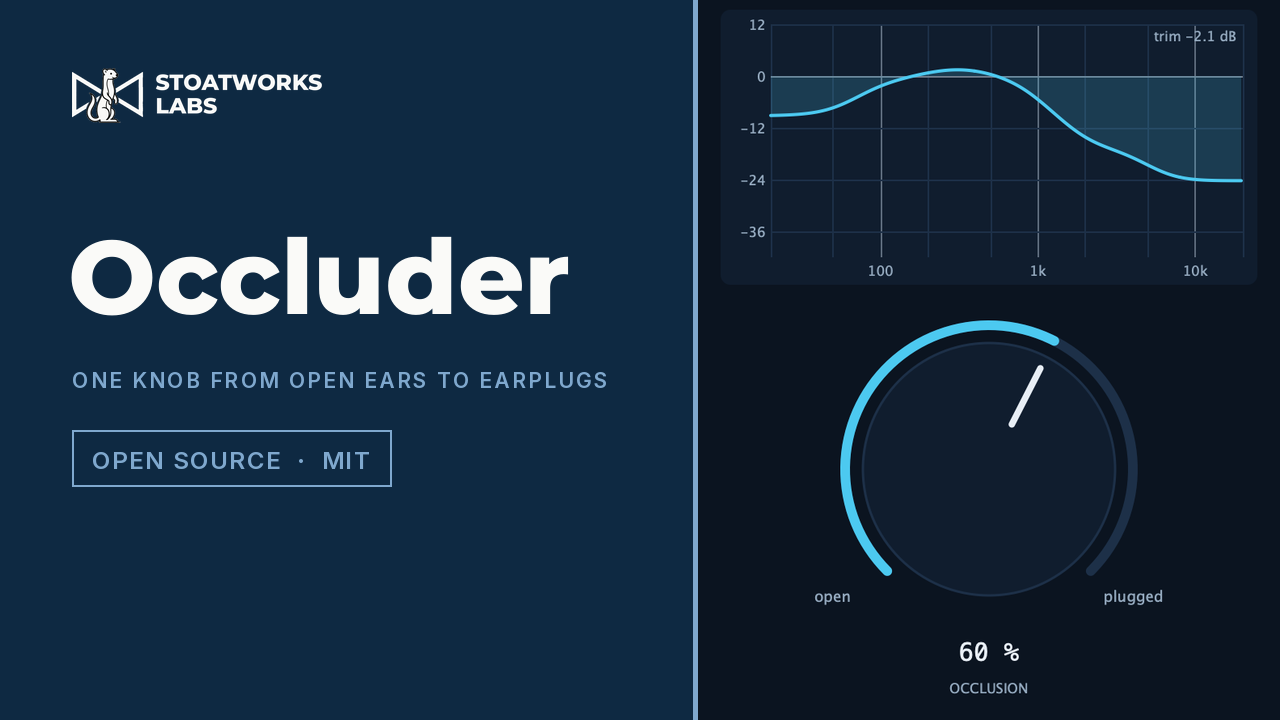
Occluder applies that change to a recording, with one control. Zero passes the audio through untouched, bit for bit. A touch of it is roughly the difference between a recording of you and you. Half way is one plug in, or hands cupped over the ears. Full scale is a pair of foam plugs: the low mids stay, the consonants are thirty decibels down, nothing above four kilohertz survives. It is an ordinary parameter, ramped over fifty milliseconds, so it can be automated click-free — faded in as a character puts their ear defenders on, snapped for a cut to a point-of-view shot.
The shape is derived, not tuned: a published model of the occlusion effect and a foam plug's attenuation curve, summed for the plugged ear and divided by the open one, then fitted with four second-order sections that are each exactly unity at zero. Every setting carries a trim computed from the same coefficients the audio runs through, so the long-term level of speech does not move and the knob changes only the sound; the display draws that exact response, trim included, at the session's sample rate.
- One knob, Occlusion, from open ears to foam earplugs; double-click returns to zero
- Zero is a true pass-through: the output is the input, bit for bit, and leaving zero is seamless
- A curve fitted to the acoustics of a plugged ear — the occlusion hump around 300 Hz and the plug's tilt above it — rather than a low-pass
- Speech-weighted level trim on every setting, computed from the live coefficients and shown on the display
- Click-free automation: 50 ms ramp with the filters redesigned every 32 samples
- Zero latency and no allocation on the audio thread; four double-precision biquads per channel
- Any channel layout from mono to surround, every channel filtered identically
- VST3 and Audio Unit for macOS, Windows and Linux, plus a standalone app for talking into
Where it stands
Released at v0.1.0, whose macOS builds are signed and notarised by Apple. Beta: the shipped processor is checked by a harness that pushes real signal through it — bit-exact pass-through at zero, the measured response within 0.01 dB of the design at three sample rates, the full-scale shape within 0.2 dB of the acoustic model, speech-shaped level within 0.01 dB across the dial, a click-free slam from 0 to 100, zero allocations with the knob moving — and pluginval passes at strictness 10 on VST3 and AU, as does Apple's auval. It has been listened to only as offline renders of a synthesised voice; it has not met a DAW in anger or been used on a show.