Stoatworks Labs

roomkit (preview)

Bass traps tuned to your room, and diffusers, as files for the slicer. Early preview

In developmentRuns in a browser tab

Your room has a few notes it won't stop playing. Print something tuned to each.

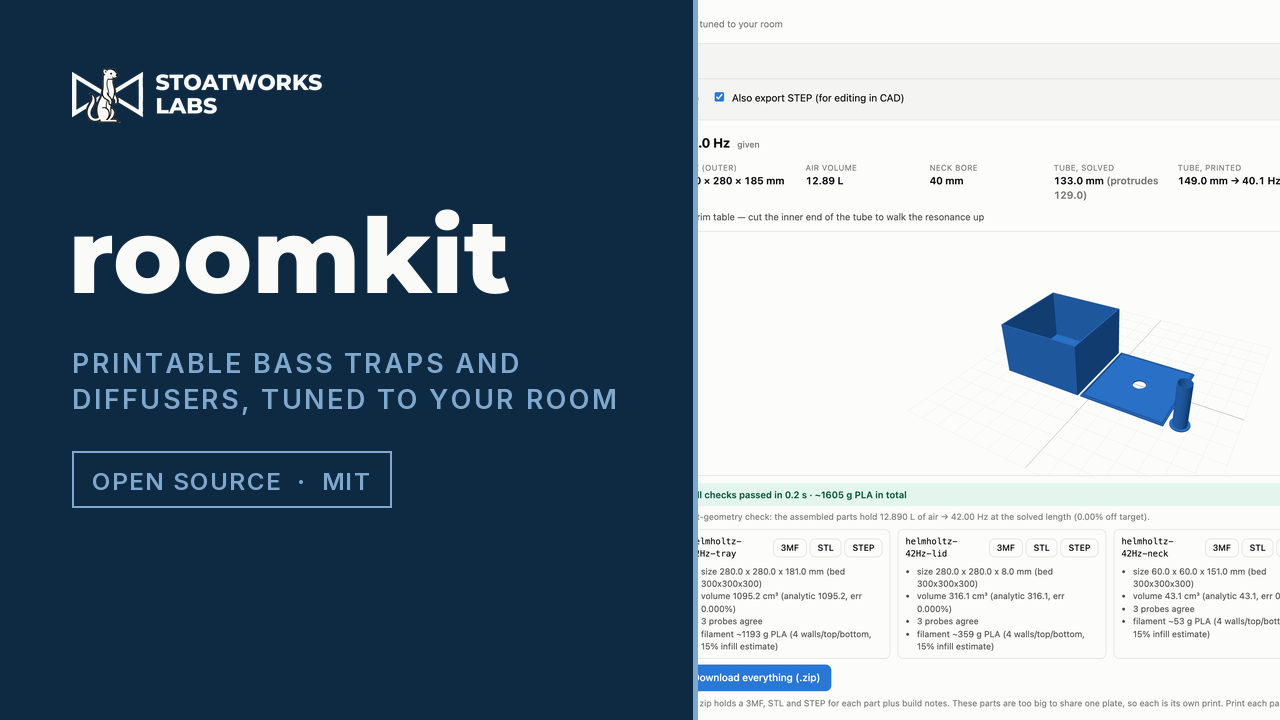
Type a frequency, drop in a REW measurement or give it the room's dimensions, and roomkit designs a Helmholtz bass trap for each problem note, plus quadratic-residue diffusers, and hands you 3MF, STL and STEP files ready for the slicer.

It runs in the browser: the CAD kernel is OpenCascade compiled to WebAssembly, so nothing you type or upload leaves the page. Every part is checked from the solid it actually built before it's offered for download. None of the designs has been printed and acoustically measured yet, so treat the first one you print as an experiment, and measure it.


roomkit (preview) — Bass traps tuned to your room, and diffusers, as files for the slicer. Early preview

What it does

01

Tuned to your room

A trap per target frequency: one you type, the peaks in a REW measurement exported as text (anything standing 4 dB over a one-octave running median, by default), or the room's axial modes. The peak frequencies are exact. The dB figure reads low and is only good for ranking them.

02

A neck that does some work

The solver picks the widest neck that reaches the note within the depth you allow off the wall. A wide neck in a big box couples to the room far better than a pinhole in a flat box tuned to the same note, and solving for the smallest box gives you the pinhole.

03

Printed long, trimmed to tune

Each trap is three prints: a tray, a lid and a push-in neck. The neck comes out longer than solved, by a margin you set, with a trim table for cutting it back to walk the resonance up once you've measured where it landed.

04

Diffusers as well

Quadratic-residue diffusers as 2D skyline tiles or 1D wells, solid or open-backed so you can fill them with plaster or sand. They work from about the design frequency up to where a well is half a wavelength wide.

What to check before a show

  1. 01

    Checked from the solid, not the numbers

    Each part has to be one valid solid that fits your bed with nothing below z = 0, its built volume has to match the analytic one, probes have to find air and material where they should, and the exported mesh has to be closed and consistently wound. A trap is then reassembled and its air re-measured, and it fails if that tunes more than 0.5% off. A part that fails isn't offered for download.

  2. 02

    Textbook acoustics, never measured

    The traps are lumped Helmholtz resonators with end corrections, the diffusers Schroeder QRDs. roomkit is a port of a Python generator, and its tests pin it to that code's numbers and built volumes, but none of these designs has been printed and measured. Measure yours before you trust it.

  3. 03

    No printed absorbers

    On purpose. FDM pores are 10 to 100 times wider than the air's viscous boundary layer at 1 kHz, so a printed lattice is mostly transparent. Use mineral wool for broadband absorption, and print the things printing is good at.

Run your own copy

There's no container for roomkit (preview), so the hosted copy is the one to use.

Self-hosting the web tools, and which ones you can