

What it does
A small room's worst bass is usually a handful of modes, each at one frequency, and a Helmholtz resonator is the textbook way to soak up one frequency: a box of air with a neck. The formula fits on one line. Getting from it to a box you can actually print, one that fits your bed and holds the air it's supposed to, is the tedious part, and that's the part roomkit does.
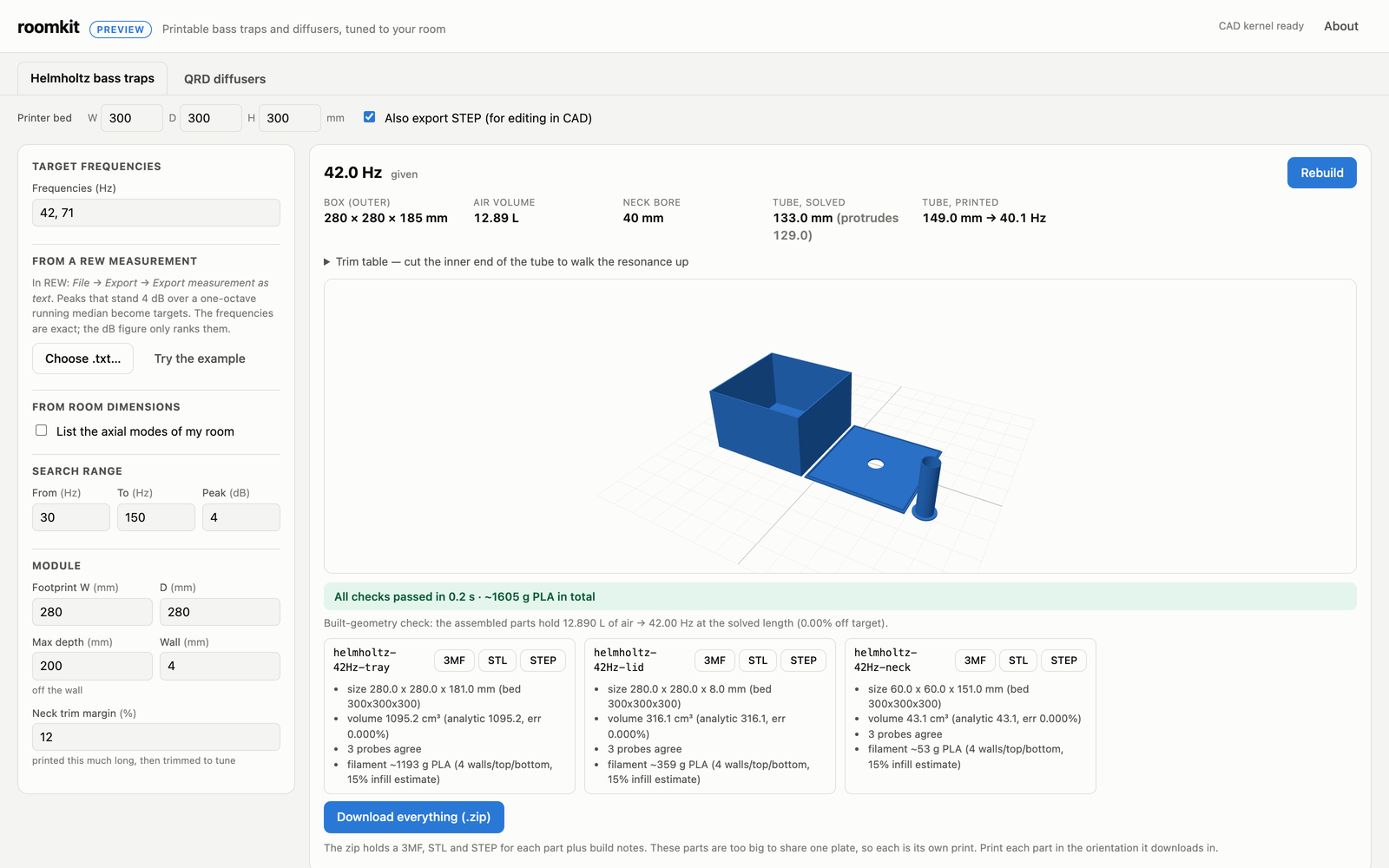
Give it a frequency, a REW measurement exported as text, or the room's dimensions, and it solves a trap for each target. It picks the widest neck that reaches the note within the depth you allow off the wall, because a wide neck in a big box couples to the room far better than a pinhole in a flat box tuned to the same note. Each trap is three prints (tray, lid and push-in neck), and the neck comes out long, with a trim table, so you can measure it and cut it back to walk the resonance up.
The other half is diffusers: quadratic-residue wells as 2D skyline tiles or 1D QRDs, solid or open-backed so you can fill them with plaster or sand. There are no printed porous absorbers, on purpose. FDM pores are 10 to 100 times wider than the air's viscous boundary layer, so a printed lattice is mostly transparent, which is a lot of filament to spend on not absorbing anything. Use mineral wool.
- Helmholtz traps tuned to a typed frequency, the peaks in a REW text export, or the room's axial modes
- The widest neck that reaches the note within the depth you allow off the wall
- Tray, lid and push-in neck, the neck printed long with a trim table for tuning after you measure
- 2D skyline and 1D quadratic-residue diffusers, solid or open-backed for plaster or sand
- Every part checked from the built solid: one valid solid, fits the bed, matches its analytic volume, probes agree, closed mesh
- Each trap reassembled and its air re-measured; more than 0.5% off target and it isn't offered
- 3MF, STL and optional STEP, built in the browser; nothing is uploaded
Where it stands
An early preview. The geometry is checked, and the port reproduces the original Python generator's numbers and its parts' volumes exactly, but the acoustics are textbook models (lumped Helmholtz with end corrections, Schroeder QRD) and none of the designs has been printed and measured yet. Measure yours before you trust it.