

One suite, three tools it grew out of
RF & wireless tools
Radio mic coordination that speaks every format.
Frequency coordination lives in three incompatible file formats and a spreadsheet somebody emailed round in 2019. Shure won't read Sennheiser's files, Sennheiser won't read Shure's, and Ofcom sends you a PDF.
RFutils is the answer to all of that in one browser app. The three standalone tools it grew out of are still here, still work, and are still the right choice if you only need the one job doing.
The suite
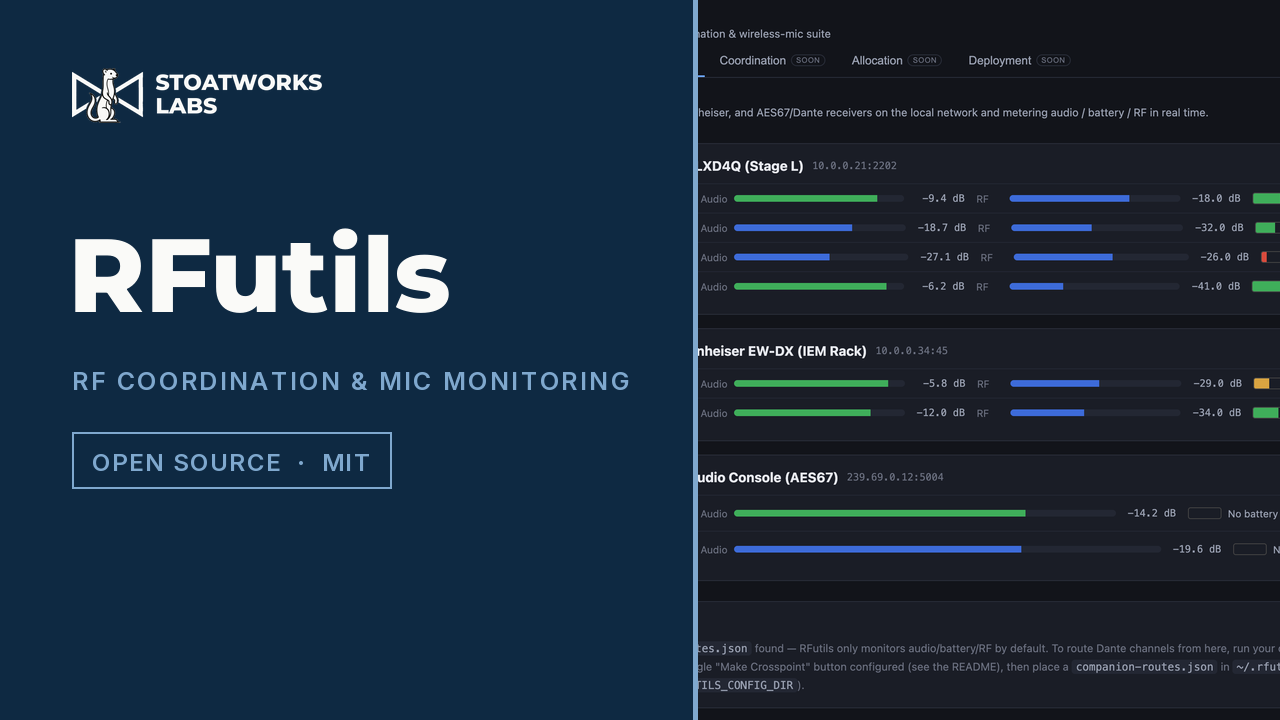
RFutils
Browser, or as a desktop app
Everything below, in one place, plus the parts that only make sense once the data is together: IM-aware coordination, inventory, allocation and deployment.
- Convert — WWB, WSM, plain CSV and Ofcom PMSE licence PDFs, in and out
- Monitor — live Shure and Sennheiser receivers with AES67 metering and headphone cue
- Coordinate — intermodulation-aware frequency planning
- Inventory, allocate and deploy across a whole show
Merged in
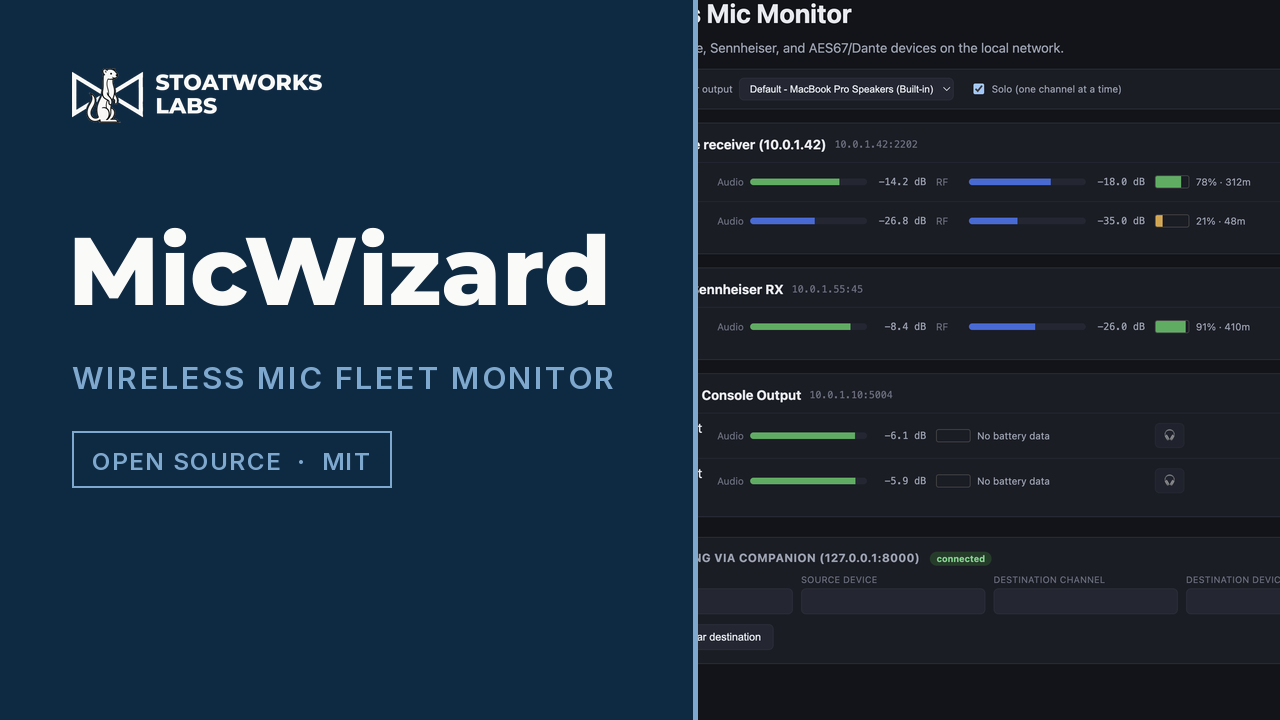
MicWizard
Now RFutils' Monitor tab
Discovers networked Shure, Sennheiser and AES67 receivers and monitors audio, battery and RF. Still ships as a standalone Electron app with local headphone and Bluetooth cue, and optional Companion-driven Dante routing.
Merged in
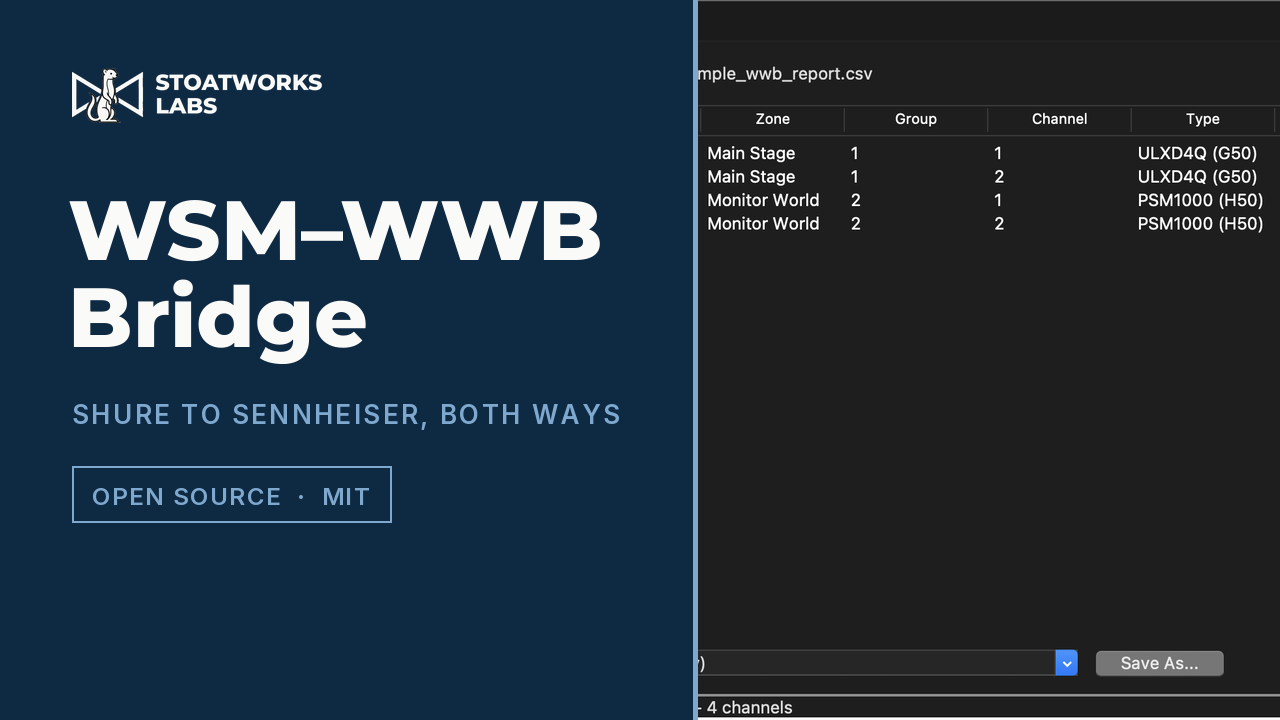
WSM–WWB Bridge
Now RFutils' Convert › Coordination files
Moves coordination data between Shure Wireless Workbench and Sennheiser Wireless Systems Manager, reading and writing both native formats plus a generic CSV column mapper. A Python desktop tool — useful when a browser isn't the right shape.
Merged in
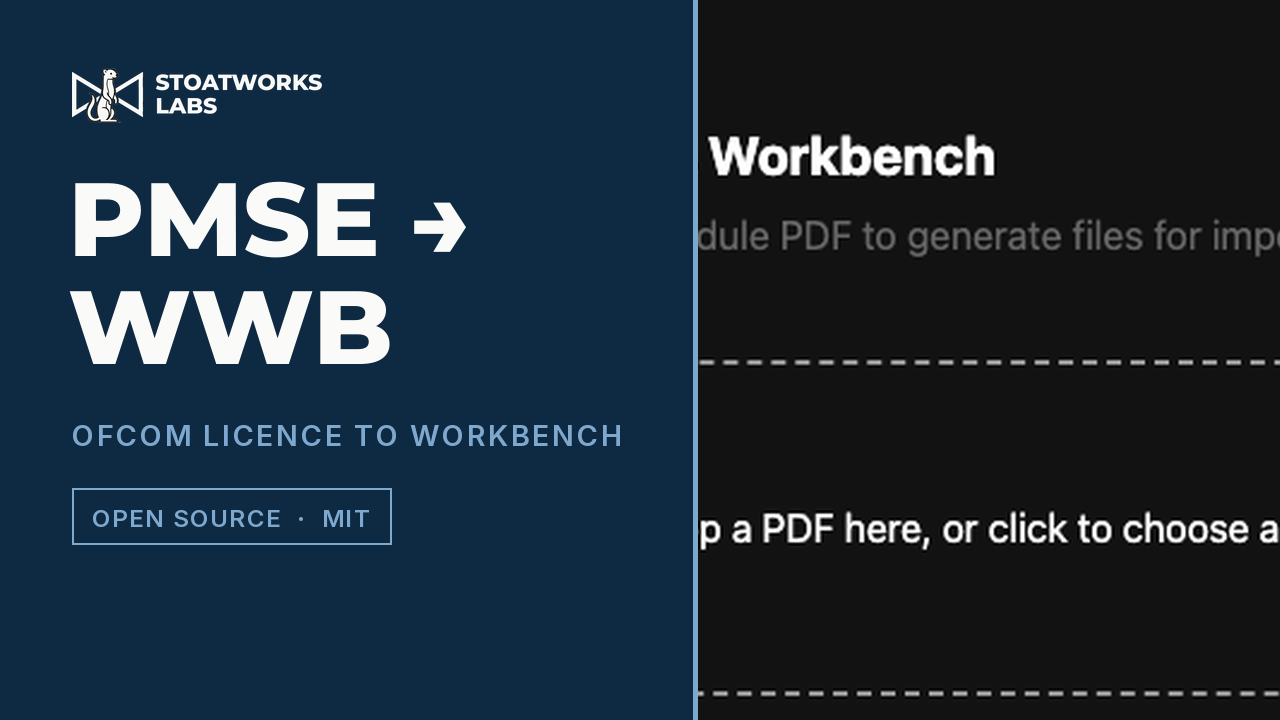
PMSE → WWB
Now RFutils' Convert › Ofcom PMSE licence
Turns an Ofcom PMSE licence schedule PDF into Workbench import files. Validated against a real licence — all 116 assignments, frequencies, sites, periods and fees parse correctly.
Which one should you use?
RFutils, unless you have a reason not to. It is where the work is going, and the file parsers were re-implemented in TypeScript and checked byte-for-byte against the originals rather than rewritten from memory.
The standalone tools remain worth having when you want one job done without a browser — WSM–WWB Bridge is a native desktop app, MicWizard has local headphone cue and Companion-driven Dante routing that the browser can't do. If you're extending a parser, check which copy is canonical first; they are separate implementations of the same formats.
A standing warning
Almost none of this is built on published specification. Neither Shure nor Sennheiser document these formats fully, so they were reverse-engineered from real exports and real hardware. The Ofcom parser is calibrated to a fixed template and a materially different revision would need re-calibrating.
It works, and it has been checked against genuine files — but verify every export against your own WWB or WSM install before you rely on it for a show.
Everything else
There's more where this came from
This is one corner of it. The full index covers audio, video, RF, content management, show control and the networking underneath.