

RFutils
RF coordination and radio-mic monitoring
What it does
RFutils merged three earlier tools (the WSM/WWB bridge, the Ofcom PMSE converter and MicWizard, all archived now) into one package, with a single channel model underneath. Anything it can read it can write back out in any format it supports, and the same model feeds coordination, allocation and deployment.
The conversion and coordination half runs entirely in the browser and nothing gets uploaded. The parsers, the .shw generator and the coordination engine all run on your own machine, so a licence PDF never leaves the laptop. Monitor and Deployment need raw sockets a web page can't open (mDNS discovery, AES67 decode, programming frequencies over TCP), so those only exist in the local build.
- Reads and writes Shure WWB and Sennheiser WSM coordination files in every direction, through one channel model
- Turns an Ofcom PMSE licence PDF into a WWB frequency list, a reference CSV and an experimental native .shw
- IM-aware coordination computed live rather than looked up
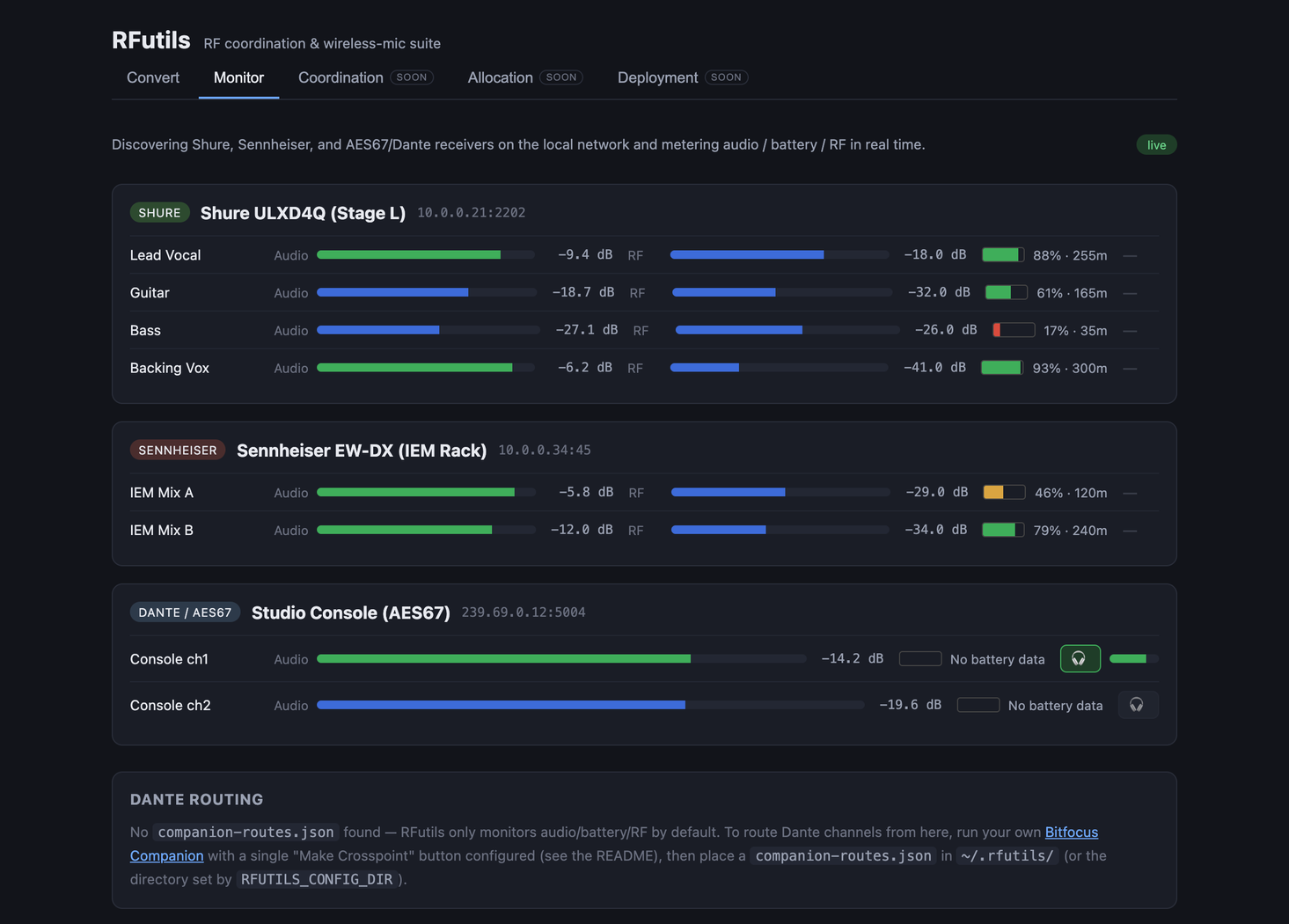
- Monitor: mDNS and Shure TCP discovery, AES67 metering, battery and RF status
- Local headphone cue, including analogue-only receivers patched through a USB interface
- Frequency programming back out to the devices
- Device support is one JSON plugin per product, so you can add a receiver or correct a built-in without touching the code
- Drivable from Bitfocus Companion
Where it stands
Released at v0.5.2, a security fix in a library underneath (multer 2.5.0) that RFutils never reached. v0.5.1 brought a security fix in the server (body-parser 2.4.0, where one malformed compressed request could crash it), and AKG WMS470 bands contributed by Johan Ehnberg, five of them checked on real units, though the WMS470 isn't marked verified yet. v0.5.0 folded in MicWizard and WSM–WWB Bridge, both now retired. Shure channel names with spaces no longer freeze a channel, Sennheiser receivers that mDNS finds now connect and are polled for metering (against a fake receiver so far, and which paths a real one answers is still a guess), the headphone cue gets an output picker, Solo/Mix and USB-input cue, diagnostics come from the UI, and conversion rounds and splits exactly as the bridge did (checked against its Python on 450,008 values). None of the Monitor changes has run on real receivers yet. v0.4.6 was maintenance: a security fix in the server (proxy-addr 2.0.8), a launcher that stops its server with SIGTERM before resorting to SIGKILL, and a hosted build that installs as an app and runs with no signal. v0.4.5 has the desktop app say why a start failed instead of appearing to do nothing. v0.4.4 fixed the packaged app: its server had crashed at startup since Express 5 (every release from v0.4.0), the Linux and Intel-Mac builds had an Apple Silicon Node runtime inside them, and the Convert tab became one drop zone that picks the parser itself. The file formats are reverse-engineered from real exports, not published schemas, because neither Shure nor Sennheiser documents most of them. The PMSE PDF parser has been tested against a real Ofcom licence, but the receivers in Monitor are the app's own mock devices, and no wireless rack has been plugged in. Check every export against your own WWB/WSM install before you rely on it for a show.
Watch it running
Nothing loads from YouTube until you press play.Watch it there instead