

What it does
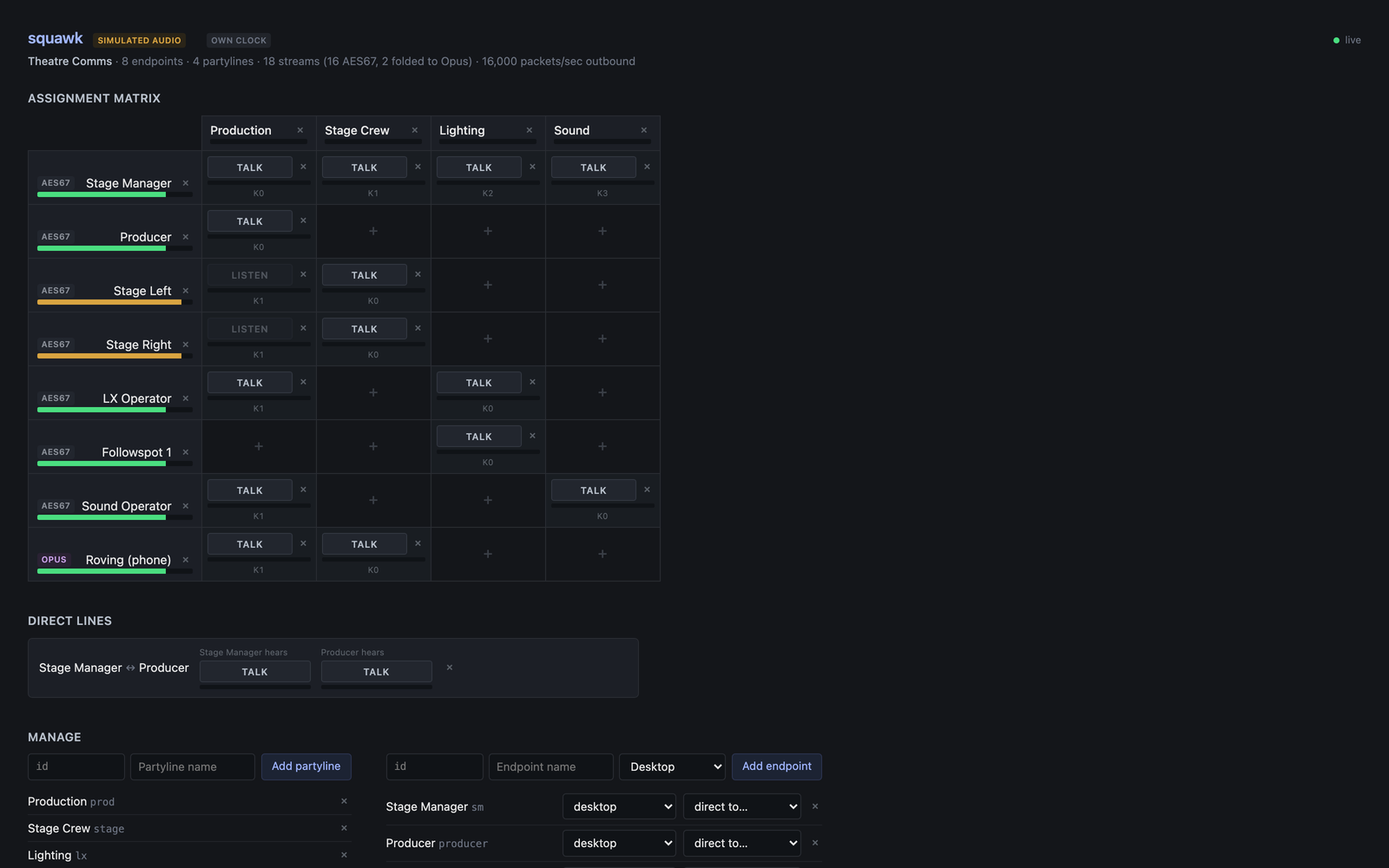
An open partyline intercom system — the software half of a Green-Go, Bolero or Clear-Com style comms rig. A server mixes; endpoints talk and listen.
Because each key arrives as a separate stream rather than a single pre-mixed feed, a panel changes its own key levels, mutes and ear placement instantly and locally, with no round trip to the server. That is the reason for the design: the thing an operator does most often should not depend on the network.
- Sample-exact mix-minus, asserted by behavioural tests rather than assumed
- Up to ten keys per endpoint, each its own AES67 stream
- Partyline buses and direct point-to-point paths on the same panel
- Local key control that does not round-trip to the server
- AES67 packets, SDP and jitter buffer built and tested over real UDP
Where it stands
In development. The transport is wired in: audio goes in and out of the running server over real AES67 multicast, with mix-minus sample-exact through the round trip, and PTP drives the media clock — RTP timestamps are PTP time, locking in about 0.6 s to ±40 µs. All of it has only ever run over the loopback interface, against a grandmaster this project wrote itself. SAP discovery, the desktop client and any hardware endpoint are not started, and nothing here has met a real switch, another vendor's device, a real grandmaster or a microphone.