

Jackpot is a casino floor for Resolume Arena and Avenue, as two FFGL plugins: SW Jackpot, a source, and SW Jackpot Over, which does the same over your clip. It has a one-armed bandit, a roulette wheel, the money wheel, a craps table and the lottery drum, and when you press Play the game plays out with proper physics and comes to rest on a random result, or the one you set, at exactly the Spin Time you set or on the next beat or bar.
Chips and coins come showering down on a win, and since you get to pick the result, it’s the one casino where the house does as it’s told.
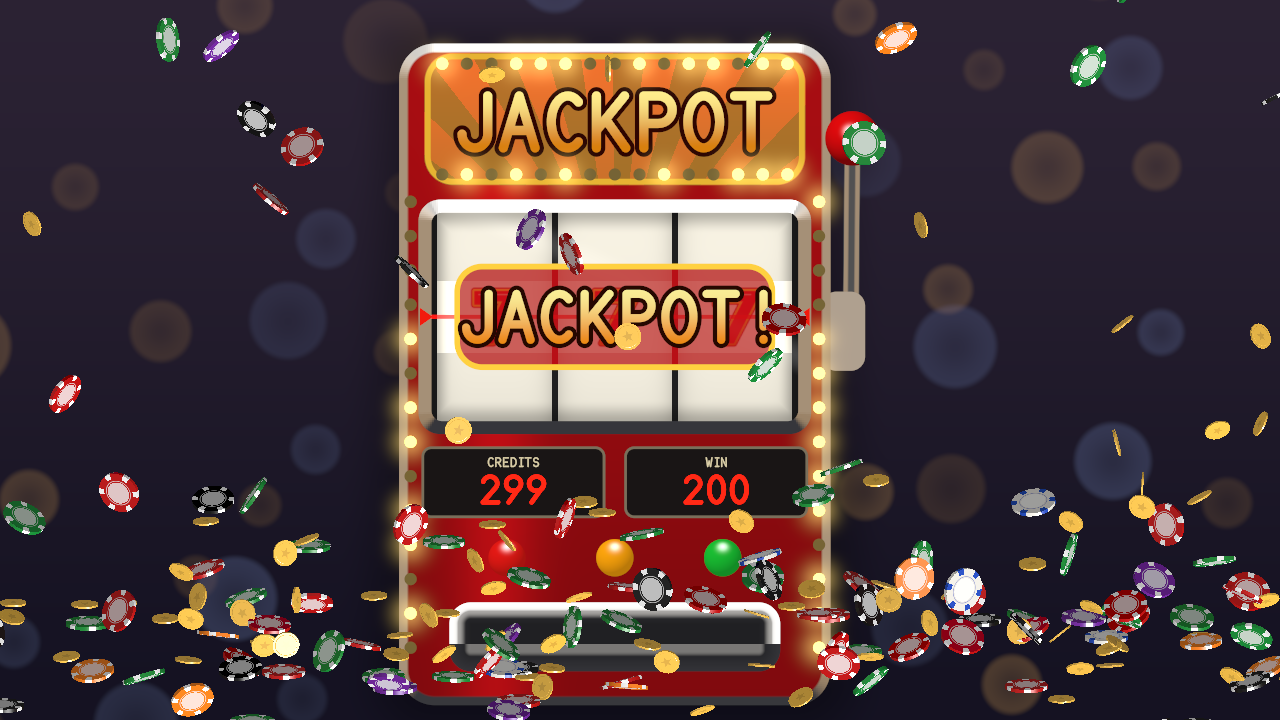
Three sevens on the line, the banner, the meters counting the win in, and the shower a jackpot sets off. Rendered by the plugin’s offline harness rather than captured from Resolume.
Before you rely on this: released at v0.2.0, and still early days. It’s been loaded into Resolume Arena 7.27.1 on a Mac and played there: a slot jackpot and a roulette spin, each landing as asked, with the shower. On Windows, both plugins load, register and render in Resolume Arena 7.27.1, with every control as declared, on a machine with software rendering and no GPU; the money wheel was played there (below), no other game. Everything else is measured by a harness that drives the real plugin classes in a headless GL context. Every number of both roulette wheels, every value of the money wheel and every craps total was played, and each came to rest as asked; the harness then reads the result out of the rendered picture for the slot machine, the roulette wheel and the money wheel. Every game stops at exactly Spin Time. Thirty-seven models that are wrong on purpose are all detected, seventeen one-character changes to the shipped code are all caught, and all 50 controls across the two plugins measurably do something. v0.1.1’s shower fix was run in Resolume Arena 7.27.1 on Windows (software rendering, a build of the 0.1.1 code made with MSVC on the lab machine, 2026-10-12): with Shower Only on Always, chips showered, then coins, the chips were gone about 14 s after the switch, the shower kept falling, and the floor was clear 15 s after Shower Off. Play’s place at the top of the panel is measured by the harness only. Try it on a spare layer before you put it in a show.
Wheel files (Segments, Wheel File, Lines and Short File on the money wheel) are new in v0.2.0. They’re measured by the harness, and the fleet’s gate passed 19 of 19 with them in Resolume Arena 7.27.1 on Windows. There (software rendering, an MSVC build of this code on the lab machine, 2026-10-15) wheel files loaded from a folder named
räder ✓ 🎰, and as Notepad saves them in UTF-8 with a BOM, “Unicode” (UTF-16) and ANSI; the emoji showed as the reel art; a PNG renamed to .txt left the Big Six, and the log said why; a file edited and chosen again was read again; a Jackpot spin landed on the*segment with its board and shower, Fixed Number 3 on the file’s line 3, and Segments changed mid-spin left that spin’s result up before painting the new wheel. Not yet on a Mac. With no file and Segments at 54 the wheel draws what v0.1.1 drew, to the byte.This codebase was created with AI assistance, directed and reviewed by a human author.
Installing
Every download has both plugins in it, the source and the effect. On macOS they’re
Jackpot.bundle and Jackpot Over.bundle; on Windows, Jackpot.dll and Jackpot Over.dll. Put
both into Resolume’s effects folder and restart Resolume:
macOS    ~/Documents/Resolume Arena/Extra Effects/
Windows  %USERPROFILE%\Documents\Resolume Arena\Extra Effects\
Avenue uses the same layout under its own folder name. SW Jackpot then turns up among the sources and SW Jackpot Over among the effects.
The macOS download is a universal build (Apple silicon and Intel), as a .dmg or a .zip. It’s
Developer ID-signed and notarised, so the bundles just load. The Windows download is an x64
installer or a .zip. It isn’t code-signed, so the installer trips SmartScreen once: More
info → Run anyway.
Two plugins
- SW Jackpot (a source) draws the game on its own. With Backdrop on Dark (the default) it stands in a dark room with the casino’s lights out of focus behind it; Felt puts it on a green table; None draws nothing behind the game, so it goes over whatever’s underneath.
- SW Jackpot Over (an effect) draws it over the clip it’s on. Its Symbols list has one more entry, Clip, which puts the clip itself on the slot machine’s reels where the seven would be.
The effect declares every one of the source’s controls and adds Mix at the end, after About, so a look built on one carries across to the other.
How a result is chosen
Every casino game is decided before you see it, and every one has something the physics can’t tell apart. A roulette rotor’s thirty-seven pockets are identical, the money wheel’s fifty-four pegs are identical, a die looks the same from every face, and lottery balls are all alike. Jackpot uses that. When you press Play it plays the game honestly, ahead of time (the ball on the track, the wheel against its clapper, the dice off the back wall, the balls in the air) until it comes to rest. It reads where it came to rest, and then turns the paint: the numbered ring, the painted segments, the die’s faces, which number is printed on which ball, so that what you see there is the result you chose.
Every bounce, every tick of the clapper and every ball you watch is the physics’ own. Only which number is painted where has moved, and you never see it move: on the roulette wheel the croupier’s spin of the rotor before the ball goes in takes the ring round, on the money wheel it happens in the pull before it’s let go, and the lottery’s drum is empty between draws, so the new balls drop in already numbered.
The slot machine doesn’t need any of that. Since the 1980s a slot’s result has been decided by its random number generator the moment the handle goes down, and the reels have just been a display. The plugin does the same and drives the reels to the stops.
So a chosen result looks every bit as random as a Random one, and a Random result is drawn by the plugin, weighted the way the real game is, rather than left to however the physics happened to go.
Start here
- Put SW Jackpot on a layer. You’ll see a red fruit machine in a dark room.
- Press Play (map it to a key, a MIDI note or a Stream Deck button). The handle goes down, the reels spin and stop one after another, and the last one stops at Spin Time, 4 seconds later. A win lights the banner, counts the credits in and showers chips.
- Choose a Game: Slots, Roulette, Money Wheel, Craps, Lottery, or Shower Only.
- For a chosen outcome, set Result (Win, Jackpot, Near Miss, Lose or Fixed) and, where it applies, Fixed Number. Press Play and the game lands on it.
- Set Land On to Beat or Bar to have every play come to rest on the beat.
On roulette, the money wheel, craps and the lottery the play starts a frame or two after the press, because the game is worked out on another thread first (about 1 ms for craps, 13 for roulette, 47 for the lottery with 49 balls and 55 for the money wheel, 82 at worst).
Game, Play and the Game group
Game and Play sit at the top of the panel, outside every group, so Play’s there to press with all the groups closed. The Game group under them holds the rest, from Spin Time to Interval.
- Game: Slots, Roulette, Money Wheel, Craps, Lottery, Shower Only. Changing it lays the new game out at once, at rest.
- Play: the button. A press while a game is still playing starts another from where it is. On Shower Only, Play is a burst of chips.
- Spin Time: 1 to 20 seconds from Play to rest, default 4. See Spin Time below.
- Land On: Time (exactly Spin Time), Beat or Bar, meaning the first beat or bar of Resolume’s tempo at least Spin Time away.
- Result: Random, Win, Jackpot, Near Miss, Lose, Fixed. Each game reads them against the bet, which is Fixed Number:
| Slots | Roulette | Money wheel | Craps | Lottery | |
|---|---|---|---|---|---|
| Random | weighted as the strip | each pocket alike | each segment alike | each die alike | each ball alike |
| Win | any paying line but the jackpot | the bet’s number | the bet’s value | a winning roll | the bet drawn |
| Jackpot | sevens across | the bet’s number | joker or logo | 11 on the come-out; the point made (the hard way on 4, 6, 8, 10) | the bet drawn last |
| Near Miss | two sevens, the third beside the line | a pocket beside the bet | beside the joker or logo | 6 or 8 on the come-out; one off the point | the number beside the bet |
| Lose | nothing paid, no near miss | anything but the bet | anything but the bet or the top | craps, or seven-out | the bet not drawn |
| Fixed | Fixed Number is the symbol | the number (37 is 00) | the value | the total | the bet drawn first |
- Fixed Number: the bet, 0 to 99. On the slot machine it names a symbol: 0 blank, 1 cherry, 2 lemon, 3 orange, 4 plum, 5 bell, 6 melon, 7 bar, 8 double bar, 9 triple bar, 10 seven, 11 diamond. On the money wheel a value it doesn’t have goes to the nearest one (1, 2, 5, 10, 20; 40 is the joker, 45 the logo). On a money wheel from a file it’s a line of the file (see Wheel files).
- Seed: 0 to 9999. The same seed replays the same sequence of plays.
- Auto Play and Interval: plays by itself, every 2 to 120 seconds (default 10). Switching Auto Play on plays at once.
The slot machine
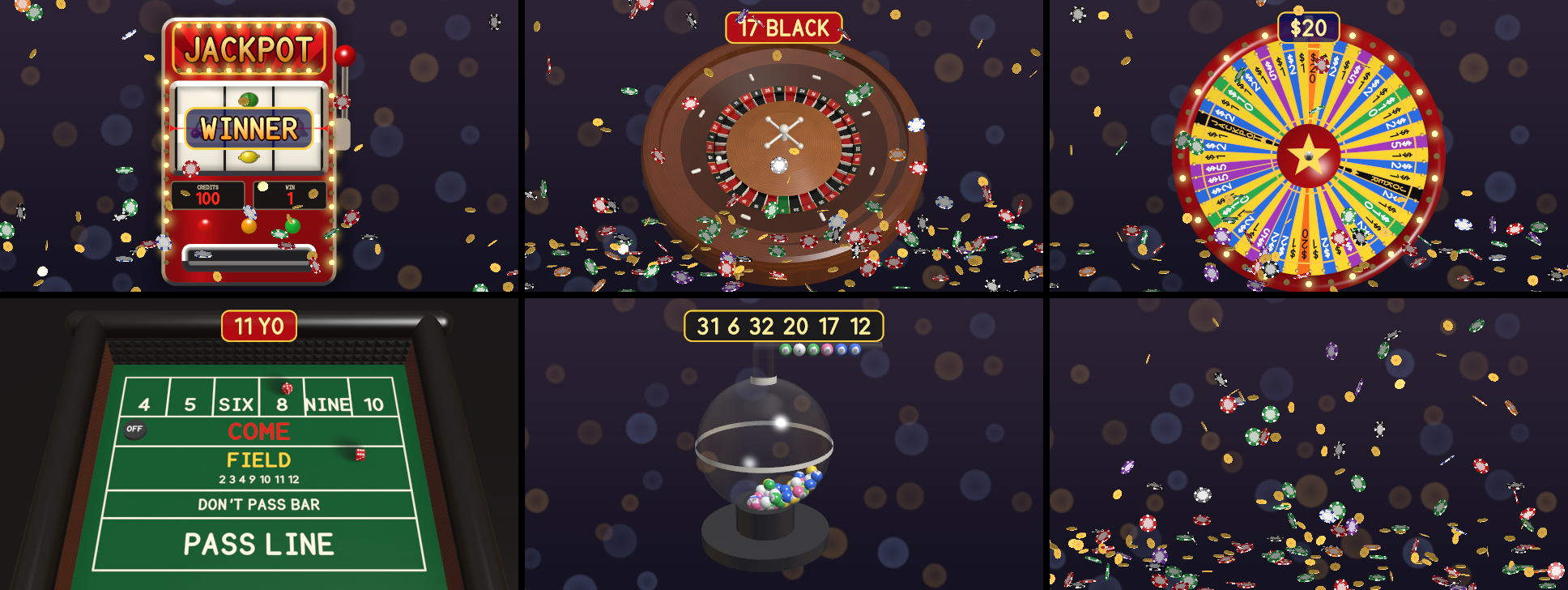
Every game at rest on its result, with the result board above it.
A three- or five-reel fruit machine with a handle, a marquee of chasing lamps, the credit and win meters and three buttons. Each reel carries 22 stops: eleven symbols with a blank between each pair, and a seven at stop 0.
- Reels: 3 or 5.
- Symbols: Fruit (cherries, lemon, orange, plum, bell, melon, bar, seven), Sevens and Bars (single, double and triple bars, cherry, diamond, seven), and on the effect Clip (the fruit, with the clip where the seven would be).
- Strip: Virtual or Physical; see below.
- Blur: the camera’s shutter, from a still frame (0) to the whole frame time (1, a 360° shutter). At speed the symbols smear into streaks and sharpen as the reel brakes.
- Reel Bounce: how lively the detent is when it catches a reel, from dead (0) to a few springy bounces (1).
It pays from the left: three or more of a symbol (seven 200, diamond 100, triple bar 60, double bar 40, bar 20, bell 18, melon 15, plum 14, orange 10, cherry 10, lemon 8, with four in a row paying four times that and five twenty times), any three bars mixed 10, a cherry on the first reel 2 and two cherries 5. A pull costs a credit, and the meter starts at 100.
The near miss is real. On the Virtual strip a Random pull draws each reel’s stop from 64 virtual stops mapped onto the 22 physical ones unevenly: the seven gets one, and each blank beside it gets six. So the seven goes sailing past just above or below the line twelve times for every time it lands on it (against twice on a fair strip), because that’s how slot machines have been built since Inge Telnaes’s patent in 1984. Physical makes every stop equally likely.
The roulette wheel
A wooden bowl, the ball track and its lip, the stator with eight diamond deflectors, the rotor with its numbered ring, its pockets and the frets between them, and the turret. The ball runs round the track against the lip until it’s too slow to stay up, spirals down the stator, can strike a diamond, rattles across the frets of the rotor turning the other way, and settles.
- Wheel: European (37 pockets, a single zero) or American (38, with 00), in their real order.
- Rotor Speed: how fast the croupier spins the rotor, up to about 38 turns a minute.
- Deflectors: the eight diamonds on the stator, on or off.
The croupier spins the rotor up before releasing the ball, and the ring turns on between plays. The result board shows the number and its colour once the ball’s at rest, and the winning pocket glows.
The money wheel
The Big Six: a big wheel of 54 segments (24 ones, 15 twos, 7 fives, 4 tens, 2 twenties, a joker and a logo), a brass peg between each pair, and a leather clapper at the top that the pegs push past. Each peg bends the leather and takes energy from the wheel, so it ticks slower and slower and may rock back off the last peg.
- Clapper: how stiff the leather is. Stiffer takes more from each peg and stops the wheel sooner, so the operator pulls it harder.
- Segments (new in v0.2.0): 2 to 54, default 54. With no wheel file, a smaller Big Six: the joker first, the logo opposite it from four segments up, and the money values between them in the Big Six’s order.
- Wheel File (new in v0.2.0): a
.txtof your own values. See below. - Lines (new in v0.2.0): In Order or Random (the default), for a file with more lines than segments.
- Short File (new in v0.2.0): Repeat (the default) or Fewer Segments, for a file with fewer lines than segments.
A wheel of fewer segments keeps about the Big Six’s 54 pegs, two or more to a segment (37 to 72 in all), so it ticks and slows as the big one does, and comes to rest on time the same way.
Wheel files
New in v0.2.0 (jackpot#1).
The money wheel can wear your own values. Write them in any text editor, one a line, save the file
as .txt, and choose it with Wheel File:
*JACKPOT
$5
🍒
FREE DRINK
%SPIN AGAIN
$10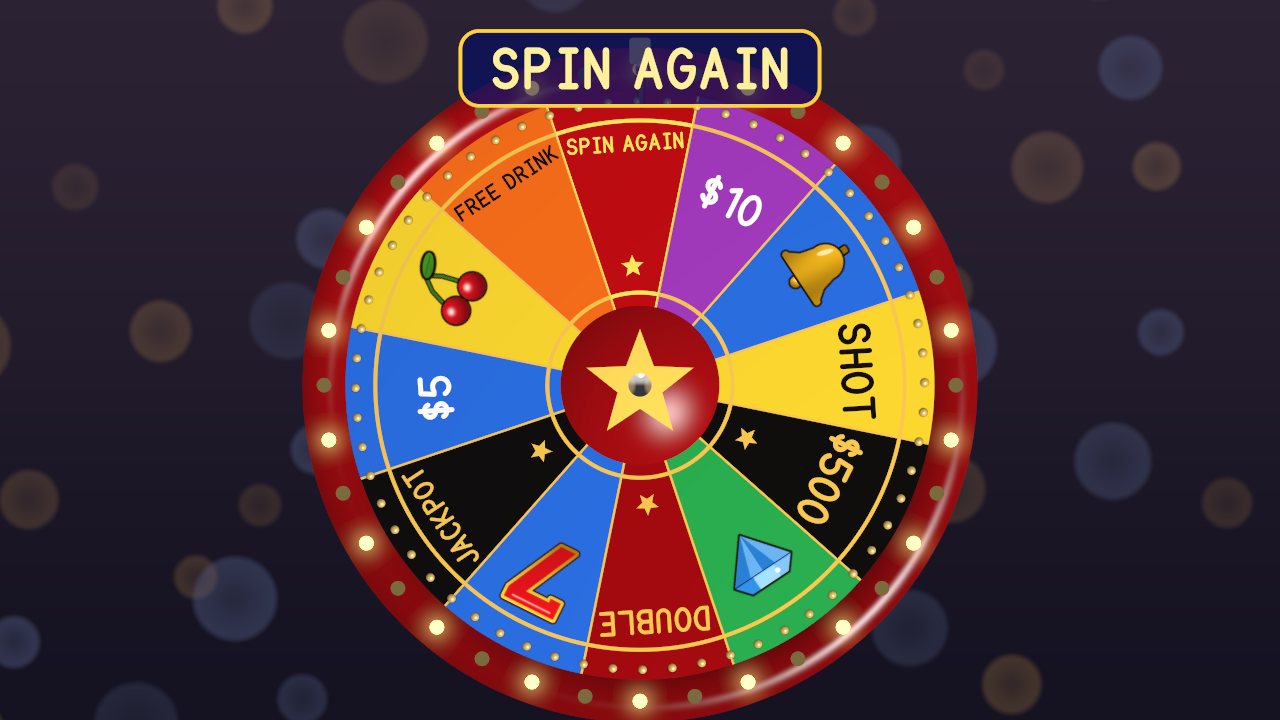
Twelve segments from a file, at rest on SPIN AGAIN. Rendered by the plugin’s offline harness.
How many, and which. Segments sets how many there are. With more lines than segments, Lines picks them: In Order takes the first ones, Random shuffles every line by Seed and takes as many as it needs. The shuffle changes only when you change the file, Seed, Segments, Lines or Short File, never between spins, so you can load a wheel and spin it all night. A bigger Segments adds lines to the draw rather than drawing again. With fewer lines than segments, Short File either repeats them round the wheel (Repeat) or makes the wheel that many segments, two at the least (Fewer Segments). The lines go round clockwise, so as the wheel turns they come past the clapper in order.
Changing it while it plays. Change the file, Segments, Lines, Short File or (on Random) Seed while the wheel is spinning and the spin finishes on the wheel it started with, showers and puts its result up as usual. The result stays on screen for 3.5 seconds after it lands, and then the new wheel goes on. With nothing showing, the new wheel goes on at once. Press Play at any point and the play spins the new wheel (pressed while a result is still up, the new wheel appears as the operator pulls it).
Markers. Start a line with * for the jackpot style (a black segment with a gold star) or %
for the joker style (a red segment with a gold star). The marker isn’t printed. Neither * nor %
is in the plugin’s type, so you can’t print a literal one at the start of a line or anywhere else.
What wins. Only the marked segments. A * is the jackpot: the result board goes red and On
Jackpot showers. A % is a win: the board goes blue and On Win showers. Anything else is a
loss, so a file with no markers never wins.
Results on a file’s wheel:
| Result | lands on |
|---|---|
| Random | any segment, each alike |
| Win | a marked segment (* or %) |
| Jackpot | a * segment |
| Near Miss | an unmarked segment beside a * |
| Lose | an unmarked segment |
| Fixed | the line numbered Fixed Number, counted as your editor counts them (blank lines too); one of its segments at random if Repeat put it there more than once |
If the wheel hasn’t got what you ask for (Jackpot with no * on it, or a Fixed line Random didn’t
draw) the play is Random, and the log says so. Fixed Number stops at 99, so a line after the 99th
can’t be asked for by number.
How it’s printed. The type shrinks to fit each segment. Up to 12 segments a label is set across its segment, level when it’s at the top; from 13 it’s stacked a character under another, as the Big Six’s values are. A label longer than its segment allows is cut:
| Segments | 2 | 3–4 | 5–8 | 9–12 | 13–40 | 41–54 |
|---|---|---|---|---|---|---|
| characters | 32 | 24 | 16 | 12 | 8 | 7 |
The result board shows the line in full, up to 32 characters.
Characters. The plugin’s type has capitals, digits and $'+-.:/!. Lowercase is printed in
capitals, accented letters lose their accents (Café is CAFE, Łódź is LODZ), curly quotes and dashes
become straight ones, an ellipsis becomes three dots, and anything else (%, &, ?, £, €,
commas, quotation marks) is left out. Runs of spaces become one.
Emoji. The slot machine’s own: 🍒 🍋 🍊 🔔 🍉 💎 and 7️⃣. Each, on a line on its own (a marker is fine), paints that reel symbol on the segment, and the result board says CHERRY, LEMON, ORANGE, BELL, MELON, DIAMOND or SEVEN. Inside text an emoji is left out like any other character the type hasn’t got (🍒 CHERRY PIE prints CHERRY PIE), and any other emoji on its own leaves its segment blank.
The file itself. UTF-8, with or without a BOM, is what any editor saves these days; UTF-16 with a BOM (Notepad’s “Unicode”) and old Windows-1252 (“ANSI”) files read too. Windows, Mac and old-Mac line endings all work, and blank lines are skipped. The first 1,000 values are used and the rest ignored; a file over 1 MB isn’t read. The file is read when you choose it: edit it, and choose it again to read it again (it’s only read again if its size or date has changed, so a host sending the same path over and over costs nothing).
When it won’t load. A file that’s missing, isn’t text, or has nothing in it leaves the Big Six on the wheel. The plugin’s log says why, and so does Resolume’s. A file whose values are all in a script the type hasn’t got (Cyrillic, Greek, Chinese) loads, but every segment is blank, and the log and Resolume say that too; when only some are, the log notes how many.
The craps table
The end of the table by the back wall: the layout (the point boxes 4, 5, SIX, 8, NINE, 10; COME; FIELD; DON’T PASS BAR; PASS LINE), the rubber pyramids on the back wall and the puck. The stick sweeps the last roll’s dice away, the shooter throws, and the dice hit the back wall and come to rest on the layout.
- Pyramids: the back wall’s rubber pyramids, on or off.
- Puck: the ON/OFF puck, shown or not.
The table keeps its point from roll to roll: a come-out 7 or 11 wins, 2, 3 or 12 is craps, and anything else is the point and the puck goes ON; after that the point again wins and a 7 is a seven-out. Result reads against the point the table is on.
The lottery drum
A glass drum of numbered balls in the UK lotto’s colours, a jet of air up the middle that carries them to the top where they fall back down the glass, a tube at the top and a rack. The old balls drain out of the bottom, the new ones drop in, the air comes on, and the tube takes one ball at a time up to the rack.
- Balls: 10 to 75 in the drum (default 49).
- Draw: 1 to 7 balls drawn (default 6).
- Air: how hard the blower blows.
It takes about two seconds just to load 49 balls, so a draw shorter than about six seconds plays fast.
The shower
Chips and coins, each one a proper spinning disc: they tumble in the air, bounce, roll on their edges and, as they lean over, whirr faster and faster before they slap flat (Euler’s disk), then land in a pile along the foot of the frame.
- Shower: Off, On Win (the default), On Jackpot, or Always.
- Shower Now: a burst, whatever the game is doing.
- Pattern: Rain across the frame, a Fountain from the bottom, a Burst from the middle, or a Pour from one place.
- Pieces: Chips, Coins or Mixed.
- Amount: how many fall each second, up to about 400.
- Piece Size: a chip’s width as a share of the frame’s height, 2% to 20%.
- Pile: on, the pieces settle into a pile; off, they fall out of the frame, and the pile there fades away in half a second.
The pile clears itself. Every piece fades twelve seconds after it was thrown (about ten seconds lying in the pile), oldest first, so a win’s pile is gone about fifteen seconds after the shower began, and a run of wins keeps one pile that renews itself. A heavy or constant shower fills the plugin’s 900 pieces quickly, and then the oldest go early, in a fifth of a second, so the shower never stops for want of room. A piece that rolls off the table, at the sides, the front or the back, is gone. Changing Pieces doesn’t sweep the table: the old kind fades out with its age, within about twelve seconds. The twelve seconds are fixed, not a control.
Shower Only as the Game is the shower on its own, and Play is a burst.
The Look group
- Backdrop: None (nothing behind the game: transparent on the source, the clip on the effect), Felt (a green table) or Dark (a dark room with the casino’s lights out of focus).
- Felt Colour: the table’s cloth, on the felt and on the craps layout.
- Accent Colour: the slot machine’s cabinet and the money wheel’s rim.
- Lights: the lamps, meaning the marquee’s chase, the money wheel’s rim and the glow on a winner.
- Display: the slot machine’s banner and the other games’ result board, on or off.
- Font, Font File, Font Name: the type on the meters, the banner, the layout and the numbers: Built-in (the same on every machine), any installed font, or a font file. Fonts travel by name: the list’s position means a different font on another computer, so the family is kept in Font Name, and when a composition restores both, the name wins.
- Light Angle: where the key light comes from, round the scene (roulette, craps, the lottery and the shower).
- Tilt: how high the camera looks from, 20 degrees to straight down (roulette, craps and the lottery; the lottery is always seen 35 degrees lower, from in front).
- Zoom: closer or wider.
SW Jackpot Over
Everything above, over the clip. Mix fades between the clip alone (0) and the clip with the game (1). Where the game draws nothing the clip comes through untouched, alpha and all.
Symbols: Clip puts the clip on the slot machine’s reels in place of the seven, so a jackpot is three of your clip.
Spin Time
Every game comes to rest at exactly Spin Time (or on the beat or bar it was sized for). Each game first aims its own natural length at it (the ball’s speed, the pull on the money wheel) and then plays what it simulated a little faster or slower so it stops on time, easing in slow motion.
- Slots always runs at real speed: the reels are driven to stop at Spin Time.
- Roulette and the money wheel are thrown to take about Spin Time on their own.
- Craps never throws harder to fill time. Dice thrown down a table settle in under a second however hard they’re thrown, so a long Spin Time is the shooter holding the dice a moment after the sweep and at most a gentle slow motion.
- The lottery needs time to load and mix, so a short draw plays fast.
Time comes from the host
The games move on the host’s clock, so a paused composition freezes a play. A step backwards in the host’s clock, or a jump forward of more than a quarter of a second (a clip trigger or a scrub), passes no time, and the play carries on from where it was. For the first few frames after it loads, the plugin runs on its own steady clock while it works out whether the host counts time in seconds or milliseconds.
Performance
Measured by the offline harness on an Apple M4 Max, mid-play, the median frame, on a machine shared with other builds:
| 720p | 1080p | 4K | |
|---|---|---|---|
| slots | 0.5 ms | 0.8 ms | 1.7–1.8 ms |
| roulette | 2.0–2.2 ms | 4.1–4.2 ms | 5.3–5.4 ms |
| money wheel | 0.3 ms | 0.7 ms | 1.4 ms |
| craps | 1.2–1.3 ms | 2.2–2.3 ms | 2.5–2.6 ms |
| lottery, 49 balls | 0.6–0.7 ms | 1.2–1.5 ms | 3.4 ms |
| a constant shower | 1.0 ms | 1.2 ms | 2.3 ms |
| money wheel, 54 from a file | 0.4–0.9 ms | 0.5–0.7 ms | 1.4 ms |
Up to 1080p every pixel of roulette, craps and the lottery takes four rays; above it only the pixels on an edge do. Nothing was timed inside Resolume.
If it looks wrong
Nothing happens when I press Play. On roulette, the money wheel, craps and the lottery the play starts a frame or two after the press, and comes to rest at Spin Time; at 20 seconds that’s a long spin. A paused composition freezes it.
I asked for Jackpot and got something else. Check the Result row actually reached the plugin: the log records every play’s result (below). Then check Fixed Number: on roulette Jackpot and Win are the bet’s number, and on the money wheel a value the wheel doesn’t have goes to the nearest one.
The lottery plays very fast. Spin Time is shorter than loading and mixing the balls takes. Give it six seconds or more.
The dice are in slow motion. Spin Time is longer than a throw. The plugin plays the throw up to a little slower and holds the dice before it, but no longer than that.
My font changed on another computer. The font isn’t installed there, so the text uses the built-in face, and Font Name still holds the name.
My wheel file didn’t take. The wheel shows the Big Six when the file is missing, isn’t text or is empty, and the log says which. If you’ve edited the file since, choose it again: it’s read when it’s chosen. A segment that comes out blank had nothing the type can print (an emoji that isn’t one of the seven, say).
The effect does nothing at all. A shader that won’t compile looks just like that. The actual message is in the log:
macOS    ~/Library/Logs/jackpot/jackpot.YYYY-MM-DD.log
Windows  %LOCALAPPDATA%\jackpot\logs\jackpot.YYYY-MM-DD.log
It records the GL vendor, renderer and version at load, a shader that failed, the font in use (and a named font that isn’t installed), a wheel file read or refused (and why), and every play: the game, its result, and how much it was slowed or sped up; on a file’s wheel, the line it landed on, and when nothing on the wheel fitted the Result.
What is verified, and what is assumed
In Resolume Arena 7.27.1 on a Mac (v0.1.0): both plugins load and register; SW Jackpot in a clip shows every control; a slot Jackpot and a roulette spin landed as asked, with the shower and the result board.
In Resolume Arena 7.27.1 on Windows (software rendering, no GPU): both plugins load and register, every control is as declared, both render with a font loaded from file, and Resolume’s log stays clean. Every control that can change the picture without a play was seen doing so (25 on SW Jackpot, 27 on SW Jackpot Over). No play was pressed there, so the games themselves haven’t run on Windows.
Measured, on an M4 Max under macOS, by the offline harness driving the real plugin classes: every reel at rest exactly on its stop, every Result honoured and the pay table as written above; the near miss twelve times a jackpot on the virtual reel and twice on the physical one; the reels’ blur the strip integrated over the shutter; the payline read out of the picture; every number of both roulette wheels at rest under the ball, and read out of the picture; turning the rotor by whole pockets leaving the ball’s path identical to the bit, and the ball leaving the track at the speed the physics of a banked track says; every money-wheel value under the clapper, and the clapper taking the energy; every craps total on the dice as drawn, and the pass line; the lottery’s rack showing the numbers drawn; the chips’ fall, tumble, bounce, pile and Euler’s whirr against the laws they should obey; the pile clearing within thirty seconds of the last shower, no piece left off the table, a constant shower at full Amount still throwing everything asked of it after a minute, and the table flat again once the pile has gone or Pile is switched off and on; Game and Play outside every group; Random fair by chi-square; every game stopping at Spin Time and on the beat; the clip untouched by the effect where it must be. Every check also runs against a model that’s wrong on purpose and must fail it, and a sweep fails if any control does nothing.
Wheel files (new in v0.2.0), measured by the same harness: what a file becomes, in every encoding above, and that a bad one falls back and says why; a path in Latin, Cyrillic and emoji read on the Mac, and turned into the UTF-16 a Windows open takes; In Order, Random and Short File, and the draw holding from spin to spin; every Result on wheels of 2 to 54 segments, at rest on the segment it asked for and read back out of the picture; only the marked segments winning; equal segments, and every label and symbol inside its own, from the pixels; and at the defaults, every frame of every game the same as v0.1.1’s to the byte. In Resolume Arena on Windows they did what the box at the top describes; not yet on a Mac.
Assumed, or not verified:
- Two plays in one Resolume on one Mac, and money-wheel spins on Windows. The Over effect, craps and the lottery, Land On against Resolume’s tempo, and a saved composition’s restore haven’t been tried in a host, and nor has any other play on Windows, or a GPU there.
- Play’s place at the top of the panel (v0.1.1) is measured only by the harness. That Resolume draws Game and Play outside the groups follows from how it groups parameters; I haven’t looked at it. The pile’s clearing was run in Resolume Arena 7.27.1 on Windows (software rendering, a build of the 0.1.1 code made with MSVC on the lab machine, 2026-10-12), with Shower Only, not after a game.
- The physics is my own, checked against the laws it should obey, not against film of real casino equipment. Every friction, bounce and stiffness is chosen to look right.
- The roulette frets are flush with the pockets’ rims, and the ball is a point carrying its radius.
- A piece that comes to rest within 16 degrees of flat is laid flat (by up to about eleven, in practice); a steeper one, leaning on a step of the pile, stays as it lies. The pile is a height field, not a stack of bodies: when a piece fades, those lying on it drop onto what’s under it.
- The same seed gives the same results everywhere, because they come from the plugin’s own random numbers or your bet. The motion itself may differ between a Mac and a Windows machine.
- The inspector shows slider positions, not seconds or degrees. This guide gives the ranges.
- No OpenFX version, no presets.
About
The last group in the source’s panel, About, has the plugin’s name, version, licence and maker, and buttons that open this guide, the project page, the source on GitHub and the support page in your browser. In the effect, Mix comes after it.
Links
- Project page: stoatworks-labs.com/software/jackpot
- Source: github.com/stoatworks-labs/jackpot
Reporting something
Open an issue at github.com/stoatworks-labs/jackpot/issues. A screenshot, the Game and Result, any controls you moved, whether it was the source or the effect, and the composition’s resolution and frame rate are usually enough to go on.