

Mynah is a lighting-desk command line for Analog Way LivePremier (Aquilon) switchers: you type what you want the switcher to do in one line, and press Enter.
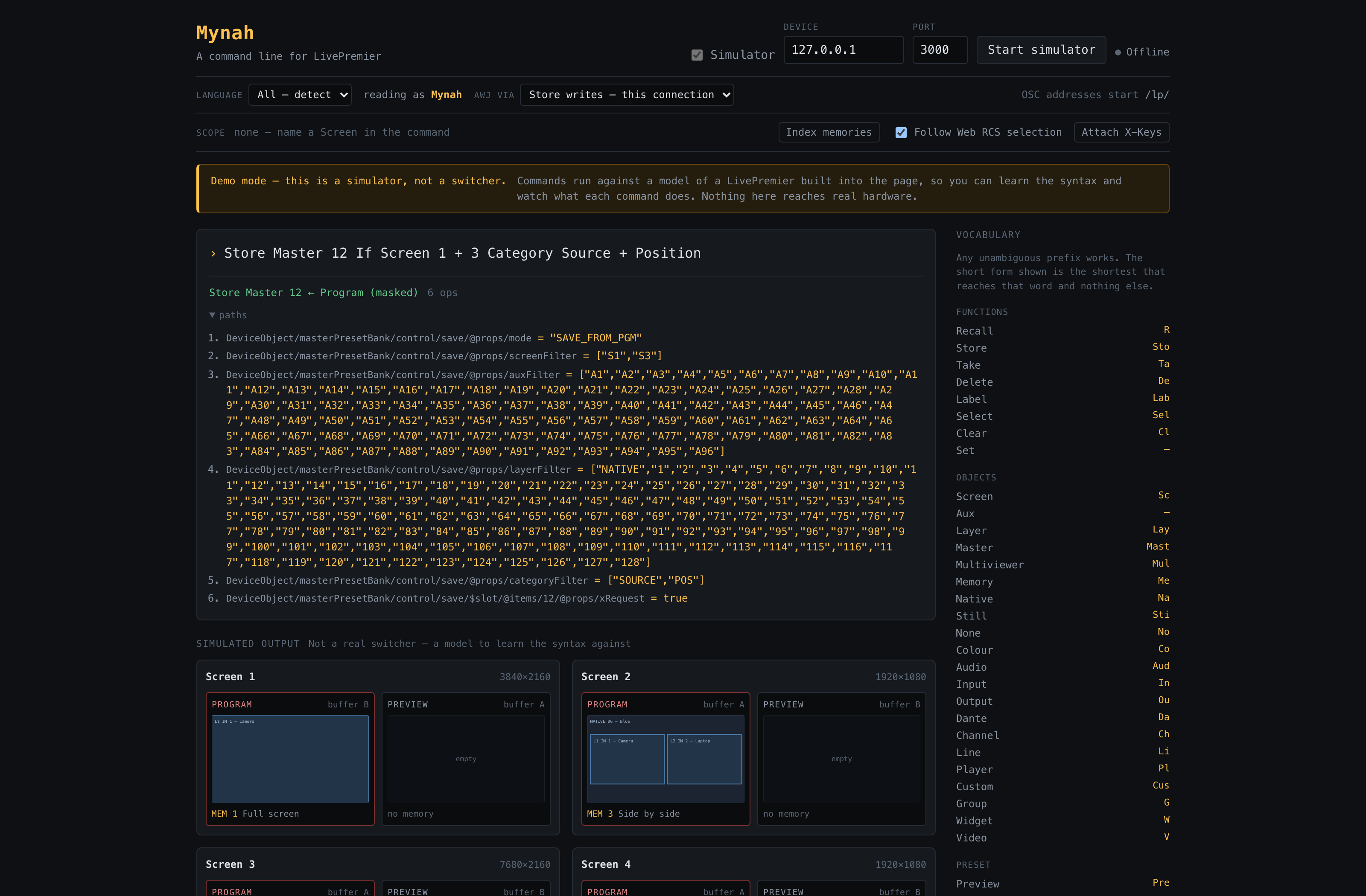
The hosted demo with a masked master store typed and compiled but not sent: one line becomes six ordered writes, the record mask narrowed to two screens and two categories, and every path is shown before anything would leave the browser. The simulator’s on and nothing here reaches real hardware, and the page says so.
Recall Screen 1 Memory 5
Store Master 12 If Screen 1 + 3 Category Source + Position
Recall Screen 1 Thru 4 Memory 7 Program
Take
The grammar rules are grandMA3’s: verb first, any unambiguous abbreviation,
Thru / + / - ranges, and an If clause that masks a store. The vocabulary is the
switcher’s own: Screen, Aux, Layer, Master, Memory, Preview, Program. Nothing here calls anything
a fixture or a cue.
A LivePremier has a lot of memories (1,000 screen, 500 master, 50 layer), and the vendor UI gets to them by pointing at things. Anyone who’s run a lighting desk knows the alternative: say what you want, in one line, without your eyes leaving the screen.
This guide is the operator’s overview. New to it? docs/GUIDE.md is the programming guide, with every command from one word upwards and worked examples you can paste into the simulator. The full grammar is in SYNTAX.md, and the device paths behind it, with the firmware they were verified on, are in PATHS.md.
Built with AI assistance, directed and reviewed by a human author.
Read this first: the hosted copy cannot drive a switcher
A LivePremier serves its web UI over plain http on port 80, with 443 closed. There’s no secure WebSocket to connect to, and browsers block an insecure socket from a secure page as mixed content.
| Where Mynah runs | Can it drive a switcher? |
|---|---|
localhost from a checkout |
yes |
| self-hosted over http on the show network | yes |
| the desktop app | yes |
| the hosted https:// copy | no — blocked before the socket leaves the browser |
Nobody can code around this. The hosted copy runs a simulator instead, and says so in a banner you can’t miss.
The desktop app is the simple answer. It runs on macOS, Windows and Linux, it’s about 5 MB, and it talks to the switcher directly with no browser sandbox in the way.
The two defaults that decide what reaches air
An unqualified Recall goes to Preview. An unqualified Store takes from Program, because
that’s the look you just made live, and the device’s own default agrees.
So getting to air always costs an explicit word: Program, or Take. A recall never reaches
program by accident.
An empty memory is reported as empty
The device accepts a recall of a slot that holds nothing, and then does nothing: no error, no response at all.
Mynah watches for that silence and says empty memory rather than done, because a green tick
on a command that changed nothing is worse than no feedback. If you see it, the slot’s empty and
the command wasn’t wrong.
What it drives
Memories: recall, store, delete, label, take, and scope.
| Bank | Slots | Scope |
|---|---|---|
| Screen | 1–1000 | Screen S1–S24, Aux A1–A96, × Preview/Program |
| Master | 1–500 | record mask: screens, auxes, layers, categories |
| Layer | 1–50 | Screen × Preview/Program × layer (Native, 1–128) |
| Multiviewer | 1–50 | output |
Live layer control: source, size, position and opacity, on any layer of any screen:
Set Screen 3 Layer 2 Source 1 Size 50% Position 33% 50%Percentages resolve against the screen’s real canvas, and position is the layer’s centre, because that’s the device’s own anchor.
Audio: Set Audio … takes the rest of the line. On LivePremier it’s the channel matrix:
Set Audio Patch Input 3 Channel 1 Thru 2 To Output 12 Channel 1
Set Audio Mute Output 3 Channel 1 Thru 4
Midra 4K and Alta 4K (QuickVu, Pulse, Eikos, QuickMatrix, Zenith 100/200) are the other platform the language core speaks, through apps that embed it (LivePremier Plus tells it which switcher it’s talking to). Screens are 1–4, auxes 1–4, layers 1–8, memories 1–200 (50 master), and audio is routed rather than patched: each screen preset carries an audio layer that takes with the preset.
Set Audio Patch Input 3 To Screen 1            the preview preset's audio layer
Set Audio Follow Layer 2 On Screen 1           the screen's audio follows live layer 2
Set Audio Follow Screen 2 On Line Output 1     a line out follows a screen
Set Audio Mute Output 1 Channel 3 Thru 4
This hosted web app and the Stream Deck plugin speak LivePremier only.
How it connects
A browser can’t open a raw TCP socket, so the documented control protocol on port 10606 is out of reach from a page. Mynah uses the Web RCS WebSocket instead, the same socket the vendor’s own UI speaks.
That beats a bridge in three ways: there’s nothing to install, there’s no five-client cap, and it pushes state without a subscription list to get wrong.
It also means Mynah sees what a human does in the vendor UI, and follows the Web RCS’s own screen selection, so selecting a screen in either place selects it in both.
The simulator is a rehearsal, not a demo
The hosted copy’s simulator is a model of a LivePremier built into the page: four screens with layers and three preset buffers each, the four memory banks, and a wireframe of what every screen is putting out.
It reproduces the device’s awkward behaviour on purpose, because those are the things worth meeting for the first time somewhere other than a show:
- a recall of an empty memory is answered with silence, and reported as an empty memory rather than as success;
- preview and program are names for whichever buffer is pending or live, the mapping differs per screen, and a Take swaps it.
That second one is the one that catches people on real hardware.
If something is wrong
| Symptom | Cause |
|---|---|
| The hosted copy will not connect to my switcher | It cannot, and no setting will change that. Use the desktop app or self-host over http. |
A command reported empty memory |
The slot is empty. The device answers silence; Mynah refuses to call that success. |
| Nothing reached air | An unqualified Recall goes to preview. Add Program, or send a Take. |
| A layer moved to the wrong place | Position is the layer’s centre, and percentages resolve against the screen’s canvas. |
| Preview and program seem swapped on one screen | They are per-screen names for buffers, and a Take swaps them. |