

What it does
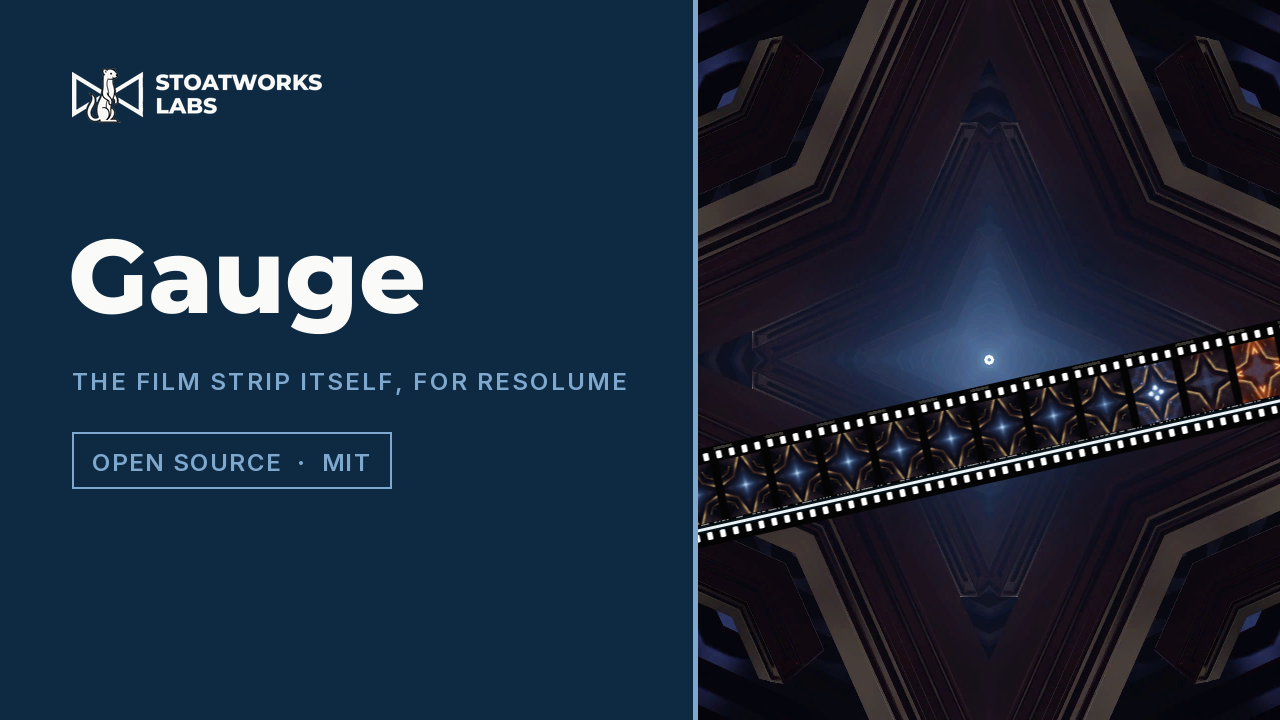
Two FFGL plugins for Resolume Arena and Avenue in one download: SW Gauge, an effect that prints your clip onto film, and SW Gauge Leader, a source that runs the countdown leader on the same film. There are eight formats: 35 mm Academy and Scope release prints, 35 mm full aperture, the 135 still roll, 16 mm, 16 mm sound, Super 16 and Super 8. Either plugin shows the frame in the gate filling the screen, or lays the film across the output as a strip at any size, angle and speed.
A film strip is a standard, so this one is built in film millimetres from the figures published, mostly in inches, by people who cared a great deal about thousandths of them, and a camera looks at it. 35 mm's KS holes are 2.794 mm across and 1.981 along, four to a frame. Academy's thick frame line and Scope's hairline are both what the camera aperture leaves of the frame pitch, and Super 8's comes to 0.014 mm. Scope's 2× squeeze prints a round face tall and thin, the leader included. Each frame is exposed once and keeps that picture, so a moving strip is a contact strip of the clip's recent past and the frame above the gate is the one before.
The sound prints carry their soundtracks. The variable-area analogue track wiggles with the music on the Audio input, drawn at the film's speed so a high note is a finer ripple than a low one, and a Scope print has DTS, Dolby Digital and SDDS as well, drawn as data with no logos. The countdown is after the SMPTE Universal Leader, PICTURE START to the 2 with its pop, with the picture eight seconds later, or eight beats later and on the bar at Rate Beat. A sync flash is one fully exposed frame, on a press, a beat or a bar. There's no grain or projector in it: rebate does the emulsion and gate does the projector, and Gauge sits in front of either.
- Eight formats from 35 mm Academy and Scope to Super 8, with the holes, frame lines and pictures at the published dimensions
- The anamorphic squeeze: the format's own, or 1.33×, 1.5× or 2× on anything, with Crop, Letterbox or Stretch to fit the clip
- Cell, one frame filling the output with Framing, Rack and a rolling frame line, or a Strip at any size, angle, position and speed, with shutter motion blur
- Held frames, so a moving strip keeps every picture it was exposed with
- An optical track driven by the Audio input, DTS, Dolby Digital and SDDS on Scope, and edge print with key numbers on three stocks
- The countdown leader and a one-frame sync flash, on a press, a beat or a bar, and a source that loops the leader on its own
- Universal macOS bundle and a Windows x64 DLL
Where it stands
v0.1.0, and early days. An offline harness driving the real plugin code on an Apple silicon Mac reads each claim back out of the picture: every format's holes, pictures and frame lines come back at the published dimensions, within 0.005 mm of a separate table of the standards' figures; a disc that's round as seen comes back half as wide as it's tall through Scope's 2× squeeze; every frame of a moving strip keeps the picture it came into view with; the countdown runs 209 frames without a wrong one to the picture at exactly eight seconds, and on the bar at Rate Beat; a flash is exactly one film frame; and a single tone on the Audio input draws the track at the film's speed. It catches ten models broken on purpose and a one-character sabotage of its own shader, and every control but the Audio input (50 across the two plugins) changes the picture. It costs 0.08 ms a frame at 720p and at most 0.42 ms at 4K on macOS. It hasn't been loaded into Resolume on macOS; the fleet's own test host loads both plugins and renders through them. On Windows, both plugins load, register and render in Arena 7.27.1 on software rendering (no GPU, no sound), every control is as declared, and they passed all 15 of the fleet's checks: all 24 of the effect's controls that can act without sound changed the picture there, and 17 to 20 of the leader's 22 across two runs, the rest too close to call on a countdown that never sits still. The DTS, Dolby Digital, SDDS and 16 mm track placements are by eye, Resolume's audio bins are assumed to be evenly spaced, and it's only been seen on a test card and Resolume's demo clips, never on footage. There's a user guide, but no presets, browser demo or OpenFX port yet. Try it in your own rig before you trust it in a show.