

Resolume Luma Keyer
A plain luma keyer, for Resolume
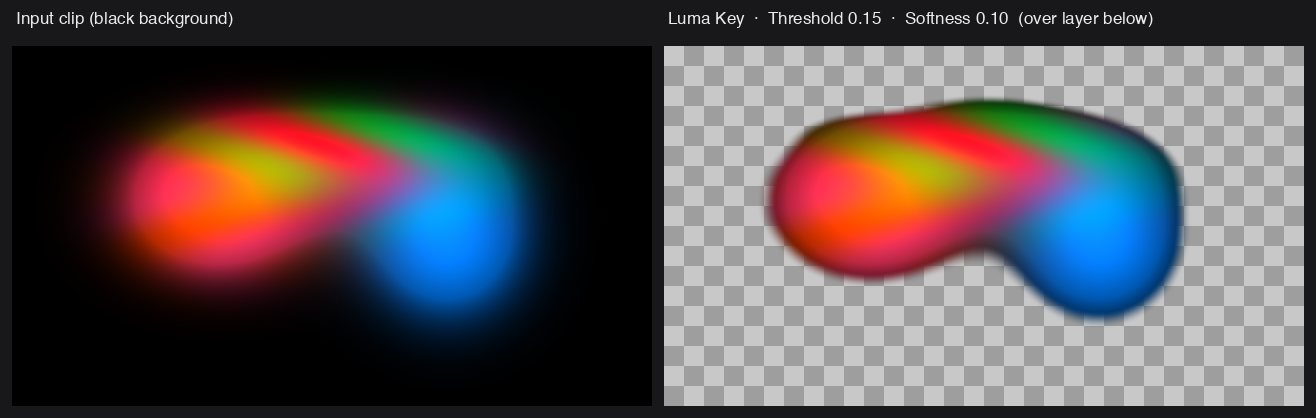
What it does
A luminance keyer effect for Resolume Arena and Avenue, built on the official Resolume FFGL SDK. It measures the perceptual Rec. 709 luminance of each pixel and drives that pixel's alpha from it, so the dark areas of a clip (or the bright ones) go transparent and let the layers below show through.
It's a quick way to key out a black background, composite content made for add blending, or pull a shadow or highlight matte, without needing a key colour.
Also available as an OpenFX plugin for DaVinci Resolve, Vegas Pro, Nuke and Natron: the same key, rendered on the CPU from the same maths as the GLSL, as its own download alongside the FFGL build.
The newest build is an After Effects plugin, which Premiere Pro loads too. It's the same key from the same repository, shipped per platform as its own download, and labelled beta until it's had the host time the other builds have had.
- Threshold — the luma level at the centre of the key edge; pixels darker than it are keyed out
- Softness — the width of the soft edge, from a hard cut to a gradual falloff
- Invert — remove bright pixels instead of dark ones
- Works on straight colour internally and outputs premultiplied, clamped to LDR, matching Resolume's pipeline
- Universal macOS bundle, a Windows DLL, and an OpenFX bundle for macOS, Windows and Linux
Where it stands
Released at v1.3.6. The three point releases since v1.3.3 changed nothing in the picture: v1.3.4 shipped a Windows installer that no longer touches the system PATH (the earlier one could overwrite it), v1.3.5 gives the effect a proper description in the field Resolume shows, and v1.3.6 reports its name as SW Luma Key, so the Stoatworks plugins sit together in Resolume's browser. The OpenFX build for Resolve, Vegas, Nuke and Natron and the After Effects and Premiere Pro build both arrived in v1.2.0, and v1.3.3 added a Linux OpenFX build, proven to load on Rocky 8 in CI. It needs Resolume Arena or Avenue 7.3.1 or newer. It's been run inside Resolume on real content. The before/after image is still rendered with the plugin's exact shader maths rather than captured from Resolume.