

What it does
An EDID is how a display tells a source what it is, and on a show it is usually somebody else's — read off a screen, a scaler or a splitter, and not quite what you want. Building your own is the fix, and the tools for it are either a hex editor or a driver utility that assumes a desktop monitor.
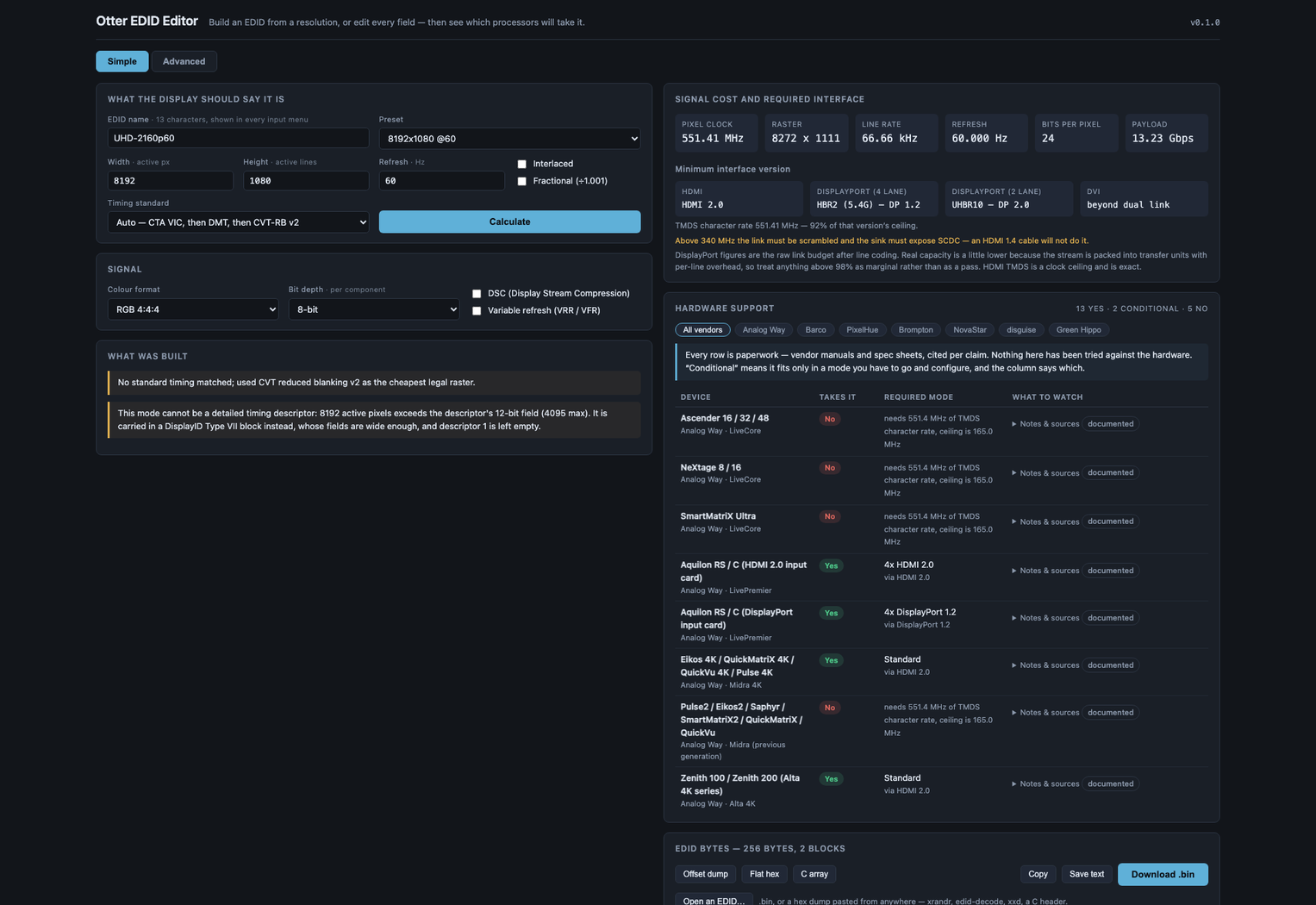
This one has two halves. Type a resolution, a refresh rate and a name, and get a complete, valid EDID 1.4 — the mode as a detailed timing, a range-limits descriptor sized to it, the name where every input menu will read it, and a CTA-861 extension carrying the standard video code when the mode has one. Or open the advanced side and edit every field there is, including the CTA-861 and DisplayID 2.0 extensions.
The half that is actually hard is the last one. Whether a given processor accepts a mode is rarely a straight yes or no: it depends on which input card is fitted, whether the input is configured single or dual link, whether 4K arrives on one cable or two, and what that setting costs you in inputs elsewhere. That question is answered per model, with the required mode named and the trade stated.
- Simple mode: a resolution and a rate in, a complete EDID out
- Advanced mode: every field, including CTA-861 and DisplayID 2.0
- The minimum HDMI, DisplayPort and DVI version the mode needs
- DSC and variable-refresh as toggles that change both the arithmetic and the EDID
- Twenty-one processor models checked, each carrying its sources
- Opens a .bin or a hex dump pasted from anywhere; a bad checksum is reported, not refused
Where it stands
Published as a beta, and hosted because there is nothing to install and nothing to upload — an EDID never leaves the tab. What is proven is the arithmetic: the timing generators reproduce published VESA values exactly, the DisplayID descriptor layout was checked byte for byte against a reference parser, and every EDID the tool builds survives a full encode-decode round trip. Eighty-two tests. What is not proven is the only thing that finally matters — no EDID this tool has produced has been fed to a real processor, and the compatibility table is vendor paperwork rather than bench results. Both caveats are on the page, not just in the repository.