

Negative Space
The gaps between the screens, as pixels
What it does
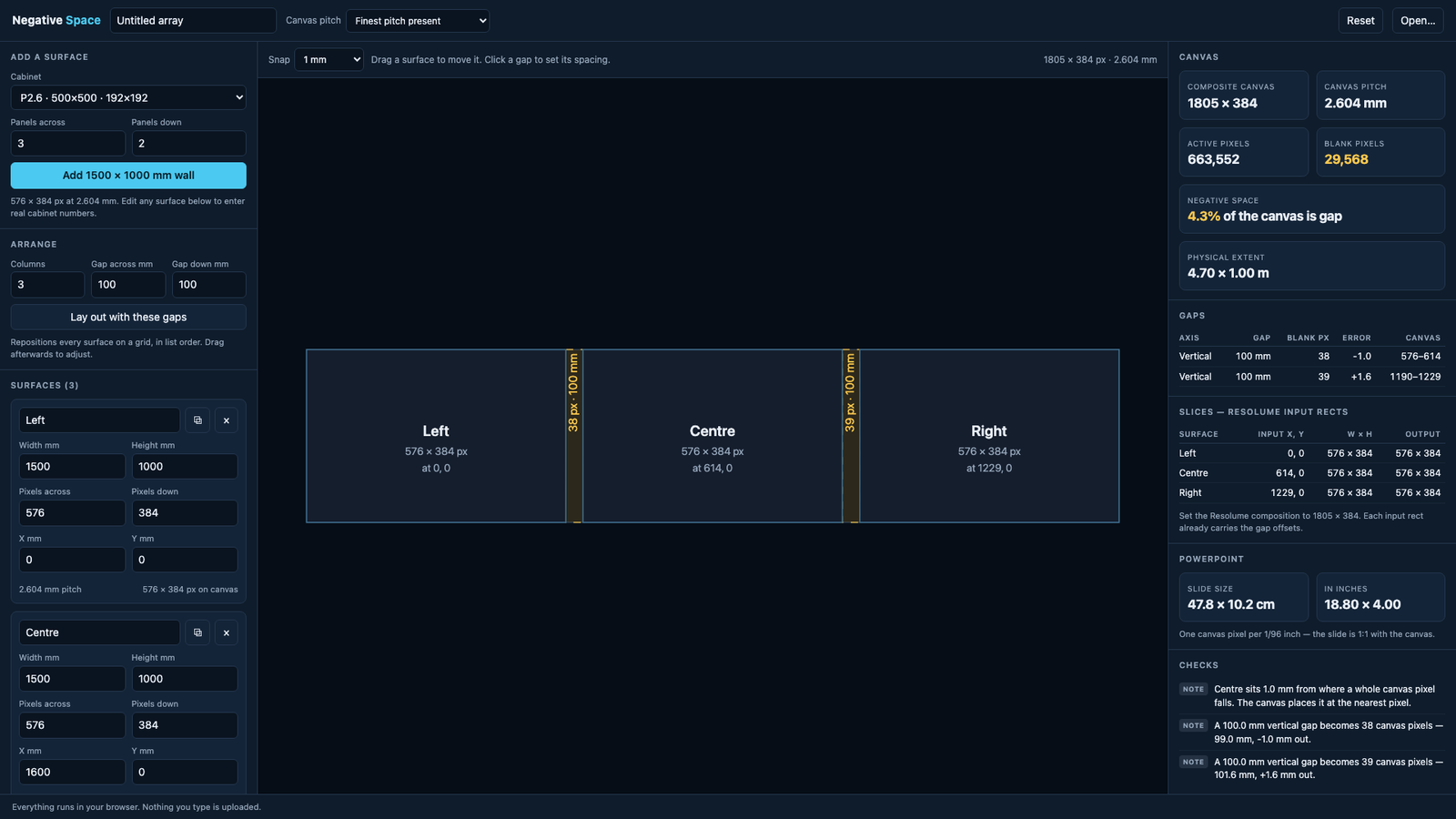
Three LED walls in a row, a hundred millimetres apart. Build the composition as the three rasters laid edge to edge and anything moving across the array jumps: it leaves the first wall and arrives on the second in the same frame, because the composition has no idea the gap is there. What you want instead is a canvas that includes the gaps as blank pixels, so the object crosses them at the speed it was really travelling and comes out the far side where the eye expects it.
Working that out by hand means dividing every physical gap by a pixel pitch that is almost never round — a cabinet sold as P2.6 is really 2.604166… mm — and then offsetting every slice by the running total. Do it for a dozen surfaces and the arithmetic is not hard so much as unforgiving, and a slice four pixels out is not obvious until the content is on the wall.
So this takes the layout instead. Add surfaces from the cabinet presets or type real numbers straight in, drag them around, and click any gap to set its spacing exactly. It reports the composite canvas, how much of it is dead, and what each gap costs in pixels — including how far the whole number of pixels sits from the real distance, which is a figure most people never see. Then it exports the tedious part: the Resolume screen setup with the offsets applied, a guide plate to design against, and a printable plan.
- Pixel pitch derived from physical size and resolution, so a P2.6 cabinet is treated as the 2.604166 mm it actually is
- Negative space found by merging the surfaces' projections on each axis — works on ragged layouts, not just tidy rows
- Mixed pitches handled: the canvas defaults to the finest present, so no surface is asked to show fewer pixels than it has
- Click a gap and type its spacing; everything beyond it slides
- Resolume Arena advanced output, both the AdvancedOutput.xml and preset forms
- A guide plate as SVG and PNG at exactly the canvas resolution, gaps hatched and dimensioned
- PowerPoint slide geometry, plus a starter .pptx with the surfaces and gaps drawn on it
- A vector PDF report with a scale plan of the canvas, for taking to site
- Checks for overlapping surfaces, non-square pixels, resampled surfaces and gaps too small to survive the pitch
- LivePremier pitch compensation — the H and V ratios an Analog Way switcher needs to drive surfaces of different pitches from one screen, on aquilon-pitch's own engine. It emits no positions: the gaps still have to be built by hand on the switcher
Where it stands
Published as a first version. The arithmetic is covered by eighty-one tests, including the pixel-conservation invariant and a Resolume schema conformance test built from shapes extracted mechanically from real Arena 7.27 files — which also proves it can catch an invented parameter, so it cannot pass vacuously. The PowerPoint file has been opened in real PowerPoint, and the PDF and guide artefacts were rasterised and looked at rather than merely parsed. What is not proven is the thing that finally matters: no generated Resolume file has been round-tripped through a running Arena, and no array has been driven from this tool. Load one, put a test pattern up, and check a slice against the wall before trusting a show to it.