

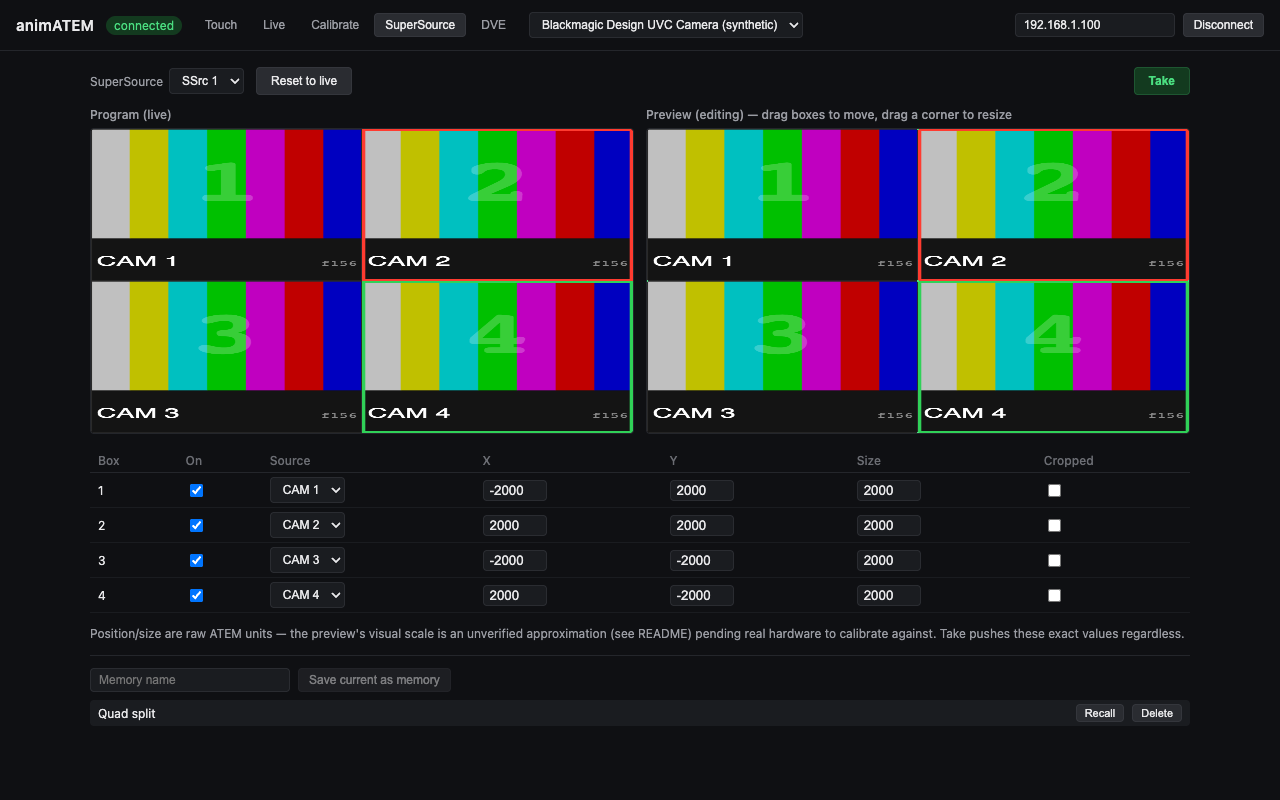
What it does
Network control for Blackmagic ATEM Mini Pro and Extreme ISO switchers with something the hardware does not offer: a software-composited preview of SuperSource and DVE box layouts, built from real live pixels.
Rather than synthesising a preview from scratch, animATEM captures the switcher's own multiview over USB — it enumerates as a UVC webcam — crops the individual source boxes out of that live feed and recomposites them into an arbitrary arrangement, so a layout can be checked before it goes to air.
- Standard PGM/PVW switching alongside the composited SuperSource and DVE preview
- Named memories — app-level layout presets, independent of the ATEM's own macro system
- Animated SuperSource moves: the protocol has no native SuperSource tweening, so the app eases into the target layout client-side as a stream of interpolated positions
- Touchscreen operator UI
- A Bitfocus Companion module in its own repo — cut, auto and FTB per M/E, program, preview and aux selection by input name, animated memory recall, and program/preview tally
Where it stands
Released at v0.2.1 — the macOS builds are signed and notarised, and the docs now say what has been run on hardware; nothing in the app changed since v0.2.0. It has been run against a real ATEM Mini Extreme ISO: the UVC multiview capture and the calibration screen were tested live, and the wrong assumption about multiview window numbering that broke every crop was found and fixed there. Two things that session did not settle: the coordinate scale behind the Preview panes' layout is still an uncalibrated placeholder, and the cut/auto/FTB/recall command path has only ever run in harnesses. It has never been used on a live show — the multiview boxes in the screenshots are a synthetic test-pattern feed standing in for a switcher's output, so the screenshots don't depend on hardware being connected. Everything else on screen is the real UI.