

Will My Show Fit?
The show you have, and the switchers that will take it
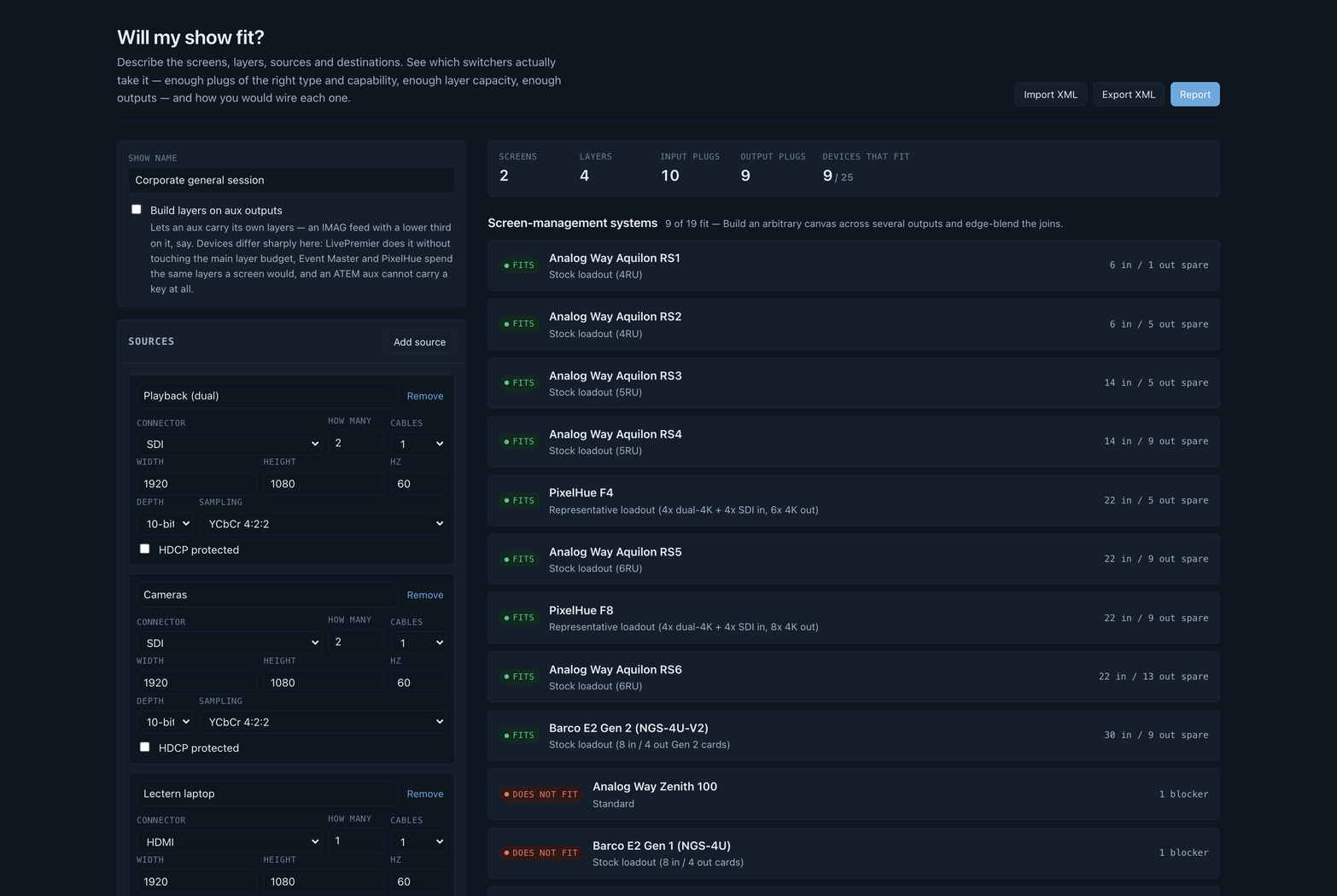
What it does
Speccing a show against a switcher is a question everyone answers from memory and experience, and the memory is usually right until the one time it is not. The trap is almost never the headline number. It is four cameras wanting the two SDI inputs; it is an output that looks like two plugs on the back panel and is really one signal on two connectors; it is a layer budget quoted in units that mean something different on the next machine along.
So this asks for the show rather than the shopping list. Screens with their real canvases, the layers on each and how big each layer has to be, every source with the connector it actually has on the back of it, every destination that needs feeding. From that it matches each signal to a specific plug — checking the format will physically travel down it — spends the layers against each machine's own published arithmetic, and gives a straight verdict with the reason attached.
Where a machine fits, it proposes the patch: which signal on which plug, where a passive adapter will do the job, and which connectors are left over. Where it does not, it says which thing ran out — and for the chassis built from swappable cards, whether a different set of them would have taken it, which is usually the question that actually matters when you are specifying a build. The whole configuration saves and loads as XML, and the answer prints as a report with the input list, the output list, the compatibility matrix and the topology on it.
- Plug fitting as a matching rather than a count — four SDI sources and two SDI plugs is a no
- Mirrored and either/or connectors counted as one output, not two
- Layer budgets in each manufacturer's own published units, including the machines that budget per output card
- Pixel rates that include blanking, so a plug's real ceiling is the one applied
- A global switch for building layers on aux outputs, which separates the machines that do it free from those that charge for it and those that cannot
- Presentation switchers and vision mixers compared side by side, in separate sections, because they answer different questions
- A suggested card loadout for the modular chassis when the stock one misses — the smallest set of cards that takes the show
- XML in and out; reports as a printable page or a standalone HTML file
- Every figure carries the document it was read from
- Installable on iOS and Android and fully usable offline after one visit, because the place you get handed a rig is the place with no signal
- Self-hostable as a container image, for a network that will not reach the web
Where it stands
Published as a beta. What is proven is the engine: seventy-three tests cover the timing arithmetic against published VESA and CTA figures, the connector matching including the cases a straight count gets wrong, dual-cable rate splitting, layer costing, all four ways a capacity budget can be scoped, the card-loadout search, and the XML round trip. What is not proven is the only thing that finally matters — no equipment has been connected to this, no show has been built from a topology it proposed, and the whole device database is manufacturer paperwork rather than bench results. A test fails the build if any figure claims to be documented without naming the document it came from, and anything that could not be sourced is marked unverified on the page rather than quietly guessed at.