

Escapement is a video feedback rig, for Resolume Arena and Avenue as a pair of FFGL plugins. It models a camera looking at a screen that is showing what the camera saw a field ago, through glass that splits the light into several paths, with a proc amp in the cable.
The fractals are what that loop settles into. Nothing in it evaluates a fractal.
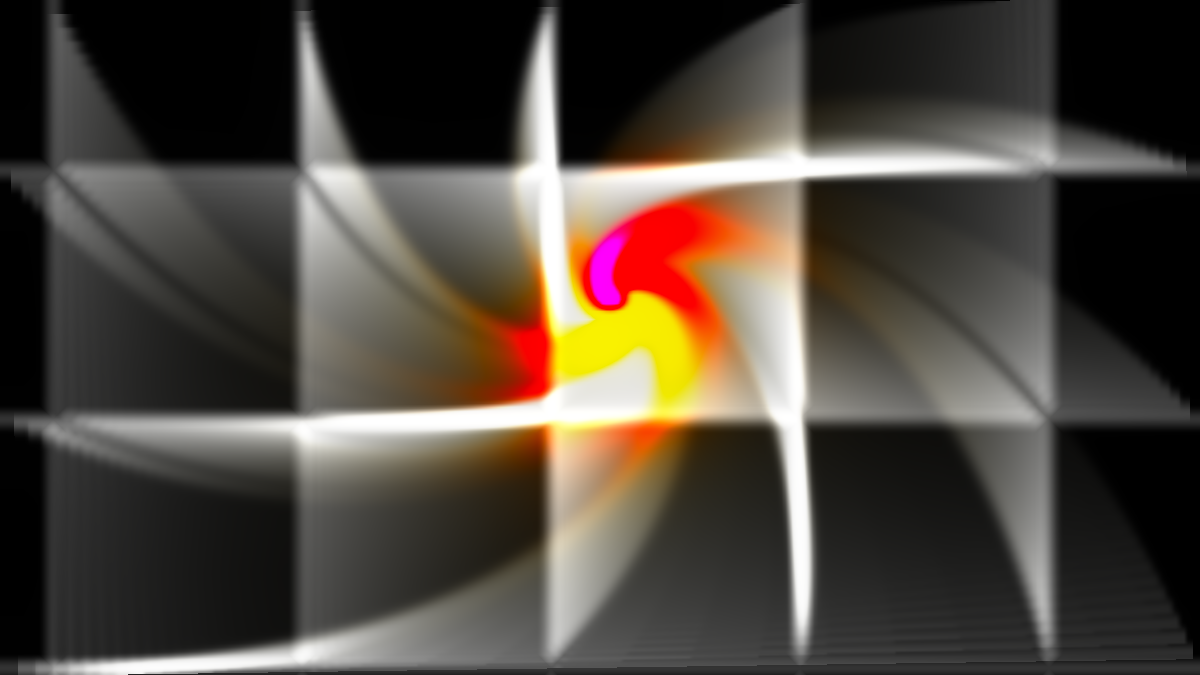
The Mirror Tunnel preset. Every edge in it is the frame’s own edge, re-photographed.
This is v0.1.4. The point release changed nothing but the Windows installer, which no longer touches the system PATH. The tap sets are checked against their published constants — Sierpinski’s three maps contract by exactly 0.500, Koch’s four by 0.333, the Heighway dragon’s two by 0.707, and Barnsley’s first map is confirmed singular, as published. Sixty trips round the loop produce a bit-identical frame whether they arrive as sixty frames of one or one frame of sixty. Four hundred fields of a deliberately hostile rig leave no NaN and the rig still draws afterwards. All twelve presets draw structure and are still moving once settled, and all 46 controls change the picture.
Both plugins load and run in Resolume Arena 7.27.1, on macOS and on Windows. The shipped Windows build is checked in a real Arena: each registers with the right name, uid and category, all 52 controls the host reports match the ones declared — name, order, type, range and default — and 47 of them demonstrably move the picture. That check runs on software rendering, so it says nothing about an NVIDIA or AMD driver, and nothing here has yet run on a discrete GPU other than one Apple Silicon Mac. Try it on a spare layer first.
Fixed in v0.1.3: choosing a preset now sticks. In v0.1.2 the dropdown snapped straight back to Custom the moment you picked anything, and the preset never applied. Resolume keeps pushing the values it still believes in, and the plugin was reading that as you having moved a slider. Every preset is now checked against all three things a host can do with the values a preset writes — honour them, ignore them, or hand back a rounded copy — and that check runs on every build.
This codebase was created with AI assistance, directed and reviewed by a human author.
Installing
Both plugins are in every download. Drop them into ~/Documents/Resolume Arena/Extra Effects (or
the Avenue equivalent) and restart Resolume — it scans that folder at startup only.
| Escapement | A source. A rig with nothing in front of the lens but what it makes itself. |
| Escapement Feed | An effect. Your clip in front of the lens — injected into the loop, so the fractal is built out of the footage. |
There is no OpenFX build. Escapement’s picture is the whole history of its loop, and an OpenFX host renders arbitrary frames in arbitrary order, which is a question a feedback rig cannot answer.
The one thing to understand
A rig with every knob held still goes still. That is not a fault to be tuned out — it is what the plugin is. The loop is a contraction mapping, so it converges on its attractor and then maps that attractor onto itself for ever. Zooming does not help either: a self-similar attractor magnified is the same attractor.
Real rigs never settle because a person is always moving the cameras. Drift is that person, and it is on by default in every preset. Turn it to zero once and watch a rig die, because that is the clearest possible explanation of what everything else here is doing.
The controls that matter
Gain is the one the whole plugin is about, because it has a threshold in it. Below unity every trip round the loop is dimmer than the last and the picture decays into whatever is being injected. Above unity it grows until the clip stage stops it, and the shape it grows into is the attractor. Unity sits at exactly 0.625 of the slider’s travel, so you can find it in the dark.
Drift moves the operator’s hands — slowly, at rates with no common multiple, so it never repeats. Its depth is scaled by how stiff the rig is: a nudge that visibly moves a mirror rig does nothing at all to a Sierpinski, which contracts by two and shrugs it off.
Hue Rotate is the difference between a picture and a performance. With it at zero the loop converges to a fixed point. With a little it cannot, because a fixed point would have to be a colour that is its own rotation, so the structure keeps re-entering itself and the colour walks the wheel for ever. Two thousandths of a turn per field is plenty.
Inject Level is food, and too much of it is what makes a rig ugly. Above unity the attractor sustains itself, so the grain is only there to give the loop something to converge from as Drift moves it. Turn it up and two things go wrong at once: the loop’s half-finished copies of the frame — the transients it is still working on, which are rectangles, because the frame is a rectangle — get bright enough to read as boxes behind the picture, and the attractor itself runs into the clip and loses its structure. If a rig looks like a white blob sitting on faint grey boxes, that is this, and the fix is less grain rather than more gain. v0.1.2 retuned Sierpinski, Koch, Dragon and Seeded for exactly this.
Focus is a lens that is slightly soft, and it is inside the loop — a low-pass filter inside a feedback loop is what stops a hot rig collapsing into single-pixel noise. Sharp and hot is static; soft and hot is what everyone recognises as video feedback. It is measured as a fraction of the frame, so a preset looks the same on your preview and on a 4K output.
Zoom below 1 gives you the tunnel. A feedback tunnel is made of the screen’s own edge, re-photographed, so the camera has to be able to see past the frame — which means pulling back, not pushing in. Above 1:1 you get expanding blooms instead, which is a different and also good thing.
Saturation above 1 is a reaction term, not a colour choice. Chroma gain over one amplifies whatever colour a pixel has, Focus spreads it to its neighbours, and the clip stops it: that is a reaction-diffusion system, and its domains are colours. It is the whole of the Cell Structures preset. Below 1.0 the same rig collapses to a dot.
Field Rate is the rig’s own clock, not Resolume’s. The picture evolves at the same speed whether the host is managing 60 fps or dropping to 24.
The rigs
The first seven are tap sets. A tap is one path from the screen back into the camera; a set of
taps is an iterated function system, and the fractal is its attractor. Sierpinski really is three
affine maps, and the gasket assembles itself out of sensor noise.
| Rig | What it is |
|---|---|
| Mirror | One tap. A camera and a screen, which is the whole classic rig. |
| Sierpinski | Three half-scale taps on a triangle. The gasket. |
| Koch | Four third-scale taps. With Symmetry at 3 it is the snowflake. |
| Dragon | Two taps at 1/√2. The Heighway dragon. |
| Fern | Barnsley’s four maps. One of them is singular — it is the stem, which is a line and not an area — so the loop drops it and the stem is missing. |
| Kaleidoscope | A mirror wedge: N unit-scale rotations. The camera’s zoom is the only contraction here, so pushing it past 1:1 whites the picture out. |
| Seeded | A rig built from a number. Every seed is framed, because a seeded attractor’s bounds are measured rather than assumed. |
| Julia, Mandelbrot | The iterator bank — analogue multipliers wired as a complex square. The only part of the plugin that holds a coordinate, and so the only part with a precision limit. |
| Globe | The rescan: the rig’s screen is a sphere and the camera is looking at it. The loop underneath keeps running, so the texture on the globe is alive rather than a still that spins. |
Symmetry is a mirror wedge in front of the lens. It is how the snowflake is made from a Koch curve: four taps plus a three-fold fold, for the cost of one coordinate wrap instead of the eight extra taps the twelve-map snowflake system would need.
Endless zoom, and where it ends
For every rig except the two escape-time ones, the zoom is genuinely unlimited. The camera’s zoom is a per-field multiplier applied to the picture, not a coordinate anyone stores, so after a thousand fields at 1.02 the magnification is 1.02¹⁰⁰⁰ — a number that never exists anywhere in the plugin. There is nothing to overflow. Leave it running for an hour.
Julia and Mandelbrot do hold a coordinate, so they have the limit the others do not. Single precision runs out around 1e5. Extended uses double-float arithmetic to reach about 1e13, for roughly three times the cost, and a starved iteration count looks exactly like a precision failure — both render a flat field — so raise Iterations before suspecting the arithmetic.
Using it as an effect
Escapement Feed takes your clip. Set Inject to Clip and the footage goes into the loop
rather than behind the picture, so the attractor is built out of its light and keeps developing
after the clip has moved on. Mask Mode and Mix decide how the result meets the original.
With Inject on anything else, the effect ignores the clip and renders its own rig over it — which is a legitimate thing to want, and is what the defaults do.
Credit
The rig this models is real: The Light Herder’s 4K Video Feedback Fractal Device — cameras, 4K screens, half-mirrored glass and analogue knobs, with the operator as part of the loop. Its video is here, and the claim in its description — fractals without a computer — is this plugin’s entire architecture.
MIT licensed. Source, issues and downloads at github.com/stoatworks-labs/escapement.