

Filament is a wall of incandescent bulbs, for Resolume Arena and Avenue, as an FFGL effect. It does not draw glowing dots with a slow fade. Every bulb of the wall is a tungsten wire heated by current, and its light is its temperature: its dimmer is set by its cell of the clip, the mains drives it through that dimmer, and the wire’s own heat balance decides how hot it gets and how fast. Dimmed bulbs going red as well as dark, flashes that come up fast and die away slowly, the surge of a cold bulb, the lag of a big lamp and the ripple of a small one are all what the filament does, not what somebody drew.
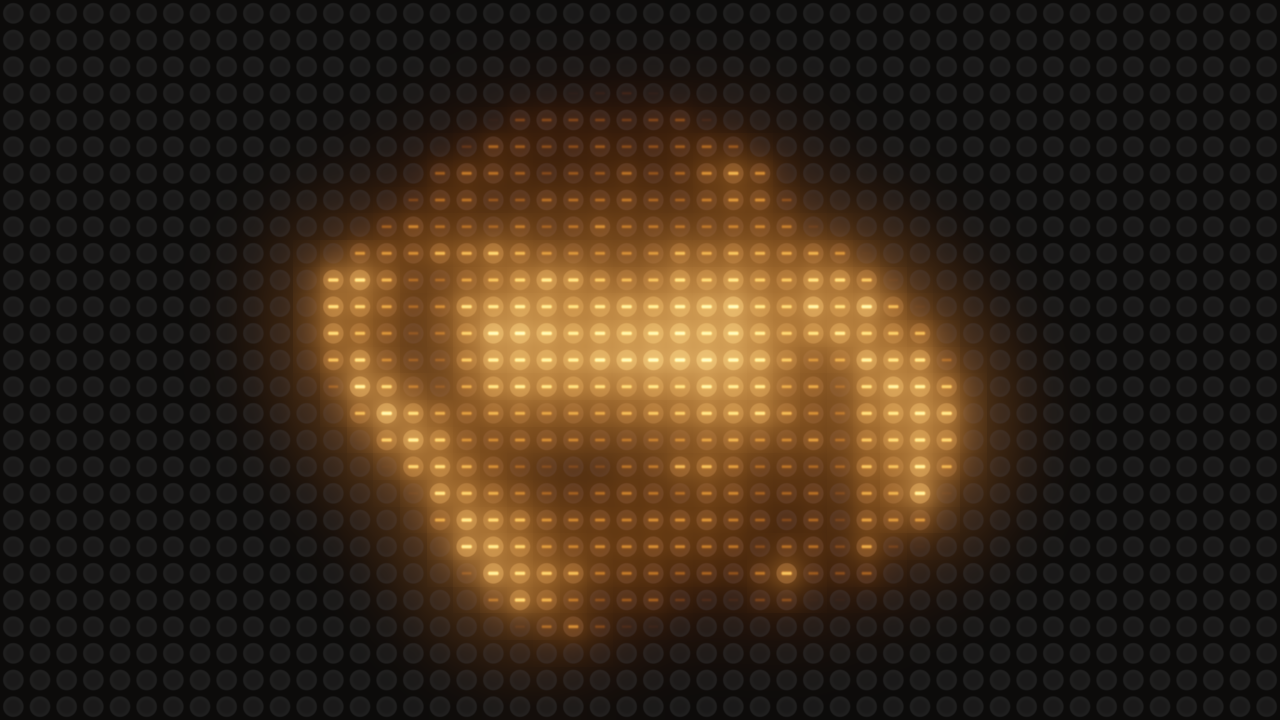
Resolume’s bundled demo clip Metalive 01 through the plugin at its defaults, rendered by the offline harness rather than captured from Resolume: a 48 × 27 wall of clear 40 W bulbs on 50 Hz square-law dimmers. The bright tiles are filaments near 2800 K, nearly white; the dim ones are cooler and so redder; the unlit bulbs are faint discs of glass.
Before you rely on this: released at v0.1.0, and honestly early. The filaments are measured rather than asserted, by a harness that drives the real plugin class and reads each bulb’s temperature back through the plugin’s own probes, at two rasters and on a software renderer: at a steady voltage a filament settles where power in balances power out (at rated voltage 2799.95 K against 2800); its light sits on the Planckian locus to 1e-6 in xy and moves redward with every step down; a cold start follows the heat-balance equation to 0.004 K and reaches 90% in 65 ms, where a lamp without tungsten’s fifteenfold inrush would take 135; a switched-off filament cools by T⁴ radiation plus conduction, its time constant 2.5 times longer at 1200 K than at 2400 K; a triac-dimmed filament ripples at exactly twice the mains, 7.4 times more on a 25 W lamp than a 500 W one; and a resize mid-fade keeps every temperature exactly. Six deliberately broken models are each shown to fail their check. All 14 controls are shown to change the picture. The checks verify the stated model, not a real lamp: three of its constants are assumptions (see Known limits), and no real bulb has been measured against it. It has never been loaded into Resolume on macOS — the one host it has run in there is the fleet’s own test host,
oxbow, for 120 frames. On Windows it has: a build of this source loads, registers and renders in Resolume Arena 7.27.1 on software rendering (win-lab, Mesa llvmpipe, no GPU), with every control matching what the plugin declares and all 14 moving the picture, in the fleet’s Arena gate (9 of 9 checks). The gate’s picture is a still, so Wattage, Mains and Ambient Temp, which act mostly on how the wall moves, read weakly there (about 4.6 to 5 levels against a noise floor of 1.1, where the other controls read 10 to 55); software rendering says nothing about a GPU or about speed. Try it on a spare layer before you put it in a show.This codebase was created with AI assistance, directed and reviewed by a human author.
Installing
Every download carries one effect, SW Filament. Drop it into Resolume’s effects folder and restart Resolume:
macOS    ~/Documents/Resolume Arena/Extra Effects/
Windows  %USERPROFILE%\Documents\Resolume Arena\Extra Effects\
Avenue uses the same layout under its own folder name. The effect then appears in the effects browser as SW Filament.
The macOS download is a universal build (Apple silicon and Intel), as a .dmg or a .zip. It
is Developer ID-signed and notarised by the release pipeline after publication, so the bundle simply
loads; if macOS refuses a download, it predates the signing — download it again. The Windows download is an x64 installer or a .zip. It is not code-signed, so
the installer trips SmartScreen once: More info → Run anyway.
A bulb is a wire, not a fade
An incandescent bulb is a tungsten wire heated by the current through it. Its temperature follows one equation, and each bulb of the wall solves it for itself, on the GPU, every frame:
C(T) dT/dt = V(t)² / R(T) − ε σ A (T⁴ − T₀⁴) − k (T − T₀)power in, through a resistance that rises with temperature; power radiated, as the fourth power of temperature; power conducted away to the lead-in wires and supports; all against the wire’s heat capacity. Each term makes something you can see:
| the term | what comes out |
|---|---|
| the light is Planck’s law at T through the CIE 1931 observer | warm fades: a dimmed bulb goes red as well as dark. A 60 W bulb is 2816 K at full and 1975 K at 45%, and its colour follows |
| radiation goes as T⁴ | a fast rise and a slow fall: a 60 W bulb reaches 90% of its rise in 65 ms and takes 176 ms to cool to 1500 K, and the cooling slows as it goes |
| tungsten’s resistance is 15 times lower cold than hot | inrush: a cold bulb draws fifteen times its rated power and heats twice as fast as a constant-resistance bulb would |
| the voltage is the mains, through a dimmer | mains ripple at exactly twice the mains frequency, large on a small filament, almost nothing on a big one |
| the heat capacity is the wire’s mass | big lamps are slow, small lamps quick: each lamp’s wire is sized from its wattage and voltage, so a 1000 W filament weighs over a thousand times what a 10 W one does |
Every lamp is designed the same way: it dissipates its rated wattage at the mains voltage with the wire at 2800 K in a 25 °C room, and 15% of that power leaves by conduction. So every lamp at full reads the same colour and the same brightness — Wattage changes how the wall moves, not how bright it is.
Start here
Put SW Filament on a layer or a clip with some brightness and some movement — the bundled Metalive, IntoTheGlow_02 or Beat 001 loops. Out of the box you get a 48 × 27 wall of clear 40 W bulbs on 50 Hz square-law dimmers, with a modest halo and bloom.
Then:
- Mix → 0 and back. Compare the clip with the wall. Where the clip is bright the bulbs are near white; where it is mid-grey they are orange; where it is dark they are off, and you see the glass.
- Wattage → 1000 W. Watch a flash or a fast move. The heavy wires barely register a quick flash and glow on after it, and movement smears into a warm trail. → 10 W and the wall follows the clip almost frame for frame.
- Dimmer → Linear. A plain sine-wave dimmer: light from tungsten goes as roughly the 3.4th power of the voltage, so the mid-greys go dark and red and only the highlights stay. → Triac chops each half-cycle instead, and sits between. Back to Square Law, which is what theatre dimmer curves are for.
- Gels → RGB. Three filaments per cell behind red, green and blue gels, drawn as one bulb: the wall now carries the clip’s colour. Blue is dim, because tungsten makes little blue light.
- Glass → Frosted, then Amber. A frosted globe glows all over instead of showing its coil; coloured glass tints the light.
- Columns → 160, Rows → 90. A finer wall. Changing the grid keeps every filament’s temperature. Pixel Mode on draws each bulb as a flat square of its cell.
- Exposure up or down: the wall’s camera exposure, in stops.
Thin, dim features vanish. Each bulb sees the average of its whole cell of the clip, so a thin line on black averages to almost nothing, and red has a luma of only 0.21. Lift a dark clip with a brightness or levels effect ahead of the plugin, or use a finer grid.
Every slider is declared to the host as 0 to 1. The value each position stands for is given with each control below.
The Wall group
Columns (4 to 160, default 48) and Rows (2 to 90, default 27). The number of bulbs across and down. Each bulb’s dimmer is the average of its cell of the clip. The bulbs are square cells of the grid stretched to the frame, so 48 × 27 is square bulbs on a 16:9 frame. A change regrids the filaments: each new bulb takes the temperature of the old bulb nearest it, so a change mid-fade carries on from where the wall was.
Gap (0 to 0.8 of the cell, default 0.24, slider 0.3). The dark space between bulbs. 0 packs the bulbs edge to edge; 0.8 leaves small points of light.
Pixel Mode (off). Each bulb is drawn as a flat square filling its cell (less the gap) instead of a bulb with a coil in a glass. The filaments, the colour and the timing are unchanged. It reads best on a coarse wall: at 160 × 90 the squares are a few pixels across and look much like the bulbs.
Glass (Clear). What the bulb’s envelope is:
| Clear | the coil shows as a bright bar in the middle of a lit disc |
| Frosted | the whole globe glows evenly, a little dimmer |
| Amber, Red, Green, Blue | coloured glass: the filament’s light times the glass’s transmittance |
The coloured glasses’ transmittances are chosen by eye, as the look of each glass, not measured from a filter.
Gels (Off, RGB). RGB puts three co-located filaments in every cell, behind red, green and blue gels, each driven by its own channel of the clip, and draws them as one bulb. That is how a bulb wall shows colour. Tungsten at 2800 K has much more red than blue in it, so the blue gel is dim; that is left in rather than trimmed. RGB costs three filaments per cell.
The Bulb group
Wattage (10 to 1000 W, logarithmic, default 40 W, slider 0.301). The lamp every bulb is. It sets the wire’s size and so its heat capacity, and so every time constant of the wall. From the model at 50 Hz / 230 V, rounded:
| 10 W | 40 W | 100 W | 1000 W | |
|---|---|---|---|---|
| wire | 10 µm × 0.51 m | 26 µm × 0.81 m | 47 µm × 1.10 m | 219 µm × 2.36 m |
| 90% of the rise from cold | 20 ms | 49 ms | 91 ms | 420 ms |
| full to 1500 K when switched off | 53 ms | 134 ms | 247 ms | 1.15 s |
| triac ripple at a half setting | 242 K | 97 K | 53 K | 11 K |
(The rise and fall figures are the model’s at a steady voltage, not a measured lamp; the harness measures the 60 W case directly: 65 ms and 176 ms.) Wattage is dynamics, not brightness: every lamp at full is 2800 K and reads the same.
Dimmer (Linear, Square Law, Triac; default Square Law). How the clip’s value becomes a voltage. All three keep the mains waveform; only the triac chops it.
| Linear | a sine-wave dimmer: RMS voltage = the level. Tungsten’s light rises as about the 3.4th power of the voltage, so this is very contrasty — mid-greys go dark and red |
| Square Law | RMS voltage squared = the level, so electrical power roughly follows the fader. The default, and what theatre dimmer curves exist for |
| Triac | a leading-edge phase-cut dimmer, firing at (1 − level) of each half-cycle: the real electronics of most wall dimmers. The ripple is largest here |
Mains (50 Hz, 60 Hz). The supply: 50 Hz is a 230 V lamp, 60 Hz a 120 V one. It sets the ripple’s frequency (100 or 120 Hz) and, because a 120 V lamp of the same wattage has a thicker, shorter wire, it makes the lamp slower: a 40 W 120 V lamp takes 76 ms to 90% where a 230 V one takes 49.
Ambient Temp (0 to 200 °C, default 25 °C, slider 0.125). The room the wire loses heat to. A hot ambient means a slightly hotter unlit filament and slightly slower cooling at the bottom; it barely matters above a dull red.
Why you rarely see the ripple. The picture each frame shows is the light averaged over the frame, as a camera’s shutter would collect it. A 100 Hz ripple averages out over a 1/60 s or 1/30 s frame almost entirely: at the defaults the frame-to-frame variation on a flat grey is ±0.3%, about one code value. A 10 W bulb on a triac at 50 Hz keeps a faint ±1% beat at 60 fps, which is what filming a small tungsten lamp at 60 fps looks like. At 60 Hz mains and 60 fps there is none.
The Look group
Glow (0 to 1, default 0.5). The halo each bulb throws from its glass and reflector onto its neighbours’ cells.
Bloom (0 to 1, default 0.35). A wider blur of the wall’s light, as a lens flares around a bright lamp.
Exposure (−4 to +4 stops, default 0, slider 0.5). The wall’s camera exposure: the light goes
through 1 − exp(−g × 2^stops × L) per channel, so bright bulbs roll off softly into white
rather than clipping. Raise it to see dim filaments; lower it to keep the hot ones from going
white.
Mix (0 to 1, default 1). The wall over the clip. At 1 the output is opaque: the wall paints the whole frame, whatever the clip’s alpha. At 0 it is the clip, with the clip’s own alpha.
How it works
Four stages a frame, with every filament’s temperature kept on the GPU between frames:
- Drive. One texel per bulb: the mean of an 8 × 8 grid of samples over its cell of the clip, as code values — Rec. 709 luma for a white wall, each channel for RGB gels. The code value is the fader.
- Thermal. One texel per bulb, ping-ponged: the heat-balance equation over the frame’s seconds in fourth-order Runge–Kutta substeps, the mains waveform through the dimmer law evaluated at each stage’s time. The substep is the smaller of a twentieth of a mains half-cycle and 1.5 over the lamp’s stiffness (a cold filament’s falling resistance is the stiff part), so a 10 W wall takes about 150 substeps a frame and a 1000 W one about 34. It writes the new temperatures and the light averaged over the substeps.
- Bloom. That light blurred at the grid’s raster, across and then down.
- Output. For each pixel, the bulb of its cell (a coil in clear glass, a lit globe in frosted, a flat square in Pixel Mode), halos from its eight neighbours, the bloom, the glass tint, the exposure curve, sRGB, Mix.
The light at each temperature comes from a table of Planck’s law integrated against the CIE 1931 colour-matching functions from 250 K to 3700 K, generated by a script from the CIE data and checked byte for byte in the build. The resistance comes from Forsythe and Worthing’s 1925 table of tungsten’s resistivity; the heat capacity from NIST-JANAF’s fit for tungsten.
Time is kept by the host’s clock. The frame’s seconds and the mains phase at its start are worked out in double precision on the CPU, because Resolume’s clock overflows a float; the shaders see only the frame’s step and the phase. A frame longer than a quarter of a second is clamped to a quarter of a second; a paused clock runs no substeps and shows the wall as it is.
Performance
Measured by the offline harness on an M4 Max, best of three, glFinish both sides, on a GPU shared
with other work:
| default (48 × 27, 40 W) | largest grid (160 × 90, 40 W) | largest, 10 W on RGB gels (worst) | |
|---|---|---|---|
| 1280 × 720 | 0.25 ms (1.5%) | 0.30 ms | 1.54 ms |
| 1920 × 1080 | 0.26 ms (1.5%) | 0.38 ms | 1.63 ms |
| 3840 × 2160 | 0.39 ms (2.3%) | 0.54 ms | 1.78 ms (10.7%) |
(percentages of a 60 fps frame). Small lamps cost the most, because they need the most substeps; RGB gels triple the filaments. The state held is the grid’s buffers only, 1.1 MB at 160 × 90, whatever the output resolution. Nothing was timed inside Resolume, and nothing was timed on Windows.
If it looks wrong
The wall is dark except for a few bulbs. The clip is dark, or Dimmer is Linear. Use Square Law, raise Exposure, or lift the clip with a levels effect ahead of the plugin.
Everything is orange, nothing is white. The clip’s highlights are not reaching full: a bulb is only near white at full drive. Raise Exposure a stop, or brighten the clip.
A thin line or a small shape is gone. Each bulb averages its whole cell. Raise Columns and Rows.
The wall smears and lags. Wattage is high: a big lamp is slow. Lower it; 10 W follows the clip almost frame for frame.
The blue is missing. That is tungsten: a 2800 K filament has little blue in it, so behind a blue gel it is dim. Blue glass is dim for the same reason.
The bulbs flicker faintly. A small lamp on a triac, at a frame rate that does not divide the ripple: the light is averaged over each frame, and what is left is a slow beat. Raise Wattage, or use Square Law.
The clip’s transparency is gone. The wall is opaque above Mix 0. Lower Mix to see the clip’s own alpha again.
SW Filament is not in the effects browser. Check the folder under Installing, and that Resolume was restarted.
The effect does nothing at all. A shader that will not compile looks exactly like that, and the real message is in the log:
macOS    ~/Library/Logs/filament/filament.YYYY-MM-DD.log
Windows  %LOCALAPPDATA%\filament\logs\filament.YYYY-MM-DD.log
It records the GL vendor, renderer and version at load, which pass failed if one did, the host’s clock and the unit the plugin decided it is in, and on every lamp change the wire the model sized (diameter, length, mass) and its stiffness.
Known limits
- Three of the model’s constants are assumptions, not measurements. The wire’s total emissivity is taken as a constant 0.30; the coiled coil is taken to radiate from half its surface (it shades itself); and 15% of the rated power is taken to leave by conduction. They are round figures, not read from a table. Together they size the wire, and so its heat capacity and every time constant of the wall. They give a 60 W 230 V filament of 34 µm by 0.92 m and 16 mg, the right order for a real one, but no real lamp has been measured against the model. Real tungsten’s emissivity rises with temperature; modelling that would make the fall slower still at low temperatures.
- The resistivity table is a web reproduction. The 34 values from 300 K to 3600 K are Forsythe and Worthing, “The Properties of Tungsten and the Characteristics of Tungsten Lamps”, The Astrophysical Journal 61, 146 (1925), copied from a web reproduction of that table (The Physics Factbook’s page on the resistivity of tungsten, which cites T. W. Zerda, TCU, 2001), not checked against the 1925 paper itself. Below 300 K the table is extrapolated.
- The filament’s colour is a black body’s. Real tungsten’s spectral emissivity falls slowly across the visible, which makes a real filament slightly bluer than a black body at the same temperature.
- Every bulb is identical. A real wall’s lamps differ a little; here they do not.
- The picture is judged by eye: the bulb shapes, the coil, the halo, the reflector, the bloom, the glass sheen, the glass tints, the gels and the exposure curve. The harness proves each control moves the picture; nothing measures how it looks.
- The fader is the code value, not linear light, averaged over the cell.
- Never loaded into Resolume on macOS. Everything numeric was compiled, rendered and measured
offline against the real plugin class in a headless CGL context, plus an
oxbowload. - Never seen on camera footage, only on Resolume’s bundled CG loops.
- Checked at 320 × 180 and 1280 × 720 in the harness, and only timed at 4K.
- Only ever run on an Apple M4 Max, although the macOS build contains an Intel slice. On Windows, see the note at the top of this guide.
- No presets, no preheat, no lamp-to-lamp variation, and no OpenFX version.
- There is a browser demo at filament-demo.stoatworks-labs.com. It is a port to a web page, not the plugin: the shaders run in WebGL2, and the time bookkeeping and the lamp sizing are rewritten in JavaScript. The page lists what it does not reproduce.
About
The last group, About, carries the plugin’s name, version, licence and maker, and buttons that open this user guide (stoatworks-labs.com/software/filament/guide/), the project page, the source on GitHub and the support page in your browser.
Reporting something
github.com/stoatworks-labs/filament/issues. A screenshot, the Wall and Bulb settings, and the composition’s resolution and frame rate are usually enough. If the effect did nothing, attach the log.