

Frame Ferret is a software virtual capture card. One application that is an NDI, OMT, SRT and ST 2110 endpoint — transmitting and receiving — over a chosen network interface, that can capture this machine’s screen, and that presents itself to other software as a camera, a shared GPU surface, an SDI output or a web overlay.
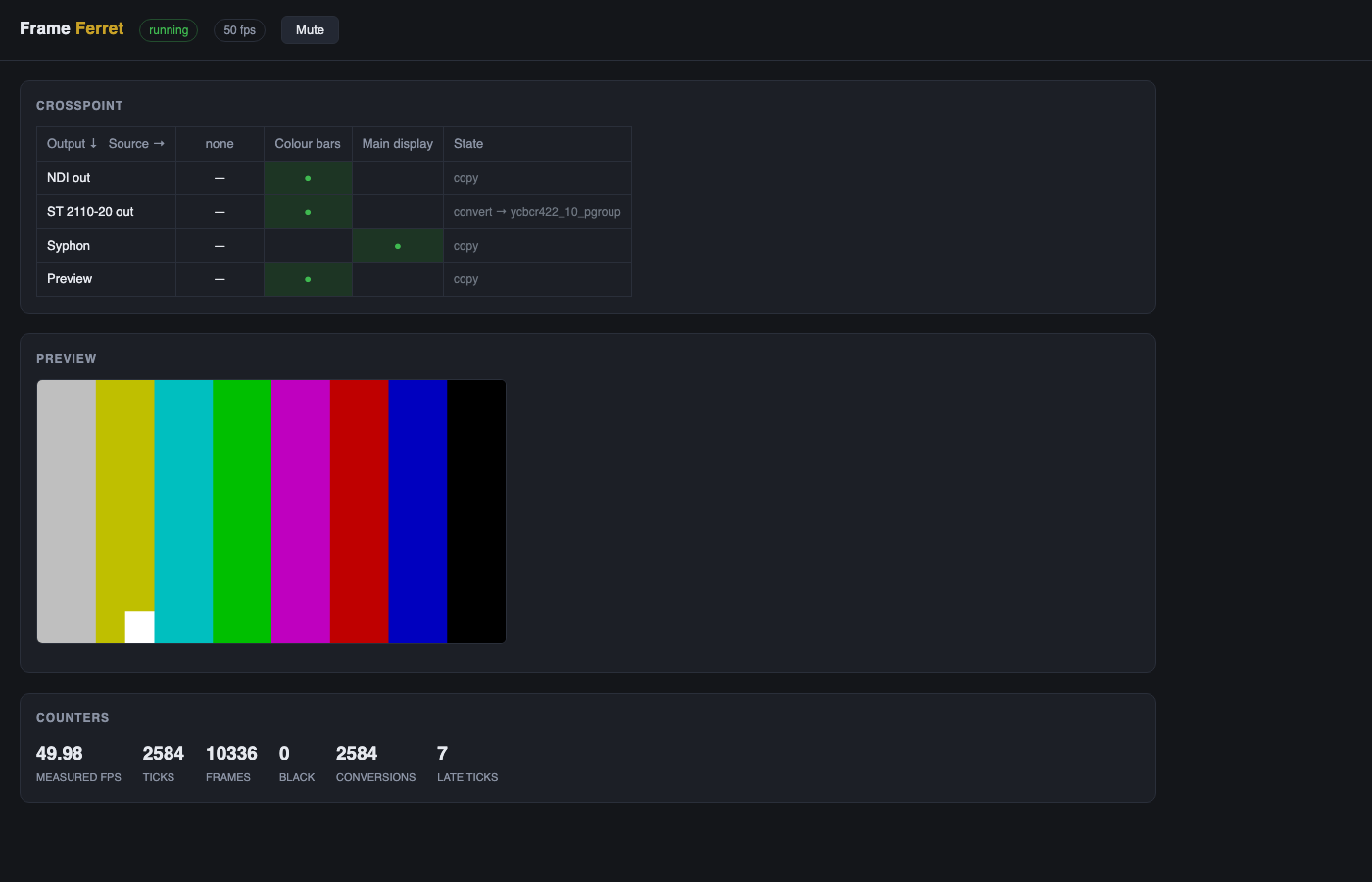
The control page at 50 fps: colour bars routed to the NDI, ST 2110-20 and preview outputs and the main display to Syphon — the ST 2110 row converting to 4:2:2 10-bit on the way — with the preview and the tick, frame and conversion counters underneath.
The idea is that a protocol is just a port on a router. Anything can be a source, anything can be a sink, and the crosspoint in the middle does not care which is which.
Before you rely on this: a great deal works and a great deal is not built yet, and the difference matters more here than in most projects. NDI and OMT both work in both directions, verified against separate implementations. SRT send and receive are verified end to end, and ST 2110-20 is verified against GStreamer’s implementation in both directions. DeckLink output has run on a real Duo 2 — 2531 frames with zero late and zero dropped by the card’s own count, though the pixels on the wire have not been checked.
Not started: the UVC virtual camera, the virtual display, DeckLink capture, Spout, HTML output, the tray launcher, and ST 2110 audio and ancillary. Windows and Linux build and self-test in CI but have never been run interactively, and no hardware path exists on either.
This codebase was created with AI assistance, directed and reviewed by a human author.
The invariant
Every sink produces a frame, every tick. A sink with nothing routed to it goes black and keeps running rather than stopping.
That has been observed rather than asserted: over one 9049-tick run, 4507 frames delivered plus
4542 black is exactly 9049 — one action per sink per tick, zero late ticks, 49.99 fps measured.
Unrouting a sink from the browser turned its output black and kept it running at 50 fps, reporting
no source routed.
Running it
frame-ferret runserves the control page. The crosspoint is clickable: sources down one axis, sinks along the other.
frame-ferret interfaces     # what NICs this machine has
frame-ferret kinds          # what node types this build has
frame-ferret selftest
Bind the interface explicitly. A stream on the wrong NIC is diagnosed on site as a network fault, which is an expensive hour. Every node takes an interface.
NDI is the exception, and it is not one Frame Ferret can fix. NDI’s own C API has no interface parameter at all, so Frame Ferret warns rather than pretending the setting applied.
What works today
| NDI send and receive | Verified against an independent implementation, both directions. |
| OMT send and receive | Verified against oxbow and macOS’s own dns-sd. |
| SRT send and receive | Verified end to end against an independent Rust SRT stack. |
| ST 2110-20 send and receive | Verified against GStreamer’s RFC 4175 implementation, within 2 code values. |
| DeckLink output | Run on a real Duo 2 at 1080p50 in v210. |
| Screen, window, application and region capture (macOS) | Built and run. A region of interest is a source rect, so a crop costs nothing. |
| Syphon output (macOS) | Verified against Resolume’s Syphon — a different implementation from the one vendored here. |
One measurement worth understanding before you report a bug
Over an NDI round trip, saturated blue comes back 178 rather than 191.
That is NDI’s own compression, not this code — an independent sender through the same round trip lands on exactly the same 178. The control experiment mattered: the number alone would have looked like a bug in the pixel conversion.
OMT does much better through the same test — all eight bars within 2 code values — because it carried BGRA rather than compressing it. That difference is the protocols, and it is the reason to choose between them.
SRT needs a codec, and that is why ffmpeg is a subprocess
NDI and OMT carry raw frames, so a node is a thin wrapper over the SDK. SRT carries an MPEG transport stream of compressed video, so it needs a codec.
Frame Ferret runs ffmpeg as a subprocess rather than linking it:
- You point at the install you already have — the node’s own setting,
$FERRET_FFMPEG,$PATH, or the usual locations, in that order. An explicit path that is wrong is an error, never a quiet fallback to some other ffmpeg. - No ABI coupling. libavcodec’s structs change between major versions; mirroring them by hand would be far more fragile than NDI, OMT or libsrt, which all expose deliberately flat C ABIs.
- Licensing stays simple. A separate process over a pipe raises no question an MIT codebase needs to answer.
Hardware encoders are preferred where present.
What is not built
Designed and documented, but not implemented: the UVC virtual camera (it needs an embedded provisioning profile the release harness does not yet produce), the virtual display (no public macOS API exists), DeckLink capture, Spout, HTML output, the tray launcher, and ST 2110-30 audio and -40 ancillary.
Those are absent from the UI rather than present and failing.
If something is wrong
| Symptom | Cause |
|---|---|
| A stream is on the wrong NIC | Every node takes an interface — except NDI, whose API has no such parameter. Check for the warning. |
| A sink is black but running | Nothing is routed to it. That is the invariant, not a fault. |
| Blue reads 178 over NDI | NDI’s compression. Independent senders land on the same number. |
| SRT does nothing | It needs an ffmpeg. Check the resolution order above; a wrong explicit path is an error rather than a silent fallback. |
| A node type is missing | Run frame-ferret kinds. Several are designed but not built — see above. |
| It does nothing on Windows or Linux | Both build and self-test in CI and have never been run interactively. No hardware path exists on either. |