

Colourunder
VHS colour-under recording, for Resolume
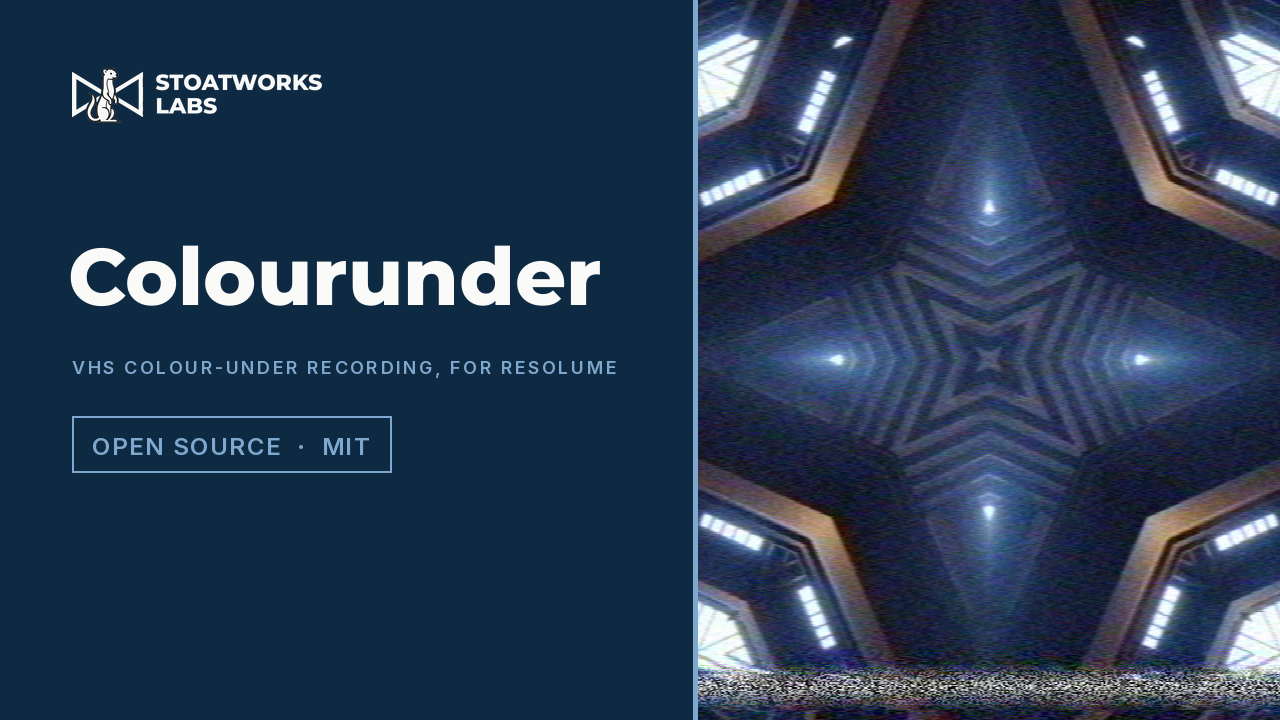
What it does
An FFGL effect for Resolume Arena and Avenue. A VHS deck cannot record colour at its broadcast frequency, so it heterodynes the chroma down to about 627 kHz (PAL) or 629 kHz (NTSC), records it under the luma's FM carrier, and brings it back up on playback. Colourunder models that choice, and the two spinning heads it rides on, and the look falls out of the mechanism rather than being painted.
The colour-under band is narrow, so chroma is half amplitude at 0.5 MHz, about 40 lines of horizontal resolution against luma's 234 at SP, and the playback filters delay it: colour arrives late, right of every edge. Noise added to that band goes through the same filter and comes out as horizontal blotches of colour. The playback phase error is a per-line rotation of the colour: NTSC shows it as hue wandering, while PAL's V axis alternates line by line and the 1H average turns the same error into a loss of saturation. The 1H comb halves chroma's vertical resolution on both standards.
The deck switches heads 6.5 lines before vertical sync, so the last lines of each field jump sideways and the TV takes a dozen lines to recover, with a switching transient across them. Off-track, the head reads the wrong track where it crosses between two of its own and the FM demodulator loses lock: a noise bar that rests in the vertical interval at good tracking and walks up the picture as the error drifts. Missing oxide is a white streak, or with DOC on the same stretch of the line 1H before, repeated. LP and EP cost luma bandwidth, and Generation runs the whole chain again for each copy of a copy.
It is not Ferric and not Old Cathode. Ferric is wow, flutter and a noise-reduction round trip; Colourunder has no time-base wander and no compander. Old Cathode is the broadcast composite route, with a subcarrier, dot crawl, cross-colour and a CRT; Colourunder never makes a composite, so there is no dot crawl, and its head switch and tracking bar come from the recorder's own geometry. The chroma bandwidth itself is unconfirmed: a patent and the spec give 0.5 MHz, Wikipedia 0.3 MHz.
- Chroma band-limited to about 40 lines and delayed, from the colour-under band
- Colour noise as blotches, band-limited like the chroma it rides on
- A playback phase error: hue on NTSC, desaturation on PAL through the 1H average
- The head switch 6.5 lines before V sync, the bottom lines torn and recovering
- A tracking bar that hides in the vertical interval and walks up as the error drifts
- Dropouts, and DOC repeating the line 1H before; SP, LP and EP
- Copies of copies: the whole chain again for up to five generations
- Universal macOS bundle and a Windows x64 DLL
Where it stands
v0.1.0, and honestly early. The deck is measured, not asserted, by an offline harness that drives the real plugin class headlessly and reads each claim back out of what it renders: chroma falls to half at 0.5 MHz (39 lines) on PAL and NTSC and luma at the Speed's figure; the chroma delay holds to 1e-4 px; the head switch disturbs exactly the lines from 6.5 H before V sync; a 20 degree phase error is 20 degrees of hue on every NTSC line and none on PAL, with a saturation of cos 20; DOC's repair is the line 1H before, bit for bit; a second generation multiplies the chroma response by the tape's filter again; and the tracking bar sits where the stated geometry puts it. Eight deliberately broken models each fail their check, and all 10 controls change the picture. The checks verify the stated model, not a real deck, and several format figures are weak: the chroma bandwidth is disputed (0.5 MHz here, 0.3 MHz in another source), the LP luma figure has one source and EP's none, and the noise levels and tracking geometry are chosen. It has not yet been loaded into Resolume on macOS. On Windows it has: a build of this source loads, registers and renders in Resolume Arena 7.27.1 on software rendering (win-lab, no GPU), with every parameter as declared and the fleet gate's 9 checks passed; four controls read as moving the picture, and seven inconclusive against the tape noise that changes every frame. The macOS build is Developer ID-signed and notarised. There is a user guide and a browser demo; no presets and no OpenFX port. Check it in your own rig before trusting it in a show.
Watch it running
Nothing loads from YouTube until you press play.Watch it there instead