

PowerPoint Font Manager
The fonts a deck actually uses, and the ones you are missing
What it does
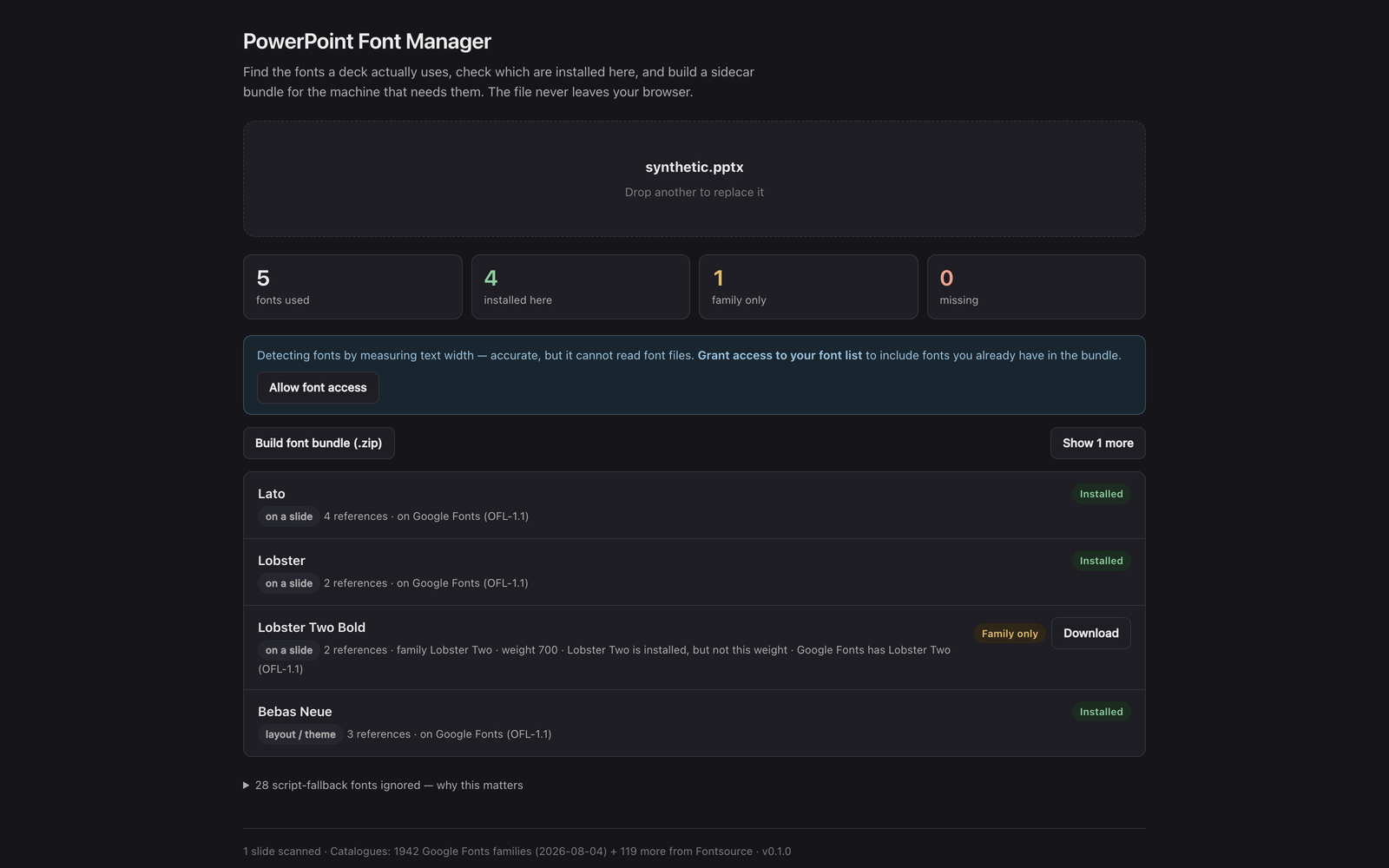
Drop in a .pptx and find out which fonts it actually uses, which of those are installed on the machine looking at it, and what to do about the rest. The hard part is that a plain search of the file is wrong: every Office theme carries a script-fallback table naming around thirty CJK and Indic fonts whether or not the deck contains a single such character, so three real presentations report 39, 36 and 9 typefaces where the true answers are 2, 4 and 6. Decks also name faces rather than families — "Helvetica Neue Medium", "Poppins Regular", "Times Roman" — which a naive check calls missing when the font is sitting right there. It resolves both before it says anything. Missing fonts are matched across two catalogues — 1,942 Google Fonts families plus 119 more from Fontsource. The ones that can never be shared — Calibri, Cambria, Arial, Times New Roman — get metric-compatible stand-ins instead, same advance widths, so line breaks hold. Adobe Fonts are named as Adobe Fonts and linked to activate rather than pretended to be fetchable. Anything left goes into a sidecar .zip with per-platform installers. A desktop build installs them outright.
Where it stands
Field proven. The scanner is verified against three real presentations of different provenance — one from Canva, one from Office with embedded fonts, one 316 MB deck that names almost no fonts explicitly — and its installed-or-missing verdicts were checked font by font against CoreText's own list on macOS. Since 7 September 2026 it tells full embedding apart from subset embedding, and checks the claim. The bundle's Windows installer has been run end to end on Windows 11 — which is how it was caught unregistering every other per-user font on the machine, fixed since; the macOS and Linux installers are syntax-checked but have not been run against a real font install. A running browser cannot see a font installed after it started — its rendering font list is frozen until it restarts — so the tool says so rather than re-checking in vain. Check the bundle on a spare machine before you rely on it in front of a client.