

Sidereal
The sky as Hubble and Webb see it, for Resolume
What it does
Two FFGL plugins for Resolume Arena and Avenue in one download. SW Sidereal is a source: a piece of sky on black. SW Sidereal Over is an effect that puts the sky over your clip, or makes your clip the gas and lets the stars light it.
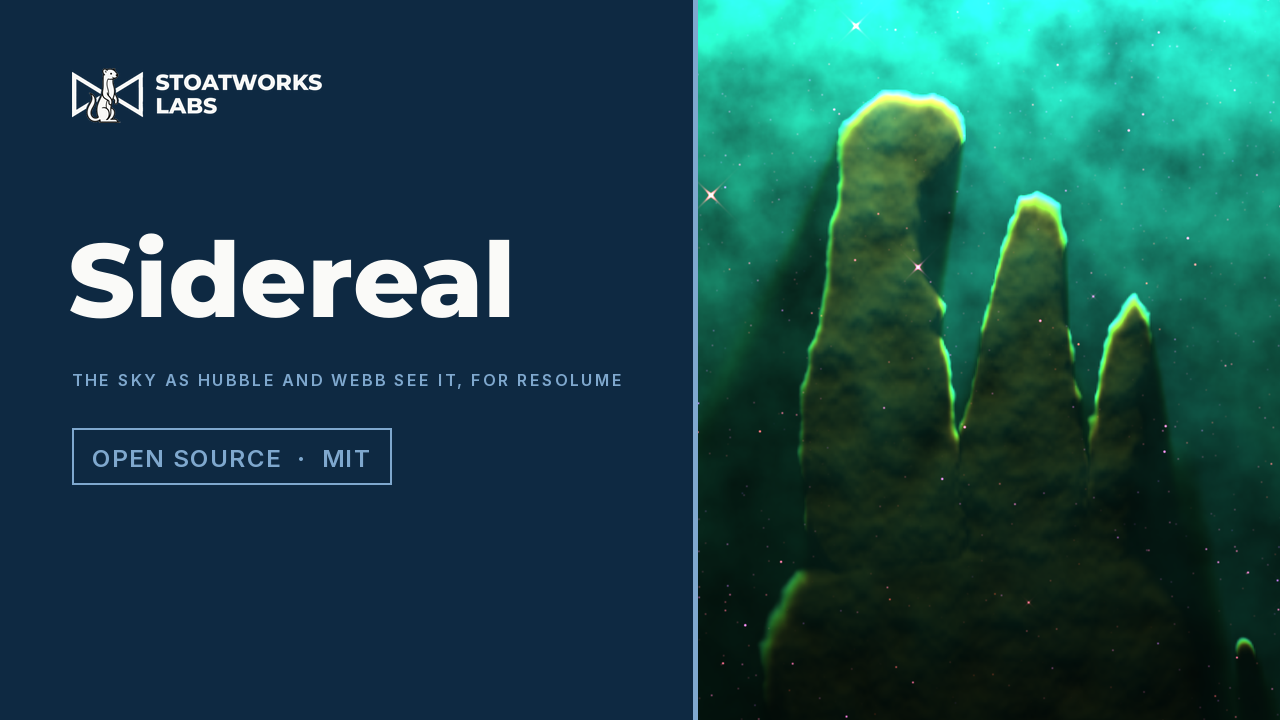
The famous space pictures aren't photographs in the holiday sense. Each is a stack of grey images, one per filter, each filter passing one slice of light: a line of oxygen, of hydrogen, of sulphur, or a band of the infrared. Each grey image is stretched, given a colour and added to the rest. The Pillars of Creation are gold and teal because [S II] went in red, H-alpha green and [O III] blue. So Sidereal builds the gas, the stars and the telescope. The gas has a column and a thickness along the line of sight; the stars' ionising light is marched across the picture through it, and every photon the gas catches comes back out as the lines of recombination, oxygen's harder photons used up first so [O III] sits nearest the star. Then the real filters and the release's colour key make the picture, with dust reddening through each filter as Cardelli, Clayton and Mathis say it should, and each telescope's own diffraction spikes.
Fifteen targets are drawn from releases: the Pillars, the Cosmic Cliffs and the Horsehead traced by eye from their pictures, and Orion, the Crab, the Ring, the Southern Ring, the Helix, the Veil, the Pleiades, Andromeda, the Whirlpool, the Sombrero, the Ultra Deep Field and Webb's First Deep Field built from what their releases show. Each comes as released, and the Telescope control shows the same gas through another instrument: the Pillars through Webb's infrared turn translucent and the young stars inside them appear. Seven more are generative, a new sky for every Seed.
Things happen, too. Meteors follow the classical ablation light curve, at random or as a shower from a radiant. A type Ia supernova rises and fades on the decay of its nickel and cobalt, leaves a remnant, and lights a ring on the dust in front where the paraboloid of constant delay puts it. Meteors through a space telescope are fiction, since Hubble is above the air that makes them; they're in because a show wants them.
- A source (a piece of sky) and an Over effect (the sky over your clip, or your clip as the gas) in one download
- Fifteen targets from Hubble and Webb releases, including the Pillars of Creation, the Cosmic Cliffs, the Horsehead and Webb's First Deep Field, plus seven generative skies
- Eight telescopes: each release as published, Hubble's narrow bands, colour and infrared, Webb's NIRCam, MIRI and deep fields, and a backyard camera
- Gas lit by its stars with every ionising photon accounted for, ionisation zones in their physical order, and dust that reddens through each real filter
- Gravitational lensing in the deep fields, diffraction spikes per telescope, parallax, zoom, drift and flying through the stars
- Meteors and showers, a type Ia supernova with its remnant and light echo, on buttons or at random
- Universal macOS bundles and Windows x64 DLLs
Where it stands
v0.1.0, and early days. It hasn't been loaded into Resolume on macOS; the fleet's own test host loads both plugins and renders through them there. On Windows it has: both plugins load, register and render in Resolume Arena 7.27.1 on software rendering (no GPU), with every control as declared and the fleet's Arena checks passed; 24 of the source's testable controls and 27 of the Over's changed a still picture, and the ones that act on meteors or a supernova can't show in a still. An offline harness driving the real plugin code measures the light out of the picture: along a ray from a star the gas gives back 0.996 to 1.001 of the ionising photons it caught, the ionisation zones stand in the physics' order, a star behind dust dims through each filter as the extinction law says to three figures, Hubble's spikes fall as the inverse square, a light echo's ring lands within half a thousandth of a frame of where the geometry puts it, and a supernova's peak obeys Arnett's rule to 0.04%. It catches thirteen models that are wrong on purpose and eighteen one-character sabotages of its own code, and all 62 controls with pixels change the picture. The pictures are like the releases, not copies of them: the Pillars through Webb come out grey where the release is amber, the Cosmic Cliffs' ridge is a harder line than Webb's, and the planetaries through Webb's own keys come out blue and lilac where the releases are orange and red. The macOS build is Developer ID-signed and notarised. There's a user guide and a browser demo, but no presets or OpenFX port. Try it in your own rig before you trust it in a show.
Watch it running
Nothing loads from YouTube until you press play.Watch it there instead