

ArrayCAD
A venue drawing in, ArrayCalc, Soundvision or EASE Focus out
What it does
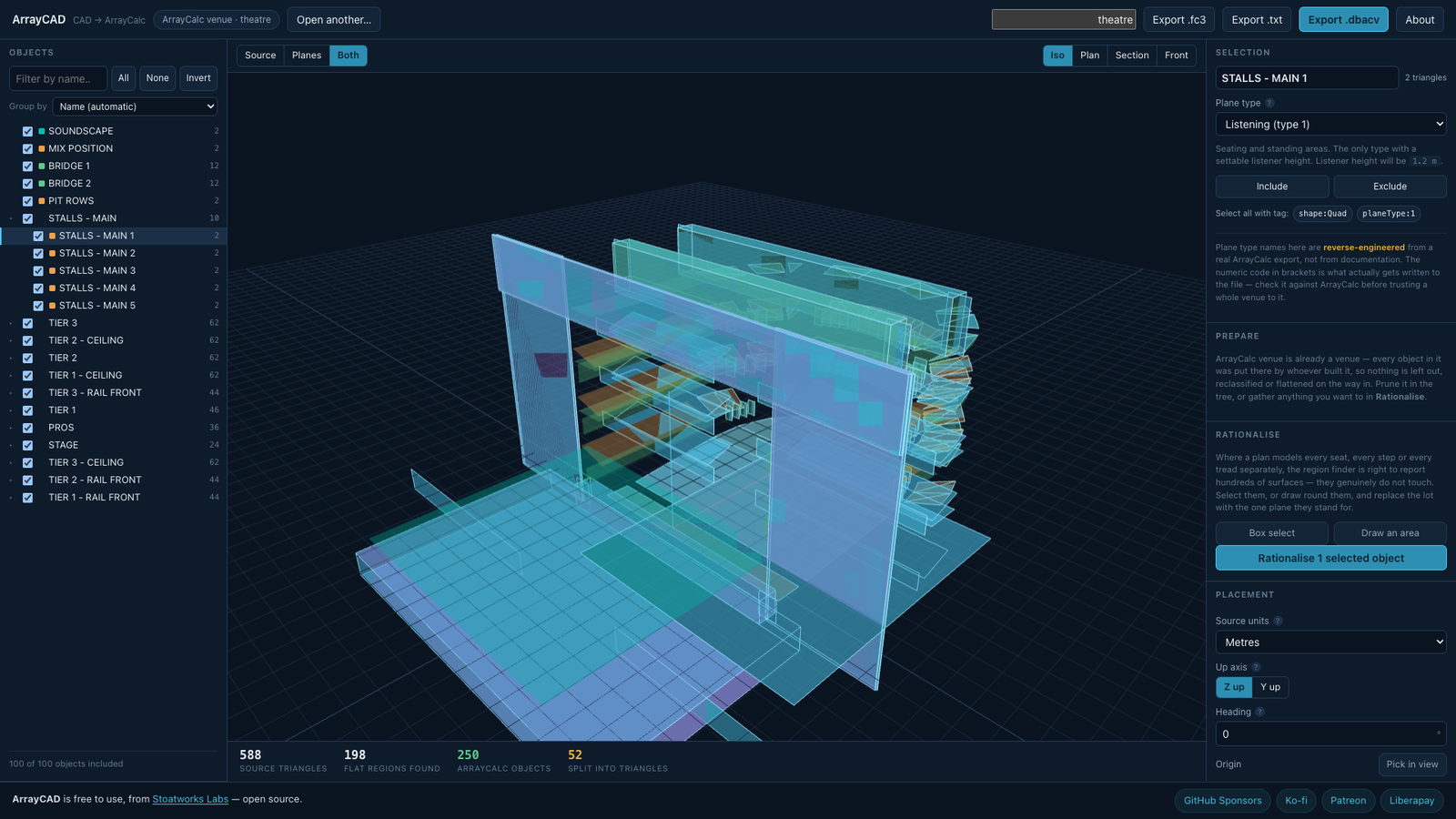
Turns a venue drawing into a file a loudspeaker prediction tool will open (d&b ArrayCalc, L-Acoustics Soundvision or AFMG EASE Focus 3) and converts between the three. An ArrayCalc venue is a few dozen parametric planes, and a CAD export of the same theatre is tens of thousands of triangles, so most of the work is boiling it down: weld, merge the coplanar bits, recover each outline and write it back as the quads and triangles ArrayCalc will actually accept. It reads the drawing on the way in, too. Layers named as dimensions, rigging or services get left out, plane types come off the layer names, banks of individually modelled seats become the audience plane they're standing in for, and meshed surfaces are re-cut from their own outlines. A theatre plan where somebody modelled every seat lands as 17 objects instead of 3,710, all of them visible and one click from being put back. It reads DWG directly, plus DXF, glTF, IFC, the usual mesh formats and MVR from any lighting visualiser, and writes MVR back so the finished venue can go home to the visualiser it came from. No 3D model? Drop in a PDF or an image of the plan, set the scale, click inside a room to find its outline and type a height at each corner, whether it's level, raked, raised or sunk. The .dbacv format isn't documented anywhere, so this reproduces a real export byte for byte, and it's been round-tripped through ArrayCalc until every object came back untouched.
Where it stands
In development and not tagged yet, but the geometry has been checked against the applications themselves rather than against somebody's description of them. A written .dbacv reproduces a real ArrayCalc export byte for byte and has been round-tripped through ArrayCalc until every object came back untouched. A written Soundvision room file was imported into Soundvision 3.18.0.15 and read back surface by surface, and an EASE Focus project of 57 audience planes was opened and saved by EASE Focus 3.1.260 with all 57 labels and every coordinate intact. 361 tests pin the reduction down. None of that proves acoustic orientation, though. I haven't yet run a prediction over an imported surface, and a surface wound the wrong way lands in exactly the right place and then returns no mapping result without a word of complaint, so check a mapping before you trust a whole design to it. The Vectorworks plug-in has never been run inside Vectorworks.
Watch it running
Nothing loads from YouTube until you press play.Watch it there instead