

Boreal
The aurora borealis and australis for Resolume
What it does
Two FFGL plugins for Resolume Arena and Avenue in one download: SW Boreal, a source that is the night sky, and SW Boreal Over, an effect that adds the aurora to your clip as light, with a sky mask that keeps a skyline in front and an Illumination control that lights the scene with the sky's own colour.
The one idea: an auroral arc is a sheet of electric charge drifting in crossed electric and magnetic fields, and a charge sheet drifting at E×B is a vortex sheet. The potential is a stream function and the space charge is its vorticity, so a thin arc obeys the same equations as a thin sheet of spinning fluid and is unstable in the same way: it rolls itself up (Hallinan & Davis 1970). The curls, the folds and the westward surge of a substorm are that one instability at different scales, and Curl Size is a physical length.
Four more models follow, with every constant in the open. Where the sheet is wound tight, the current along the field is high and by the Knight relation so is the electrons' energy. That energy goes into a real atmosphere (NRLMSIS) at the heights Fang et al.'s parameterisation gives, exciting each line by its own chemistry. The green line's atoms glow after 0.7 s and the red line's after minutes, and low down the red ones are knocked out of it by collisions first, so the red lives above 200 km, lags a moving curl and lingers. A camera on a curved Earth looks up through it, the air dimming and reddening what is low.
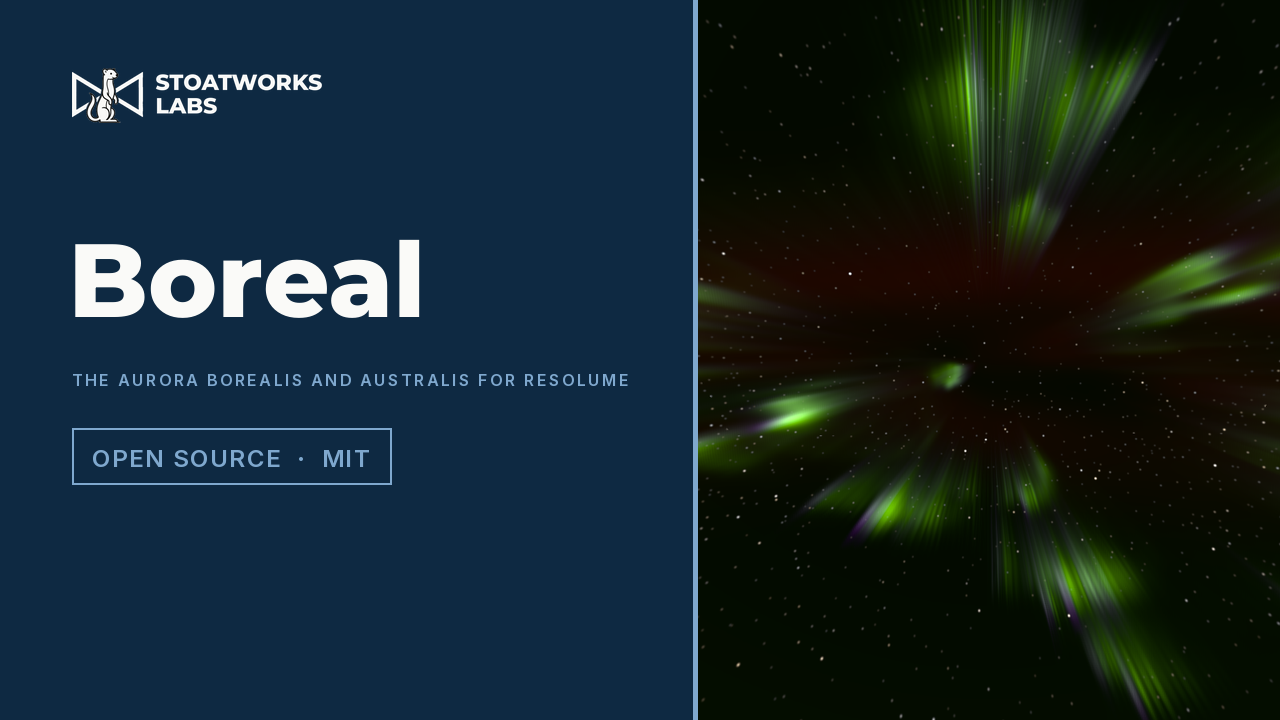
What falls out rather than being arranged: the pink lower border of a hard display, the corona overhead with its rays converging on the magnetic zenith, arcs on the horizon shrinking to bands, red tops that rise with solar activity, the airglow band low in every long exposure, and snow that goes green under a strong display.
- A source (the night sky) and an Over effect (the aurora added to a clip as light) in one download
- Arcs as a Birkhoff–Rott vortex sheet: curls, folds and substorm surges from one instability
- Precipitation by the Knight relation, deposited in an NRLMSIS atmosphere at Fang et al.'s heights
- The green, red, blue and pink lines, each with its own lifetime and collisional quenching
- A ground camera on a curved Earth: rectilinear or all-sky fisheye, extinction, airglow, stars
- Borealis or australis, a Substorm button and audio onsets that fire one
- Seven presets, from a quiet arc to a red storm and a corona overhead
- Universal macOS bundles and Windows x64 DLLs
Where it stands
v0.1.0, and honestly early. The physics is measured, not asserted, by an offline harness that drives the real plugin classes headlessly: a wave on the plugin's own vortex sheet grows at the rate derived for its regularised kernel to 1e-9; the ionisation peaks land within 1.5 km of Fang et al.'s published figure; the red/green ratio the GPU samples matches the collisional-quenching formula at every height to 1.6e-7; the populations decay exactly as their lifetimes say; each spectral line sits at its CIE chromaticity to the fifth decimal; the rays meet the magnetic zenith within 0.32 px at three rasters in both hemispheres; the shipped shader's airmass matches Kasten & Young to 9e-7. Fourteen deliberately wrong models are all detected, one-character mutations of the shipped shaders are caught, and all 39 controls change the picture. Render cost on macOS is roughly 4–9 ms/frame at 720p and 6–12 at 1080p at the default Detail; use Detail Quarter at 4K. It has never been loaded into Resolume on macOS. On Windows it has: a build of this source loads, registers and renders in Resolume Arena 7.27.1 on software rendering (win-lab, no GPU), both plugins with every parameter as declared, and 33 of the source's and 38 of the effect's controls shown moving the picture; the Substorm and Calm buttons and the audio controls could not be exercised there. Some line yields are assumptions (the green is calibrated to about 1 kR per erg, the red and pink are chosen), each line has one lifetime and one vertical shape, and no real audio has reached it in a host, so Resolume's 64-bin FFT mapping remains an assumption. There is a user guide and a browser demo (a port of the engine, checked only by a reader); no OpenFX port. Check it in your own rig before trusting it in a show.
Watch it running
Nothing loads from YouTube until you press play.Watch it there instead