

Flyback
Tesla coils and Jacob's ladders for Resolume
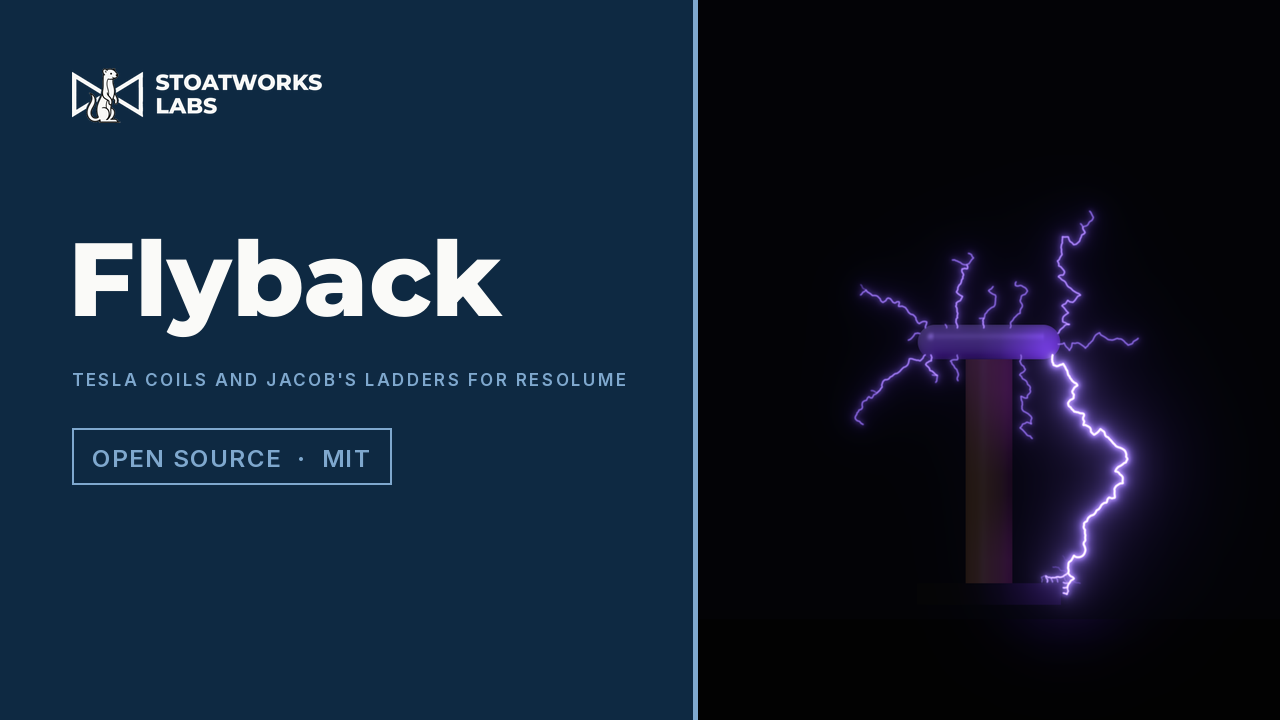
What it does
Two FFGL plugins for Resolume Arena and Avenue in one download: SW Flyback, a source with five high-voltage machines, and SW Flyback Over, an effect that makes the clip the ground, so bolts strike its bright parts, arcs bridge its highlights and the flash lights it.
The one idea: air is an insulator until the field tears it, and where it tears is a Laplace problem. Every discharge grows by the dielectric breakdown model (Niemeyer, Pietronero and Wiesmann, 1984). The electrodes and the channel already grown are held at their potentials, the potential in the air is solved on a lattice sized in metres of scene, and the channel extends to a neighbouring site with probability proportional to |∇φ|^η. One exponent decides the look: η = 1 is a Lichtenberg figure, η ≈ 2–3 is lightning, a large η is a nearly straight arc.
Around that model sit the circuits of the classic machines. The Jacob's ladder's arc obeys Ayrton's equation on a supply with a source resistance, so it snaps at an extinction length solved in closed form and restrikes at the bottom. The Tesla coil bangs at the interrupter rate, and its hot channels remember, so streamers lengthen once the interrupter outruns their cooling. The Van de Graaff sparks when Peek's field is reached at the sphere, every C·V/I seconds, and a rough sphere sits in corona instead. The plasma globe's filaments wander and gather to a finger on the glass.
Light is one model for all five: current flows through each grown tree by Kirchhoff, a frame's light is exactly the event's energy times a luminous efficiency, so a bang split into ten branches is not ten times brighter, and colour comes from each gas's spectral lines through the CIE observer, turning white-hot as a channel's current nears an ampere.
- A source and an Over effect in one download; Over makes the clip's bright parts the ground
- Five machines: Jacob's ladder, Tesla coil, Van de Graaff, plasma globe and Lichtenberg figure
- Every discharge grown by the dielectric breakdown model on a real Laplace solve
- Each machine's circuit decides when the air breaks and how much energy it carries
- Light conserved per event and split by Kirchhoff; colour from each gas's spectral lines
- Fire button, audio onsets that fire it (a singing Tesla coil) and audio-driven voltage
- Air, neon, argon and neon-xenon, shutter angle and camera persistence
- Universal macOS bundles and Windows x64 DLLs
Where it stands
v0.1.0, and honestly early. The central claims are measured, not asserted, by an offline harness that drives the real plugin classes headlessly: the potential solver holds the coaxial closed form within its one-lattice-step bound; breakdown-model clusters at η = 1 measure a fractal dimension of 1.744 against the same estimator's 1.742 on true DLA; every Jacob's ladder arc goes out at Ayrton's extinction length to one lattice step; the Van de Graaff sparks every C·V_b/I to 1.3e-11 s; the Tesla coil bangs exactly at its interrupter rate; current balances at every node of every tree to 1.1e-7; and each frame's light equals the event's energy times efficiency within a derived bound of 4.1e-5. Thirteen deliberately wrong models are all detected, seven one-character mutants of the engine and shaders are all caught, and every control changes the picture where it applies. GPU cost on macOS is about 1–1.3 ms/frame at 1080p. It has never been loaded into Resolume on macOS. On Windows it has: a build of this source loads, registers and renders in Resolume Arena 7.27.1 on software rendering (win-lab, no GPU), both plugins with every parameter as declared, and 33 of the source's and 43 of the effect's controls shown moving the picture; eight of the source's machine controls act through discharges too brief for the gate's single frames. Some constants are models rather than measurements (the low-current Ayrton constants, the streamer field, the globe's glass coupling); the Lichtenberg figure grows over seconds and stays lit, which is staging; and no real audio has reached it in a host, so Resolume's 64-bin FFT mapping remains an assumption. There is a user guide and a browser demo (a port of the engine, checked only by a reader); no OpenFX port. Check it in your own rig before trusting it in a show.
Watch it running
Nothing loads from YouTube until you press play.Watch it there instead