

Idler
The Windows 95/98 screensavers, for Resolume
What it does
Eleven screensavers in one generator for Resolume Arena and Avenue: Mystify, Beziers, Curves and Colors, Flying Windows, Flying Through Space and Scrolling Marquee — the flat ones that shipped with Windows — plus 3D Maze, 3D Pipes, 3D Flying Objects, 3D FlowerBox and 3D Text, the OpenGL ones that arrived with Plus! and became stock in 98. It ships as two plugins rather than one, because FFGL resolves a single entry point per binary: Idler is a source that draws over its own background, and Idler Mask draws the saver over the clip it sits on, reveals the clip only where the saver drew, hides it there, or tints it through.
It is nostalgia that had to be rebuilt properly to be useful, and the rebuilding is the interesting part. Every saver is a pure function of time and a seed — nothing integrates a velocity and nothing remembers the previous frame. A Mystify polygon bounces because its position is a triangle wave rather than a collision test, and a star's trail is that star evaluated a fraction of a second ago rather than a buffer of where it has been. Resolume's frame rate drops when the projection load goes up, and a saver that slowed down with it would come apart from the music.
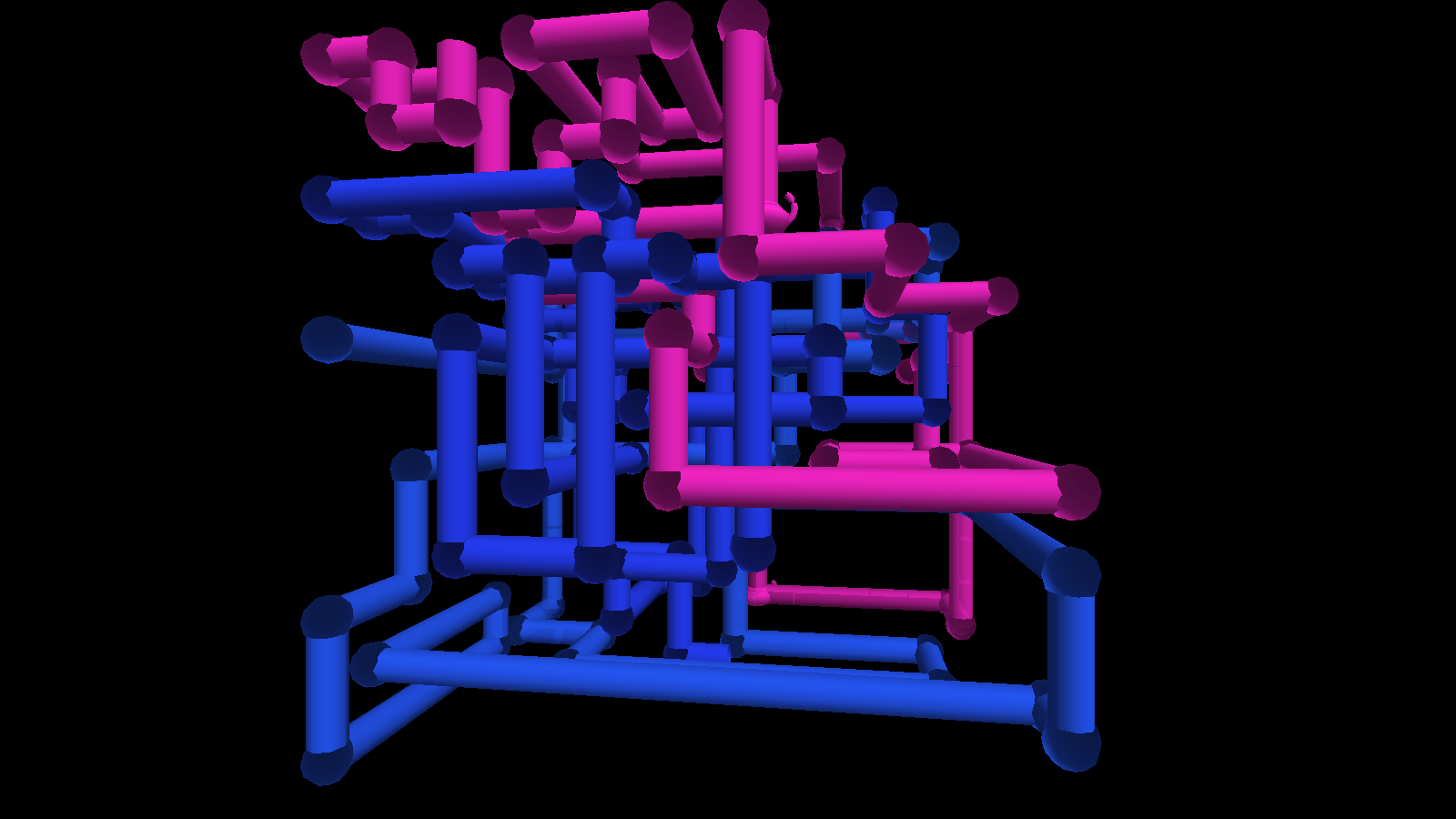
Two of them genuinely grow. Where a pipe goes next depends on where it has already been, so 3D Pipes and 3D Maze cannot be a closed-form function of the clock. Rather than give those two an exception, they are made deterministic by replaying from the seed: the state at any moment is defined by the time you asked for, the network can be scrubbed to wherever the Phase slider is dragged, and the same composition grows the same plumbing on the show laptop and on the rack machine.
The eleven share one parameter list — seven scene controls that each saver maps to whatever it has that is analogous — with a preset per saver that sets them the way that saver actually ran. Colour Mode is the one worth knowing: Classic is each saver's own palette as it was, and Tint, Spread and Cycle put the whole suite under one scheme, which is what makes any of it usable behind a band. Some of it the originals could not do at all: streaks on the starfield, wireframe on the FlowerBox, and all eleven over transparency.
Not affiliated with Microsoft. No Microsoft code, artwork or assets are used or included — the Flying Windows logo is a four-quad gesture toward the mark rather than a reproduction, and 3D Pipes' teapot is generated from a profile curve rather than being Newell's dataset.
Also available as OpenFX plugins for DaVinci Resolve, Vegas Pro, Nuke and Natron — the generator and the mask filter in one bundle, driven by the same saver code. An OFX host hands a plugin a buffer rather than a GL context, so that build rasterises the scene in software; a test renders all eleven savers through both renderers and compares them, so a preset cannot come to mean one thing in Resolume and another in Resolve. Sync there offers Free and Manual only, because OFX carries no tempo — Phase is the control to keyframe.
- Eleven savers in one plugin, with a factory preset per saver that sets it up the way it actually ran
- Two plugins from one core — a source with its own background, and an effect that masks the clip
- Also an OpenFX pair for Resolve, Vegas, Nuke and Natron, from the same saver code
- Every saver a pure function of time and a seed: frame-rate independent, resolution independent, and scrubbable
- 3D Pipes and 3D Maze grow by deterministic replay, so the same seed builds the same network on any machine
- Free-running, beat-locked, bar-locked, or driven entirely by an external Phase control
- Classic palettes, or a single tint, hue spread or hue cycle across the whole suite
- Flat, lit and wireframe shading, with fog on the 3D savers
- Four mask modes on the effect — saver over the clip, reveal, hide, or colourise through it
- Your own text in Scrolling Marquee and 3D Text
- Universal macOS bundle (Apple Silicon and Intel), a Windows DLL, and an OpenFX bundle for macOS, Windows and Linux
Where it stands
Released at v1.0.9, on the 1.0 line. The two point releases since changed nothing in the picture: v1.0.8 shipped a Windows installer that no longer touches the system PATH — the earlier one could overwrite it — and v1.0.9 gives both plugins a real description in the field Resolume shows for them. The OpenFX build arrived in v0.1.1; Since v1.0.1: 3D Maze is an endless maze built around the camera as it walks rather than one small grid, the host clock's epoch no longer freezes the two growing savers in Resolume, a Speed change no longer teleports the picture, and the OpenFX plugin gained a Linux build. Both plugins have been loaded into Resolume and run, and all eleven savers render there. Everything else is verified by its own offline harness, which renders real frames and checks the mesh each saver builds, that all eleven draw at five different times including zero, that no control is dead, and — for the two savers that grow — that a frame reached by replaying the clock is byte-identical to the same frame rendered cold. Bar sync has not been checked against a real transport, and it has never been used on a live show, so check it in your own rig first. The OpenFX build loads and renders in a test host and its software renderer is checked against the GL one on all eleven savers, but it has never run in Resolve, Nuke or Natron.
Watch it running
Nothing loads from YouTube until you press play.Watch it there instead