

Instant
Instant film developing, for Resolume
What it does
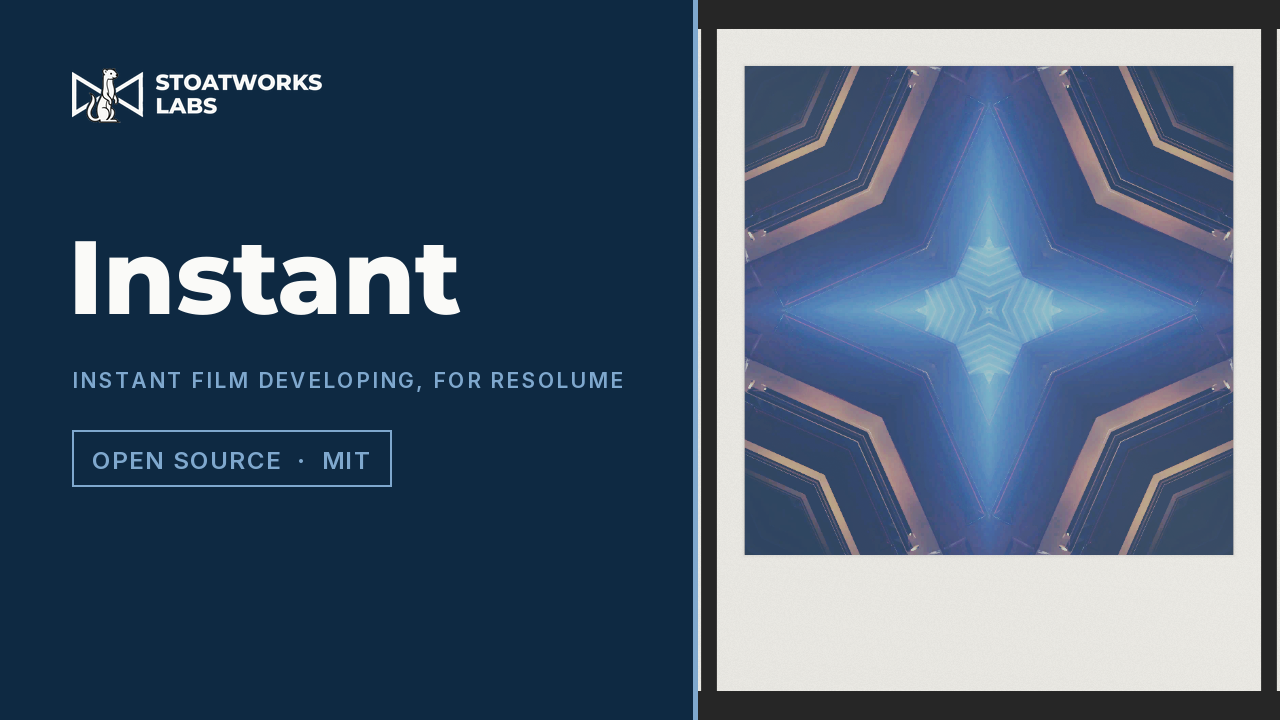
An FFGL effect for Resolume Arena and Avenue. An integral instant print is exposed through its front and then develops in the open, over minutes, in an order the chemistry sets. Instant runs that process on the clip, stage by stage, on the host's clock, and the look falls out of it rather than being painted.
A Take captures the frame, and an averaging meter sets the exposure the way a camera would, bringing the frame's mean to mid grey within a camera's range; Exposure is the lighten/darken wheel on top. From then on the print develops from that moment whatever the clip does next. In Continuous mode a new print is taken every Interval seconds; in Take mode the plugin shows the clip until you press Take.
The reagent front leaves the pod edge and climbs the frame, so the print develops bottom-first. Under a dark green-grey opacifier the three dye layers arrive at their own rates, cyan first and yellow last, so the picture comes up pale and blue-cyan and warms. Temperature changes every rate by the Arrhenius law, with an activation energy fitted to a published development chart, and the timing layer that ends development speeds up less than the dyes: cold film stops before the yellow arrives, hot film finishes warm.
Spread picks a full, short or uneven reach, and where the reagent never got the dark negative shows; Expired paste reaches less far and fades the dyes toward pink; Dirty Roller leaves a mark that repeats at the roller's circumference. Speed runs film time at 1x (a real print, ten minutes to the stop) up to 256x, 64x by default; Border shows the print in its frame or the process full-frame, and Mix fades back to the clip.
- A Take exposes the clip's frame; the print then develops from it whatever the clip does
- An averaging camera meter at the take, with Exposure as the lighten/darken wheel
- Three dye layers, each first-order at its own rate: blue-cyan first, warming to full colour
- The opacifier's dark green-grey clearing, and the print developing bottom-first from the pod
- Arrhenius temperature: cold film stops short and pale, hot film finishes warm
- Colour, black and white and vintage stock; short, uneven and expired spreads; a dirty roller
- Speed from real time (1x) to 256x; Continuous prints every Interval seconds, or Take on demand
- Universal macOS bundle and a Windows x64 DLL
Where it stands
v0.1.0, and honestly early. The process is measured, not asserted, by an offline harness that drives the real plugin class headlessly and reads each claim back out of what it renders: each dye layer's density follows its first-order law with the stated time constant, recovered to 1e-5; four minutes in a neutral grey reads R 0.68, G 0.61, B 0.52, a blue-cyan print, and then moves only toward neutral, reaching it at the stop; the time constants at 14 and 34 degrees C stand in the Arrhenius ratio for every layer and the timing layer; each row starts at its distance from the pod over the front's speed; the dirty roller repeats at exactly its circumference; and a print survives a resize. Eight deliberately broken models each fail their check, and all 12 controls change the picture. The checks verify the stated model, not a real print: the dye activation energy is fitted to a black-and-white development chart, which is itself an assumption for instant dyes, and the time constants, the stop and the timing layer's activation energy are chosen. The manufacturer describes cold prints with a green tint; this model gives cyan, and the guide says so. The reagent front is modelled but cannot be seen. It has not yet been loaded into Resolume on macOS. On Windows it has: a build of this source loads, registers and renders in Resolume Arena 7.27.1 on software rendering (win-lab, no GPU), with every parameter as declared and the fleet gate's 9 checks passed; nine controls read as moving the picture, Speed inconclusive, and Mode and Interval act only at the next take. The macOS build is Developer ID-signed and notarised. There is a user guide and a browser demo; no presets and no OpenFX port. Check it in your own rig before trusting it in a show.
Watch it running
Nothing loads from YouTube until you press play.Watch it there instead