

Slitscan
Slit-scan and strip photography, for Resolume
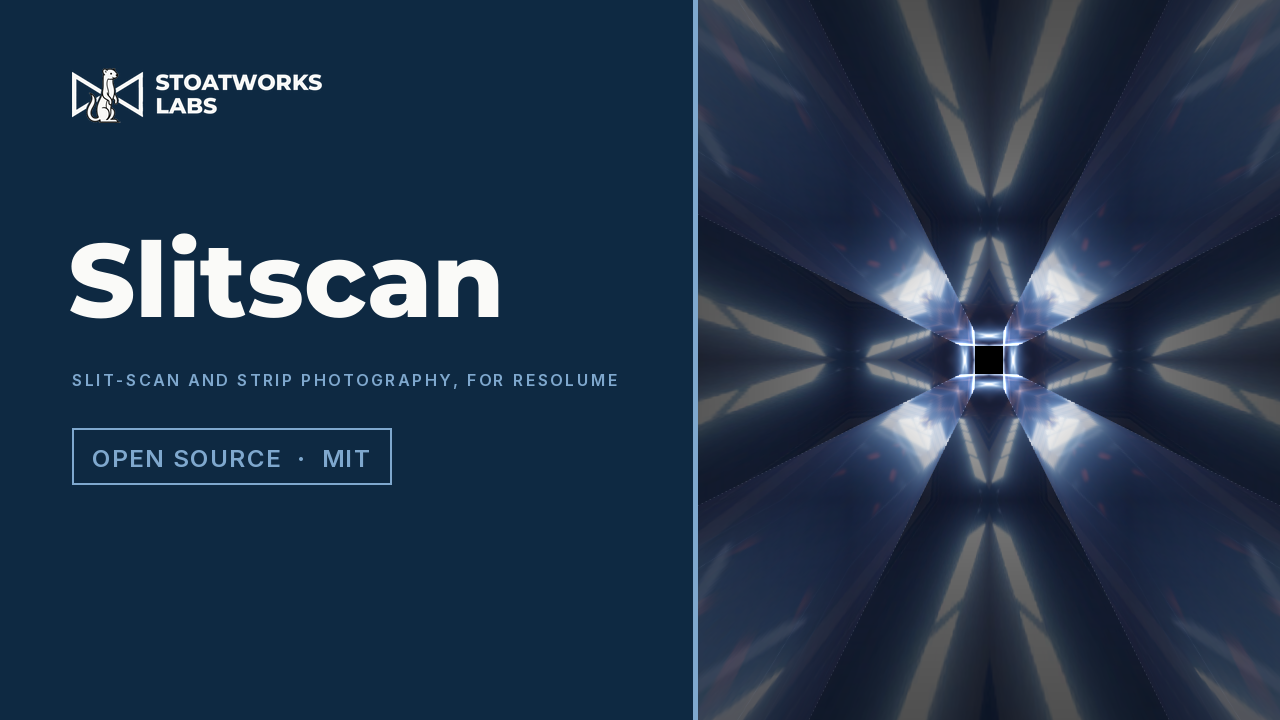
What it does
An FFGL effect for Resolume Arena and Avenue: SW Slitscan. A slit-scan picture is one long exposure, taken while something moves. The shutter stays open and a slit decides which bit of the film can see out, so each point of the film records the moment the slit lay over it. Time turns into space, and nobody had to warp anything. The plugin works out, for every pixel, when it was exposed and what it could see then.
Scan is strip photography, the slit at the film. A line sweeps down, up, across, round like a clock hand or out from the centre, on its own clock or in step with Resolume's beat, and behind it each row is the instant the slit went past. A still picture comes through untouched, things moving sideways lean, and a face drifting down with the scan comes out with a chin three feet long. Ahead of the slit is the live clip, the last pass or black.
The other three put the slit at the subject. Corridor is Douglas Trumbull's machine from 2001: a camera dollies towards one, two or four slits with your clip sliding along behind them, and the clip lands on the walls of a corridor in perfect perspective, glowing at the far end as his did. Tunnel shapes the slit as a circle, square, diamond or hexagon, the way Bernard Lodge built the Doctor Who titles. Stretch is John Knoll's warp stretch for The Next Generation: a strip of light sweeps the clip while the camera closes in, so whatever's lit late is drawn large.
- Scan: a slit sweeping Down, Up, Right, Left, Clockwise or Outward, free-running or locked to Resolume's beat and bars
- Corridor: Trumbull's Stargate, with one, two or four walls and the clip streaming past behind them
- Tunnel: Bernard Lodge's shaped slit, as a circle, square, diamond or hexagon
- Stretch: John Knoll's warp stretch, with your clip as the subject
- A slit with real width, which averages what it saw in linear light, as film would
- A dolly at Constant Speed or Even Exposure, Exposure in stops, Roll and a vanishing point you can move
- Universal macOS bundle and a Windows x64 DLL
Where it stands
v0.1.0, and early days. It's measured by an offline harness driving the plugin's own code on an Apple Silicon Mac, at two rasters and on Apple's software renderer: after a knife-thin scan not one of 921 600 pixels holds the wrong frame, a still picture comes through a whole pass bit for bit, sideways movement leans by the rolling-shutter law to a hundredth of a pixel a row, and every corridor, tunnel and stretch pixel shows the artwork from the moment the dolly's own law says. It catches fourteen models that are wrong on purpose and twenty-seven one-character sabotages of its own code, and all 25 controls change the picture. It hasn't been loaded into Resolume on macOS. On Windows it loads and renders in Resolume Arena 7.27.1 on software rendering, with every control as declared, and 17 of them measurably changed Arena's picture of a still; nobody has watched it follow Arena's transport. The macOS build is Developer ID-signed and notarised. There's a user guide and a browser demo, which draws what the plugin draws to within a level on the Mac it was checked on, but no presets or OpenFX port yet. Try it in your own rig before you trust it in a show.
Watch it running
Nothing loads from YouTube until you press play.Watch it there instead