

Woofer
A loudspeaker the music drives, for Resolume
What it does
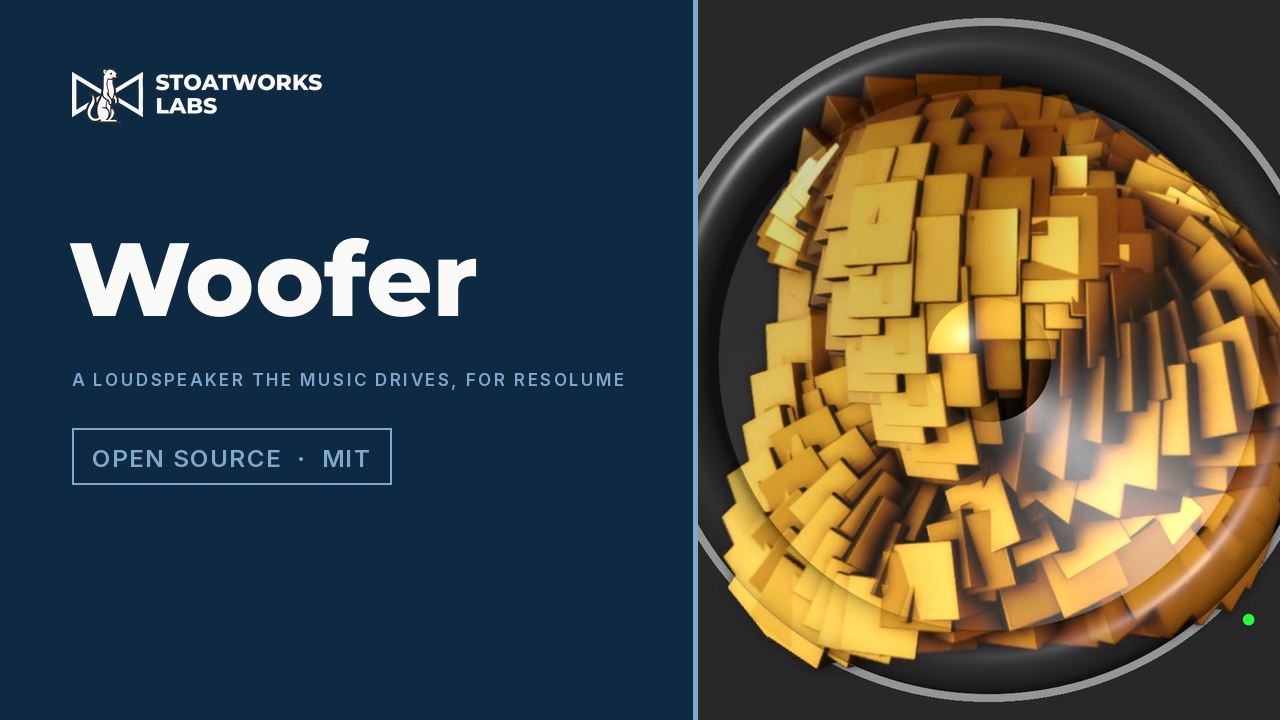
An FFGL effect for Resolume Arena and Avenue, SW Woofer: your clip printed on the cone, dust cap and surround of a loudspeaker seen face-on, carrying on across the baffle around it, and the music driving the loudspeaker. Pick one of five real drivers, from a 10 cm full-range to an 18-inch PA sub, set the sealed box's Q and the amplifier's Drive, and the cone moves as that driver would.
The drivers are Scan-Speak's and B&C's, from their datasheets: resistance, inductance, force factor, moving mass, compliance, damping, cone area and the coil's travel. Each one sits in a sealed box and is voltage-driven by the audio waveform, integrated at 32 kHz, with the force factor falling as the coil leaves the gap, a suspension that stiffens, the air in the box as an adiabatic spring, a hard stop at the maximum mechanical excursion and four breakup modes. Above the box's resonance the stroke falls as 1/f², so a kick moves the cone millimetres and a hat at the same level moves it microns, and nothing in the audio path looks at frequency. A big hit flat-tops, the coil bottoms with a white flash of the status lamp, and with the coil set off the gap's centre an overdriven cone walks off centre.
The stroke carries the printed clip toward and away from a pinhole camera, so it swells and shrinks, the surround's roll bends without stretching and creases the print over its crest, and the front is lit as a glossy relief with motion blur set in milliseconds. A Height view shows the stroke as grey instead. At rest the picture is exactly your clip.
The audio comes from an input you choose by name, through earshot, the fleet's shared audio front end, or, with none chosen (the default), from Resolume's own FFT. That fallback is much less: four band levels a frame and no waveform, so woofer plays a sine per band and its level isn't calibrated. Resolume's lowest band runs from 0 to 375 Hz, so there the kick, the bass line and the low toms move the cone as one. In Arena on a Mac, one of Arena's demo drum loops moved the cone only a little at the default Drive. A status lamp says which is driving. On macOS the first input opened inside Resolume asks for Resolume's microphone permission.
Photosensitivity: the default Lit view added no flashes to any of Resolume's 33 demo clips, at the default Drive or at full Drive. The Height view can: with a loud master (about −11 dBFS RMS or hotter) it crossed three flashes a second over large areas on 5 to 10 of them. The user guide gives the rates.
- Five real drivers from Scan-Speak's and B&C's datasheets, 10 cm to 18 inches, in a sealed box of the Q you set
- The cone integrated from the audio waveform at 32 kHz, not driven by a level
- Bl(x), a stiffening suspension, the box's air spring, the stop at Xmech and four breakup modes
- Kicks pump the cone and hats leave it still, with nothing looking at frequency
- Your clip printed on the cone, swelling toward the camera, with motion blur in milliseconds
- Any audio input, remembered by name, or Resolume's own FFT
- A Height view of the stroke, and a status lamp for the audio
- Universal macOS bundle and a Windows x64 DLL
Where it stands
v0.1.1, and early days. v0.1.1 reads Resolume's own FFT as Arena 7.29.0 was measured to send it: 64 bands of 375 Hz, from 0 to 24 kHz. In v0.1.0 the bass band, the one that moves the cone, took all of the lowest, 0–375 Hz; now it takes its share, so on Resolume's FFT the cone moves about 0.69 as far, as an A/B in Arena on a Mac confirmed. It has run in Resolume only on one layer over a still: in Arena 7.29.0 on a Mac, and in Arena 7.27.1 on Windows on software rendering, where the fleet's Arena gate passed 9 checks with 2 skipped (that machine has no sound device). It registers, shows its controls with the declared defaults and renders, and every control that acts on a still cone changes the picture. In Arena on the Mac, Resolume's own FFT moves the cone with one of Arena's demo drum loops playing, but only a little at the default Drive, about 4% of its stroke at the peaks (more with Drive up), and it has never opened a live audio input. Everything else is measured offline, by a harness driving the plugin's own code on an Apple Silicon Mac at two rasters and on Apple's software renderer, with audio fed through the same path a device would use and, for Resolume's FFT, through bands built the way Arena was measured to build them: the cone's stroke matches the sealed box's closed-form response, coil inductance included, to 3.2e-4 over 24 sines from 10 Hz to 2 kHz on all five drivers; the coil never passes its mechanical limit at any substep; a sine inside the motor's linear range makes no harmonic above −175 dB; and the same audio at 24, 30, 60 and 144 fps moves the cone identically, bit for bit. It catches twenty-two models that are wrong on purpose and seventeen one-character sabotages of its own code. The cone's profile, its breakup modes and how hard the stop is are chosen, not measured. The Height view can flash more than three times a second with a loud master; the default Lit view added no flash to any of Resolume's demo clips. The macOS build is Developer ID-signed and notarised. Try it, with your own input, in your own rig before you trust it in a show.
Watch it running
Nothing loads from YouTube until you press play.Watch it there instead