

Zoetrope
Your clip on a strobed disc, for Resolume
What it does
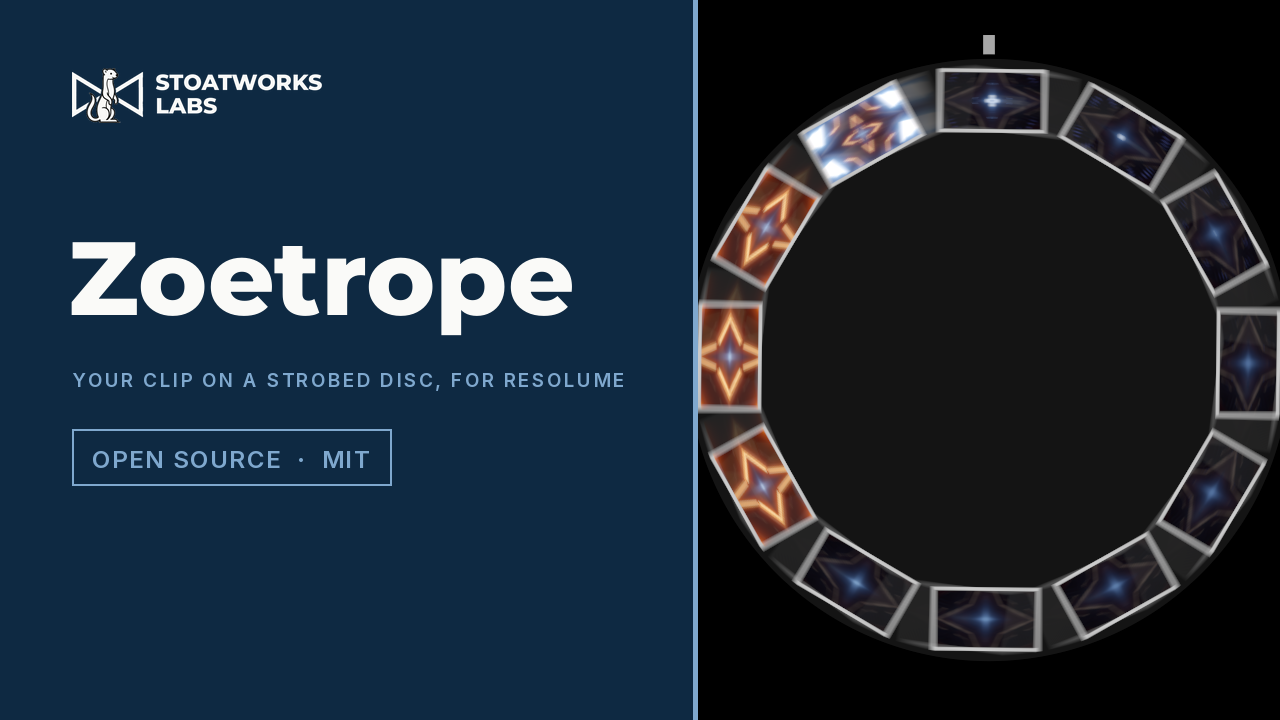
An FFGL effect for Resolume Arena and Avenue: SW Zoetrope. Your clip is printed onto a ring of cards on a black disc, one card at a time as each passes a print head, and the disc turns. You only see it when a strobe fires: on the beat or a subdivision of it, on hits in the music, at a set rate, or when you press Fire. A little room light shows the spinning blur in between.
It's the oldest trick in moving pictures, run backwards. A Victorian zoetrope turns a strip of drawings into motion; this turns the motion back into a ring of pictures and shows you the ring the way a zoetrope would. Turn the disc exactly one card per flash and the figures stand still and play the clip. Turn it a little more or less and they crawl round, forwards or backwards, which is the wagon-wheel effect doing what it does to film of stagecoaches. Each card was printed when it passed the head, so the ring is also a delay line you can see, the clip a little older at every card round from it.
The disc can be a motor locked to Resolume's tempo, a motor at so many RPM, or a hand that pushes it on the beat while a bearing slows it down. The flash has a length, so a long one smears the cards, and the camera has a shutter, so a strobe faster than the frame rate catches two flashes in one frame and none in the next. A Persistence control adds the eye's afterimage for the look it has in a room, and the Drum view is the original: the cards inside a drum, seen through slits in its wall, squeezed sideways as the real thing squeezes them.
- Flashes on the beat, half, quarter or eighth beat, or bar of Resolume's tempo, on onsets in the music, at a set rate, or when you press Fire
- A disc of 4 to 48 cards, printed with the clip as each passes the print head, so the ring holds the clip at growing delays
- Sync locks the disc to the tempo; Slip either side of 1 crawls the figures forwards or backwards
- Hand drive: each beat pushes the disc and a bearing's friction slows it, solved in closed form
- Flash length, room light, a camera shutter and the eye's persistence, all integrated over the exposure
- A Drum view: the cards inside a drum, seen through slits, squeezed by the geometry
- Universal macOS bundle and a Windows x64 DLL
Where it stands
v0.1.0, and early days. It's measured by an offline harness driving the plugin's own code on an Apple Silicon Mac, at two rasters and on Apple's software renderer: a disc locked to the beat stands still to a ten-thousandth of a pixel over a hundred flashes, a crawl advances by the wrapped turn per flash to 3e-8 rad, a smear is the length the flash and the speed say, a flash keeps its light whatever its length, every card shows the frame it was printed with, a hand-spun disc follows an independent solution of its bearing and stops when the closed form says, and the drum's figures stand where its geometry puts them. It catches deliberately wrong models and thirteen one-character sabotages of its own code, and all 22 controls the sweep can move change the picture. It hasn't been loaded into Resolume on macOS yet, and no host has played it any music. On Windows it loads, registers and renders in Arena 7.27.1 on software rendering (no GPU, no sound), with every control as declared, and passed all 9 of the fleet's checks twice; 18 and then 19 controls measurably changed the picture there, and Push and Print At, which act on a moving disc and a small marker, were too close to call. It flashes: mind anyone in the room who is sensitive to that. There's a user guide and a browser demo running the plugin's own code, but no presets or OpenFX port yet. Try it in your own rig before you trust it in a show.
Watch it running
Nothing loads from YouTube until you press play.Watch it there instead