

Nipkow
Baird's 30-line television, for Resolume
What it does
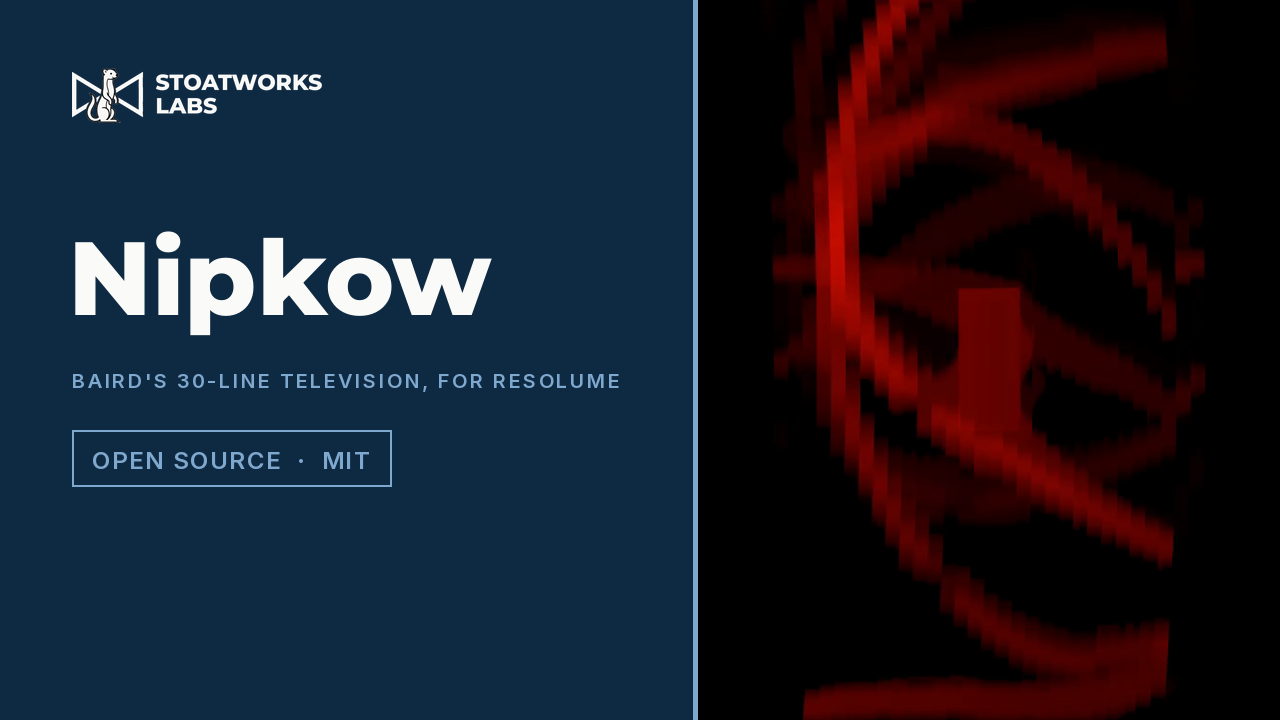
An FFGL effect for Resolume Arena and Avenue: SW Nipkow. Your clip, as Baird's 30-line mechanical television showed a picture in the BBC's 1932–35 service. A mirror drum at the transmitter explores it in 30 straight vertical strips, 12½ pictures a second; the signal goes through a narrow amplifier into a flat-plate neon lamp whose brightness follows it; a disc with 30 holes on a spiral turns in front of the lamp, each hole tracing one arc of the picture; and a toothed wheel on the motor shaft, its coils in series with the lamp, holds the disc in step with the transmitter, and hunts.
Nothing in the picture is drawn. The lines are arcs because the holes travel in circles. The picture is taller and dimmer on its outer side, because a straight line from the drum becomes an arc as long as its radius and an outer hole dwells less on each point. Edges smear upwards along the lines, the same angle on every line, because the amplifier is narrow. A lamp starved of current glows over only part of its plate and strikes late. A dark picture holds the wheel weakly, so it swings and slips and the picture drifts up and down; set the motor free and it rolls steadily.
Photosensitivity warning: it flickers, as a Baird televisor did. At its defaults every point is lit once a picture, so the picture flickers in saturated red 12½ times a second, over most of the field on bright clips, past WCAG's red-flash threshold; Frame Fill, a higher Lamp, some Picture Rates and a shorter Persistence make it flash harder. Turning Persistence up calms it. The user guide and the README measure where it crosses.
- A mirror drum or a disc at the transmitter, 8 to 120 lines, 2 to 30 pictures a second
- A one-pole amplifier from 0.5 to 40 kHz, so edges smear along the lines as on a 9 kc/s channel
- A neon lamp that follows the signal, strikes late and glows over part of its plate when starved
- A phonic wheel that locks, hunts and slips, with the motor's speed error and the framing to set
- Baird's 7:3 field, or the field stretched to the frame; the screen's persistence; Mix
- Universal macOS bundle and a Windows x64 DLL
Where it stands
v0.1.0, and early days. It's measured by an offline harness driving the plugin's own code on an Apple Silicon Mac, at two rasters and on Apple's software renderer, reading it back off the pixels: each scanned line sits at the spiral's radius to 0.008 px, a dot drawn by the mirror drum moves as far along the arc as the geometry says to 0.009%, every line's brightness falls as 1/r to 2e-7, a free-running receiver's picture drifts at the rate its speed error gives to 1e-6 of a line, and the phonic wheel hunts at the swing equation's frequency to 1.2e-4. It catches 24 models that are wrong on purpose and 51 one-character sabotages of its own code, and all 11 controls change the picture. In Resolume Arena 7.29.0 on a Mac and 7.27.1 on Windows (software rendering) it loads with every control as declared, and on the Mac every control changed Arena's picture over a still test card; it hasn't been through a show. Some of it is chosen rather than measured: the amplifier as one pole, the lamp's source resistance, the wheel's hunting frequency and the motor's time constant, and where a starved glow sits. Open questions the guide lists: the wheel's pull grows with the lamp's current squared with no limit, the default Lamp leaves black only just lit, and whether the Fill frame is wanted. It flickers past WCAG's red-flash threshold at its defaults: the guide says where. There's a user guide, but no presets. Try it in your own rig before you trust it in a show.
Watch it running
Nothing loads from YouTube until you press play.Watch it there instead